
The Best Countertop Water Filters: How to Choose the Right One
Author:Kathleen Ferraro
Reviewed By:Katherine Janosz, MD
Published:
April 29, 2026
Last Updated:
October 06, 2026
Truemed writers and editors independently evaluate all our product recommendations. If you make a purchase through any affiliate links we provide, we may receive compensation. Learn more.



Key Takeaways
The best countertop water filter depends on your goal: Whether that’s improving taste, reducing specific contaminants like lead or PFAS, or getting broader filtration across multiple concerns.
Different filtration types serve different needs: Carbon filters are often enough for taste and chlorine, while reverse osmosis systems are better for more comprehensive contaminant reduction.
Certifications matter more than marketing: Look for third-party standards (like NSF/ANSI) that match the specific contaminants you want to address.
Day-to-day usability plays a role: Consider factors like tank size, refill frequency, filtration speed, and maintenance—they'll influence whether you’ll actually use the system consistently.
Some countertop water filtration systems may be eligible for HSA/FSA spending: Qualified customers may be able to use HSA/FSA funds when the purchase is tied to a documented medical need and supported by a letter of medical necessity, but final approval depends on your plan administrator.
Key Takeaways
The best countertop water filter starts with your water and health priorities
Countertop water filtration system types to compare
What to look for in certifications and proof
Size, speed, waste, and maintenance tradeoffs
Materials, taste, and everyday usability
When a reverse osmosis water filter makes sense
How It Works with HSA/FSA and Truemed
Compliance & Documentation
The bottom line
Deep dive recommendations
FAQ
Shop Eligible Products
Ready to unlock your HSA/FSA funds for qualified medical expenses?
I’ve spent a lot of time reporting on health products that promise to make everyday life “cleaner” or “better.” But finding the best countertop water filter is one of the more confusing purchases because they don’t all do the same thing.
Some improve taste. Some reduce specific contaminants. Some go much further, filtering out a wide range of substances—but with tradeoffs in cost, speed, and upkeep. And most product pages don’t make those differences especially clear.
That’s where countertop water filters come in. They’re often the go-to option for people who want stronger filtration than a pitcher or faucet filter, but without the installation or commitment of an under-sink system. They’re especially appealing if you’re renting, working with limited space, or just want something you can set up in minutes.
In this guide, we’ll walk through how to choose the best countertop water filter based on what actually matters: what’s in your water, which filtration method fits your needs, how much maintenance you’re willing to take on, and how the system fits into your daily routine. We’ll also cover how certain products may fit into HSA/FSA spending for qualified customers (and how Truemed can help).
The best countertop water filter starts with your water and health priorities
Before comparing brands or features, let’s back it up and start with a simpler question: Is a countertop system actually the right fit in the first place?
A countertop water filtration system sits in the middle ground between simple and permanent options. It offers stronger filtration than pitchers or faucet-mounted filters, but without the installation, cost, or commitment of an under-sink system. That makes it a practical choice if you want better contaminant reduction without modifying your plumbing. This also makes it a convenient option if you’re renting, short on space, or just want something you can set up quickly.
Once you know a countertop system makes sense, the next step is getting clear on what you want it to accomplish.
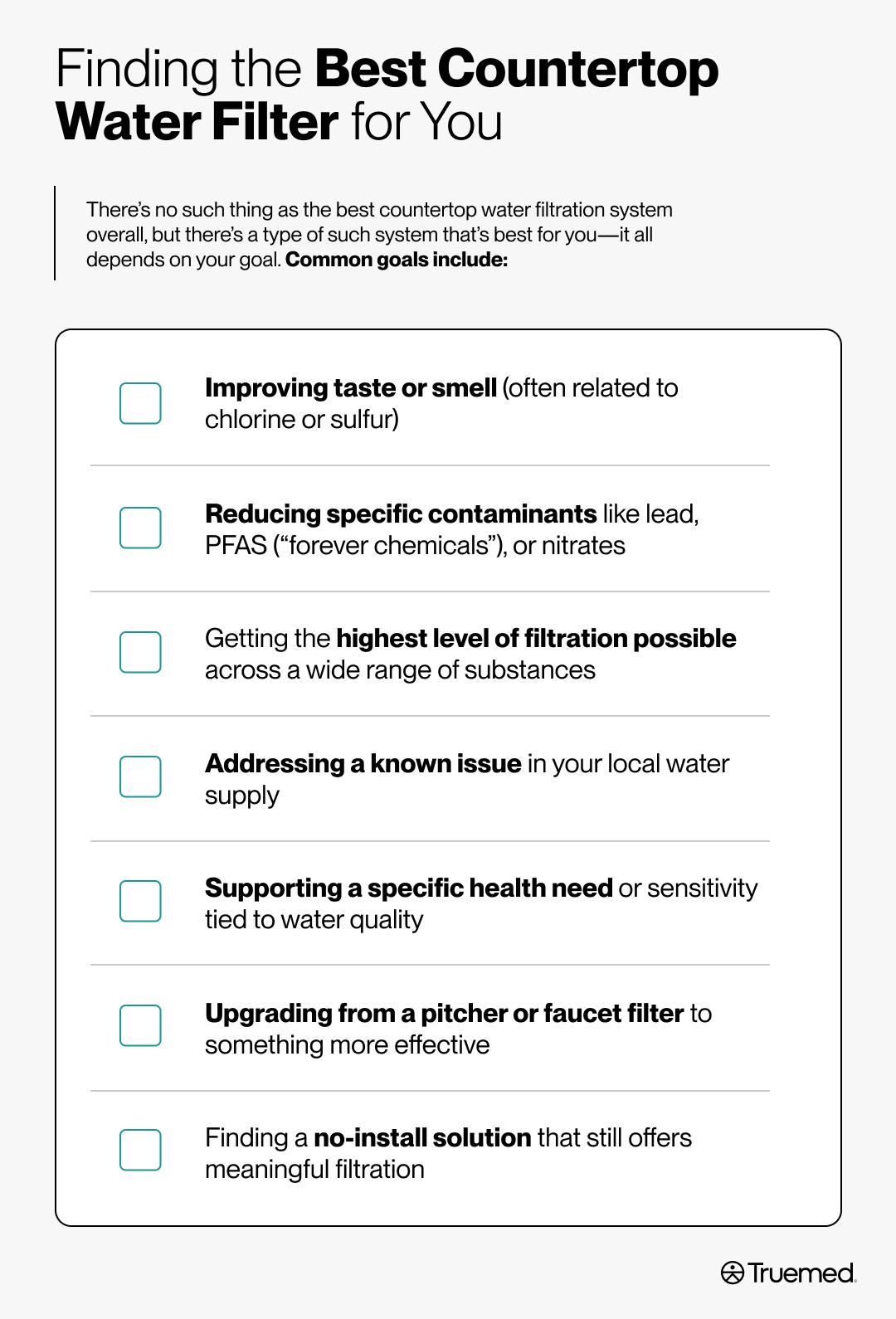
“There’s no such thing as the best countertop water filtration system overall, but there’s a type of such system that’s best for you—it all depends on your goal,” says Megan Doser, owner of Doctor Fix It Plumbing, Heating, Cooling & Electric. “Most people overbuy or underbuy because they don’t start with their goal.”
In practice, she says that goal usually falls into one (or more) of the following categories:
- Improving taste or smell (often related to chlorine or sulfur)
- Reducing specific contaminants like lead, PFAS (“forever chemicals”), or nitrates
- Getting the highest level of filtration possible across a wide range of substances
- Addressing a known issue in your local water supply
- Supporting a specific health need or sensitivity tied to water quality
- Upgrading from a pitcher or faucet filter to something more effective
- Finding a no-install solution that still offers meaningful filtration
From there, it’s worth checking what’s actually in your water. Your local Consumer Confidence Report (CCR) gives a baseline view of your municipal supply, including common contaminants like chlorine, lead, and disinfection byproducts. Note that CCR reflects treated water leaving the utility, not what you may pick up from household plumbing.
Not sure where to start? Look for a few key contaminants in your report. Chlorine is common in municipal water and mainly affects taste and smell. Lead is more likely in older homes with aging pipes. PFAS have been detected in some water systems and are a growing concern due to their potential long-term health effects.
If your report feels overwhelming, focus on whether any contaminants exceed recommended limits—or are flagged at all. Even low levels can influence which type of filtration system makes the most sense for your home.
And if you want a more personalized snapshot—this can be especially beneficial if you live in an older building—at-home testing can help identify what’s coming out of your specific tap.
That combination—your goal plus your water quality—is what should drive your decision. Because not every countertop water filter is designed to handle every issue, says Doser. A system that improves taste may not reduce contaminants like lead or PFAS. And more advanced systems may add cost and maintenance you don’t actually need.
Countertop water filtration system types to compare
Not all countertop water filtration systems work the same way. Even if two products look similar on your counter, they may use completely different filtration methods and target completely different contaminants.
That’s why there’s no single best water filter. The right choice depends on what you’re trying to remove and how much complexity you’re willing to manage day to day.
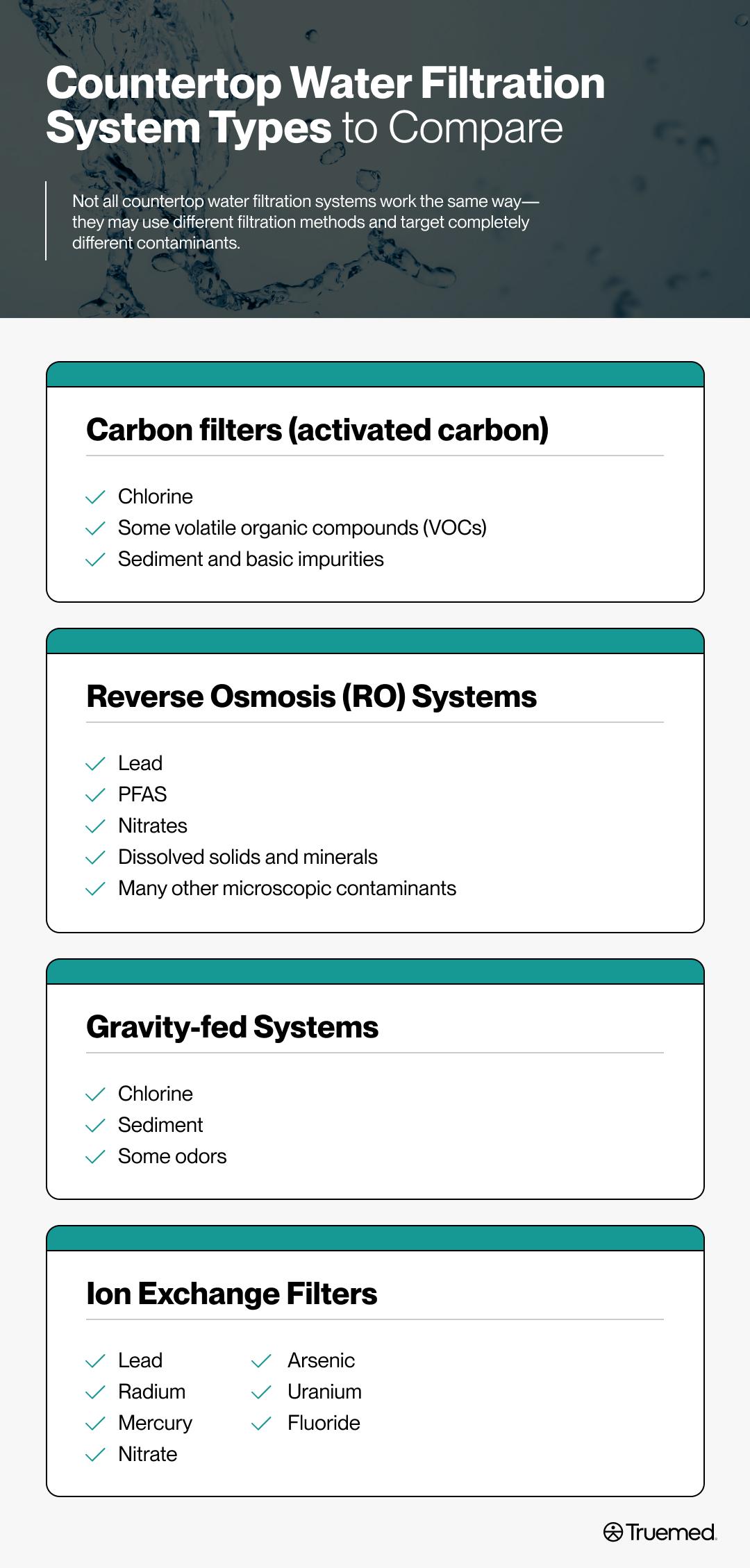
Here’s how the main types compare:
Carbon filters (activated carbon)
These are typically the most common and accessible option, and often the best starting point for everyday use, says Doser.
Carbon filters work kind of like a sponge with millions of tiny pores. As water flows through, things like chlorine and some chemicals get pulled in and stick to the surface, so they don’t end up in your glass.
They’re especially effective for:
- Chlorine (a major cause of taste and odor issues)
- Some volatile organic compounds (VOCs)
- Sediment and basic impurities
They’re typically fast, affordable, and easy to maintain. But they have limits. For instance, most carbon filters don’t reliably remove contaminants like lead, nitrates, or PFAS unless they’re paired with additional filtration stages.
Reverse osmosis (RO) systems
“Reverse osmosis water filter is closer to a universal option that will suit most homes and most needs because it removes the widest range of contaminants,” says Doser.
These systems work by pushing water through an ultra-fine filter (called a membrane) that acts like a barrier. Water can pass through. But many contaminants get left behind, including:
- Lead
- PFAS
- Nitrates
- Dissolved solids and minerals
- Many other microscopic contaminants
But that broader filtration comes with tradeoffs. Even the best reverse osmosis water filters tend to be slower, more expensive, and require more maintenance (including multiple filters). Many also produce some wastewater during the filtration process. You may also find that filtered water tastes “flat” because minerals are removed. Some may choose to remineralize to improve taste, add back magnesium and calcium, and/or raise alkalinity/buffering (bicarbonate).
Gravity-fed systems
Gravity systems rely on time, not pressure. You pour water into the top chamber, and it gradually drips down through the filter into a lower container—no pressure or electricity needed.
They’re appealing because they:
- Don’t require electricity or plumbing
- Are easy to set up and move
- Work well in off-grid or low-tech setups
But they’re also slower and typically less powerful than other options. “Gravity-fed systems are best when you don’t want to deal with installation, but they are slow and mostly remove only basic contaminants like chlorine, sediment, and some odors,” explains Doser.
Ion exchange filters
Ion exchange systems are less common in standalone countertop units, but they’re often used as part of multi-stage systems.
These systems use tiny resin beads that act like magnets. As water flows through, the beads attract and hold onto certain minerals or metals, such as calcium or magnesium. This can help with:
- Water softening
- Reducing certain metals
- Improving overall water balance
On their own, they’re not a complete filtration solution. But they can enhance performance when combined with carbon or RO systems.
What to look for in certifications and proof
Once you’ve narrowed down the type of system you need, the next step is making sure it actually does what it claims.
Water filters are often marketed with broad terms like “pure” or “advanced,” but those don’t tell you much. Certification and testing details are what separate products that perform from ones that just sound good on paper, according to Doser.
Here’s what to look for:
- Third-party certification: Look for independent testing from organizations like NSF International or the Water Quality Association (WQA). This confirms the filter has been tested under specific conditions, not just internally by the brand.
- Certification type: Not all certifications mean the same thing. NSF/ANSI 42 covers taste and chlorine, NSF/ANSI 53 covers health-related contaminants like lead, and NSF/ANSI 58 applies to reverse osmosis systems. Make sure the certification matches what you want to remove.
- Contaminant-specific claims: Instead of relying on general language, check whether the filter is certified to reduce the exact contaminants you care about. After all, a filter can be “certified” but still not address your specific concern.
- Exact model verification: Certification applies to individual products, not entire brands. Always double-check that the specific model you’re considering is certified and not just another product from the same company.
- Testing conditions and limits: Look at how the filter was tested. Performance can depend on things like flow rate, water pressure, and filter lifespan. A product may only meet its claims under certain conditions.
- Reduction levels: Stronger product pages will show how much of a contaminant is reduced (for example, 90% or 99%), rather than just saying it’s “removed” or “filtered out.” This gives you a clearer sense of performance.
- Filter lifespan and replacement schedule: Certification is tied to proper use. If a filter is only effective for a certain number of gallons or months, you’ll need to replace it on schedule to maintain that level of protection.
- Transparency of information: A trustworthy brand will clearly list certifications, contaminants tested, and performance data. If that information is hard to find or vague, that’s worth a second look.
Size, speed, waste, and maintenance tradeoffs
The next step is thinking about how the system will actually work in your day-to-day life.
This is where a lot of “perfect on paper” systems fall apart in practice. If a filter is too slow, too complicated, or requires more upkeep than you expected, it often ends up unused.
According to Doser, here are the key tradeoffs to think through:
- Tank size and refill frequency: Smaller systems take up less counter space but need to be refilled more often—sometimes multiple times a day. Larger tanks are more convenient but require more room and can feel bulky in smaller kitchens.
- Filtration speed: Not all systems produce water at the same rate. Gravity-fed and reverse osmosis systems are typically slower, which means you may need to plan ahead or keep a reserve. Faster carbon systems can filter water almost immediately.
- Daily usability: Think about how you’ll interact with the system. Is it easy to fill? Does it pour cleanly? Will you need to move it often? Small friction points here can make a big difference in whether you actually use it consistently.
- Filter replacement and upkeep: All countertop water filtration systems require ongoing maintenance. This may include replacing one filter—or several, in the case of multi-stage or reverse osmosis systems—on a regular schedule. Missing replacements can reduce performance over time.
- Ongoing cost: The upfront price is only part of the equation. Replacement filters, especially for more advanced systems, can add up. It’s worth estimating the annual cost of ownership before committing.
- Wastewater and efficiency: Some reverse osmosis systems produce wastewater as part of the filtration process. And not all countertop RO systems are equally efficient, so this is worth checking if water usage is a concern.
- Complexity vs. convenience: More advanced systems often mean more setup steps, more components, and more maintenance. Simpler systems are easier to live with, but may not address higher-level contaminant concerns.
These factors don’t show up in marketing headlines, but they’re what determine whether a system fits seamlessly into your routine or becomes something you stop using after a few weeks.
The goal is to find a balance: strong enough filtration for your needs, with a level of maintenance and effort you’re actually willing to keep up with.
Materials, taste, and everyday usability
By this point, you’ve narrowed down what a system can remove and how it performs. Now it comes down to something just as important: what it’s like to live with. (Because even the best countertop water filter won’t make much of a difference if you don’t enjoy using it every day.)
Here’s what to pay attention to:
- Materials and water contact surfaces: Many systems use plastic components, which can be perfectly safe. But quality matters. For example, “cheap plastic filters do remove the taste of chlorine, but they can leave a plastic taste at the same time,” says Doser. Look for BPA-free materials, or consider options with glass or higher-grade, food-safe plastic if taste or material exposure is a concern.
- Taste changes: On that note, different filtration methods affect taste in different ways, says Doser. Carbon filters are especially effective at improving taste by removing chlorine. Reverse osmosis systems remove a broader range of substances, which can result in a very “clean” or neutral taste. That’s why some options include remineralization filters to add minerals back in for a more balanced flavor.
- Intended use (drinking vs. cooking): If you’re mainly using filtered water for drinking, you may prioritize higher-end materials and more advanced filtration, says Doser. For cooking, a simpler system that improves taste and removes basic impurities may be enough.
- Spout design and pouring experience: This sounds minor, but it matters. A poorly designed spout can drip, spill, or make it awkward to fill bottles and glasses. Look for designs that feel stable and easy to use.
- Cleaning and maintenance routine: Beyond filter replacement, consider how easy the system is to clean. Are there removable parts? Does the tank need regular rinsing? Systems that are difficult to clean tend to get neglected over time.
- Leak risk and build quality: A countertop system sits out in the open, often near other appliances. Solid construction and a well-sealed design help prevent leaks and give you confidence in day-to-day use.
- Portability and flexibility: One advantage of a countertop water filter is that it’s not permanent. If you plan to move it, store it, or travel with it, look for a design that’s easy to handle and doesn’t require a complicated setup.
When a reverse osmosis water filter makes sense
In many cases, RO is the most comprehensive type of countertop water filtration system available, says Doser. It removes a wide range of contaminants, including lead, PFAS, nitrates, and dissolved solids. That’s why it’s often considered one of the best in-home water filters for people who want broader protection, not just better taste.
So if your goal is to address multiple concerns at once—or you’re unsure what’s in your water—RO can offer more coverage than simpler systems.
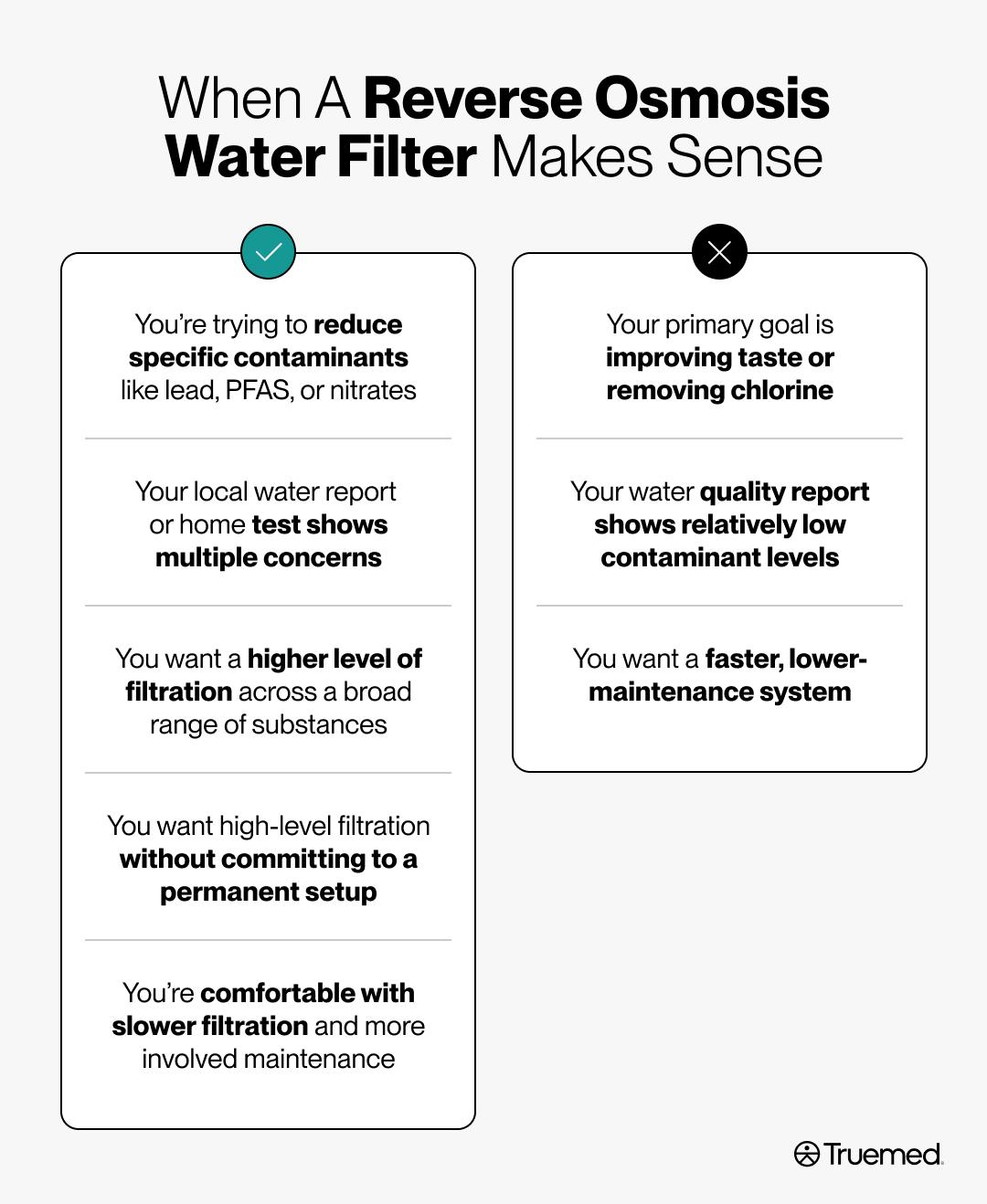
More specifically, reverse osmosis tends to make the most sense if:
- You’re trying to reduce specific contaminants like lead, PFAS, or nitrates
- Your local water report or home test shows multiple concerns
- You want a higher level of filtration across a broad range of substances
- You want high-level filtration without committing to a permanent setup (like if you’re a renter or don’t want to install an under-sink system)
- You’re comfortable with slower filtration and more involved maintenance
That said, more filtration isn’t always necessary. RO may not be the right pick for you if:
- Your primary goal is improving taste or removing chlorine
- Your water quality report shows relatively low contaminant levels
- You want a faster, lower-maintenance system
For many households, a basic carbon-based countertop water filter is enough—especially if your main concern is chlorine, odor, or overall taste, according to Doser. These systems are faster, easier to maintain, and typically more affordable. Choosing a more complex system than you need can mean slower filtration, more upkeep, and higher long-term costs without a meaningful benefit.
Ultimately, the decision comes back to your original goal. If you need broad contaminant reduction, a reverse osmosis system can be worth the tradeoffs. If you don’t, a simpler system may serve you just as well with less effort day to day.
How It Works with HSA/FSA and Truemed
Countertop water filters aren’t automatically eligible for HSA or FSA spending. They may qualify under IRS §213(d) only when a licensed provider determines that the product is medically necessary to treat or manage a diagnosed condition, not for general health or convenience.
For example, a provider may recommend a filter if you’re immunocompromised and living in a home with confirmed water contamination (such as elevated lead levels).
To use HSA/FSA funds, you may need a letter of medical necessity (LMN) from a licensed provider that documents your diagnosis and explains why a countertop water filtration system supports your treatment plan.
If you qualify,* Truemed can help guide you through the process. Here’s how Truemed works:
First, check whether the product is typically considered a qualifying medical expense or whether you might need a letter of medical necessity.
Complete a health intake survey, which will be reviewed by an independent licensed clinician.
Purchase the item by either using your HSA/FSA card at checkout or paying out of pocket and submitting for reimbursement later.
An independent licensed practitioner will review your medical history and, if appropriate, issue an LMN. Truemed itself does not make eligibility determinations.
If your claim is denied, Truemed can help you gather and provide the necessary substantiation documentation to support your reimbursement request.
Final approval always rests with your plan administrator, so it’s worth confirming your plan’s requirements before you complete your purchase.
*Truemed is for qualified customers. HSA/FSA tax savings vary. Learn more at truemed.com/disclosures.
Compliance & Documentation
If you’re planning to use HSA or FSA funds, it’s worth understanding how documentation and approval actually work because this is where many purchases get tripped up.
First, eligibility is not automatic. Even if a product is sold through a health-focused marketplace, reimbursement depends on your specific situation. In most cases, you may be able to use HSA or FSA funds only if the purchase is tied to a diagnosed condition and supported by proper documentation.
Here’s what that typically involves:
- An independent clinical review: If you’re using Truemed,* an independent licensed practitioner reviews your health intake and determines whether a water filtration system is necessary to manage or treat your health condition. Truemed itself does not make medical or eligibility decisions.
- A letter of medical necessity: This is the document from a licensed provider that explains your diagnosis and why a specific product—like a countertop water filtration system—is part of your treatment plan.
- Your plan administrator’s approval: Even with an LMN, final reimbursement decisions are made by your HSA or FSA plan administrator. Requirements can vary by plan, so it’s important to check your specific guidelines.
- Proper documentation: Keep records of your purchase, including receipts, product details, and any supporting documentation like your LMN. You may need to submit these for reimbursement or in response to a claim review.
It’s also important to use clear, accurate expectations when evaluating eligibility. A countertop water filter may be eligible in certain cases, but not all. The key factors are your diagnosis, your provider’s recommendation, and your plan’s rules.
*Truemed is for qualified customers. HSA/FSA tax savings vary. Learn more at truemed.com/disclosures.
The bottom line
The best countertop water filter is the one that matches your water, your priorities, and your routine. If your main goal is better taste, a simple carbon system may be enough. If you’re trying to reduce specific contaminants like lead or PFAS, a more advanced system—like reverse osmosis—may be worth the added cost and maintenance. Certifications help confirm whether a product actually does what it claims.
Just as important are the practical details. Tank size, refill frequency, filtration speed, and upkeep all shape whether a system fits into your day-to-day life. And if you’re considering HSA or FSA funds, eligibility depends on medical necessity and proper documentation, with final approval determined by your plan administrator.
In the end, the best water filter for you doesn’t come down to picking the most advanced system. Instead, choose the option that solves your specific problem in a way you’ll actually stick with.
Deep dive recommendations
- https://www.epa.gov/ccr
- https://www.epa.gov/ground-water-and-drinking-water/basic-information-about-lead-drinking-water
- https://www.nsf.org/consumer-resources/articles/home-water-treatment
- https://www.wqa.org/consumer-information/
FAQ
Some can, but not all. It depends on the type of filtration and whether the system is certified to reduce those specific contaminants. Basic carbon filters may reduce chlorine and improve taste, but they don’t always remove lead or PFAS. If those are your concerns, look for systems with NSF/ANSI 53 (for lead) or NSF/ANSI 58 (for reverse osmosis), which are designed to reduce a broader range of contaminants.
Not necessarily. Reverse osmosis systems remove the widest range of contaminants, which makes them a strong option for many households. But they also come with tradeoffs like slower filtration, more maintenance, and higher cost. If your main goal is improving taste or reducing chlorine, a simpler carbon-based system may be enough (and easier to live with day to day).
It depends on the system and how much water you use. Some filters need to be replaced every 2–3 months, while others last 6–12 months or longer. Reverse osmosis systems often have multiple filters with different replacement schedules. Following the recommended timeline is important, since performance can drop if filters aren’t replaced on time.
They can be, depending on your needs. Countertop systems often offer stronger filtration and larger capacity than pitchers or faucet-mounted filters. At the same time, they take up more space and may require more maintenance. If you want a step up in filtration without installing an under-sink system, a countertop option is often a good middle ground.
Possibly. Countertop water filters aren’t automatically eligible, but they may qualify if a licensed provider determines the product is medically necessary to treat or manage a diagnosed condition. In many cases, you’ll need a letter of medical necessity, and final reimbursement decisions are made by your plan administrator.



See what you can do with your HSA/FSA.
Join 1.5 million Americans who have routed their healthcare dollars toward root cause health via Truemed's HSA/FSA marketplace.
New product announcements
Sales and special offers
Tips for utilizing your HSA/FSA
Editorial Standards
At True Medicine, Inc., we believe better health starts with trusted information. Our mission is to empower readers with accurate and accessible content grounded in peer-reviewed research, expert insight, and clinical guidance to make smarter health decisions. Every article is written or reviewed by qualified professionals and updated regularly to reflect the latest evidence. For more details on our rigorous editorial process, see here.