
2026 HSA Trends: The Participation Gap Report
Author:Kathleen Ferraro
Reviewed By:Michaela Robbins, DNP
Published:
March 27, 2026
Last Updated:
September 15, 2026
Truemed writers and editors independently evaluate all our product recommendations. If you make a purchase through any affiliate links we provide, we may receive compensation. Learn more.



Key Takeaways
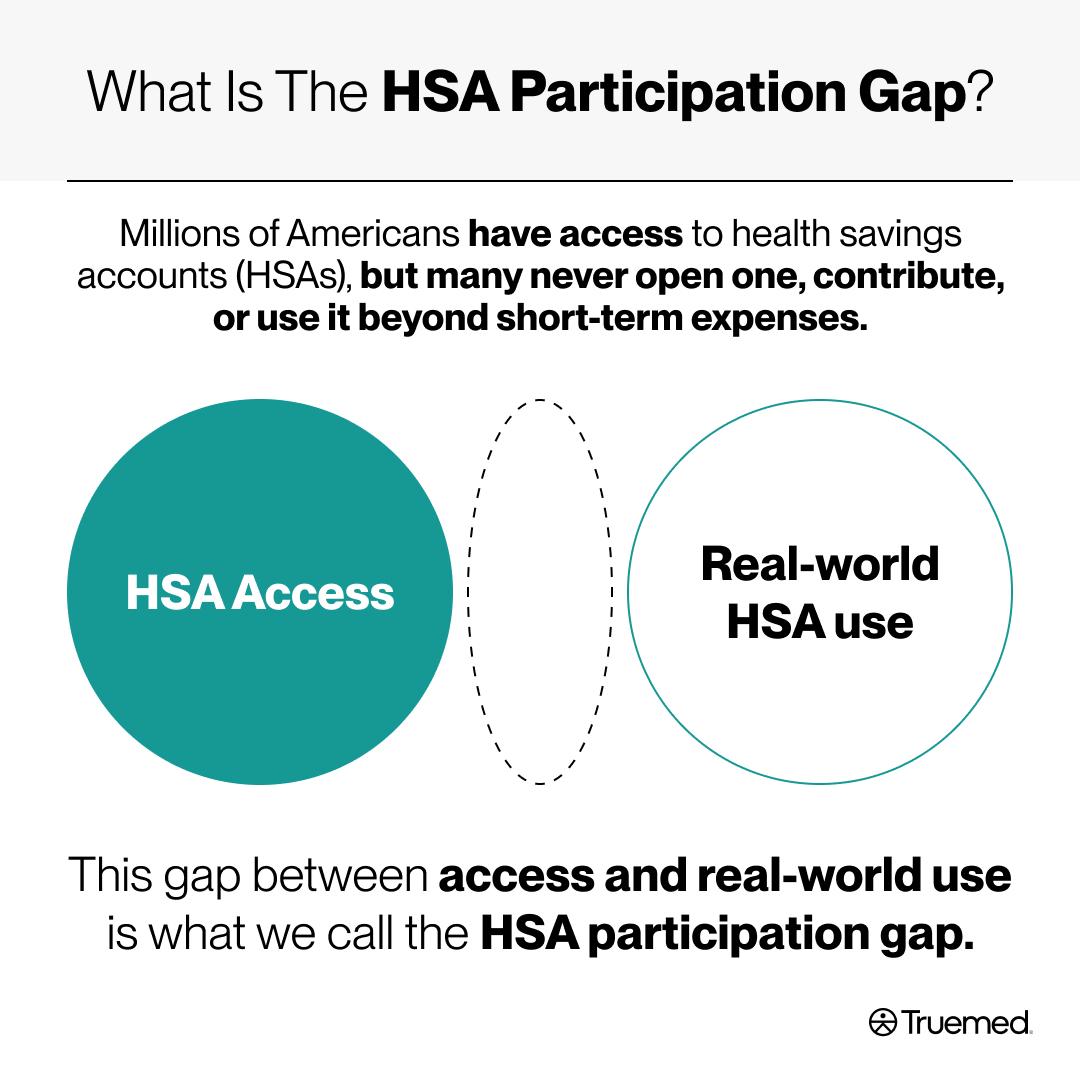
There's an HSA participation gap: It's the disconnect between people who have access to HSAs and those who actually use them fully by opening accounts, contributing regularly, and investing funds.
Participation tends to drop off at several points: That includes account opening, consistent contributions, and investing balances for long-term growth.
Many people use HSAs mainly to pay current medical bills: This can limit the account’s long-term growth potential.
Some expenses may be HSA- or FSA-eligible: Customers may be able to use HSA or FSA funds for certain health-related purchases when supported by appropriate documentation.
Simple steps can help close the participation gap over time: Examples include automating contributions, setting an investing trigger, and keeping documentation organized.
Key Takeaways
HSA Participation Gap Report: What the Gap Is and How to Measure It
The Perception Gap: Why Employees and Employers Talk Past Each Other
HSA Trends in 2025: HDHP Selection, Demographics, and Engagement
HSA Balance and Contribution Behavior: What Recent Surveys Show
Why the Participation Gap Persists (And What to Do About It)
How Much Should I Contribute to an HSA?
HSA Catch-Up: Who Qualifies and How to Use It Strategically
HSA Investing: When to Start and How to Reduce Risk
Compliance and Documentation
How It Works With HSA/FSA and Truemed
Closing the gap: a 30-day action plan
FAQ
Health savings accounts (HSAs) are one of the most powerful tools in personal finance. They offer a rare triple tax advantage: Money goes in tax-deductible, grows tax-free, and can come out tax-free for qualified medical expenses. On paper, it’s hard to beat. But as this HSA participation gap report explores, many people still don’t take full advantage of these accounts.
But in the real world, the story looks different. Millions of people enroll in high-deductible health plans that make them eligible to open an HSA, yet research shows that 1 in 3 people never open an account. On top of that, others contribute only occasionally or spend the money as soon as it lands instead of letting it grow.
Below, we’ll take a closer look at where participation breaks down—from opening the account to contributing, investing, and actually using the funds. Along the way, we’ll look at what recent HSA trends reveal, why so many people miss out on the full benefits, and practical steps that can help customers make the most of their money.
HSA Participation Gap Report: What the Gap Is and How to Measure It
The HSA participation gap doesn’t show up in just one place—it appears across several stages of how people actually use these accounts.
Researchers typically track HSA engagement using a handful of core metrics:
- Participation rate (how many eligible people open an account)
- Average annual contribution
- Average HSA balance
- The percentage of accounts that invest funds, and net flows (contributions minus withdrawals)
Together, these numbers reveal something important: Access to HSAs is widespread, but consistent participation is not. When you look at the data through that lens, a clear pattern emerges. Participation tends to drop off at the following four points:
- Opening the account: Many employees enroll in high-deductible health plans but never open the accompanying HSA. According to Eric Croak, CFP, an accredited wealth management advisor and president of Croak Capital, this often happens because people don’t understand how the account works or assume it requires extra paperwork. HSAs are also frequently presented as optional add-ons during benefits enrollment, which makes them easy to skip.
- Contributing to the account: Even after opening an account, contributions can be inconsistent. Because HSA funding is optional, it often takes a back seat to immediate expenses like credit card debt or monthly bills. Some people also see HSAs as a bonus savings account rather than an essential part of their healthcare strategy.
- Investing HSA funds: Many HSA users keep their entire balance in cash instead of investing it. In some cases, people don’t realize investing is an option, while others face provider minimums—often $1,000 to $2,000—before they can begin investing.
- Using the account for long-term savings: HSAs are often marketed as long-term savings tools, but many people use them mainly to pay current medical bills or other eligible health items.
The Perception Gap: Why Employees and Employers Talk Past Each Other
Another layer of the HSA participation gap comes down to perception. Employers often frame HSAs as long-term savings tools, while many employees treat them as spending accounts for current medical bills.
That disconnect shapes how people use their accounts. Instead of contributing consistently or investing for the future, many account holders deposit just enough to cover expected healthcare costs for the year.
Confidence can also be misleading. Many employees say they feel comfortable choosing a health plan, yet concepts like deductibles, coinsurance, and out-of-pocket maximums can still be confusing. Without a clear picture of how healthcare costs unfold over a year, it’s hard to know how much to contribute (or whether to save at all).
Timing adds another hurdle. Most HSA education happens during open enrollment, when employees are already juggling multiple benefits decisions. Months later—when healthcare spending decisions actually happen—those explanations are often forgotten.
HSA Trends in 2025: HDHP Selection, Demographics, and Engagement
Recent HSA trends show that roughly 40% of people with employment-based health insurance enroll in an HDHP, but HSA participation still varies.
Younger workers are increasingly enrolling in high-deductible health plans that make them HSA-eligible, often drawn by lower premiums. But because younger adults tend to use less healthcare, they may feel less urgency to learn how HSAs work or contribute early. In fact, research found that only 0.2% of HSA holders under the age of 25 made individual contributions.
On the flip side, participation tends to rise when the process is simpler. Tools like decision support during enrollment, payroll contribution automation, and clear reminders throughout the year can all help people stay engaged. Policy changes—such as expanded flexibility around telehealth and direct primary care—may also make HSAs easier to use for everyday healthcare spending.
HSA Balance and Contribution Behavior: What Recent Surveys Show
Recent surveys suggest that HSA balances and contributions are gradually rising, but participation patterns still show the same gaps.
Average balances have increased in recent years as more workers contribute and investment options become more common. Employer contributions also play a meaningful role—especially early in the year—by helping employees build an initial balance that can cover unexpected healthcare costs.
At the same time, investing rates remain relatively low. Many account holders keep their entire HSA balance in cash, even when their provider offers investment options.
Withdrawals are also increasing as healthcare costs rise. And when most HSA dollars go toward current healthcare bills, the balance has less chance to grow through contributions and investing.
Why the Participation Gap Persists (And What to Do About It)
If HSAs offer such strong tax advantages, why do so many people underuse them? Here are some of the most common barriers, along with simple ways to address them.
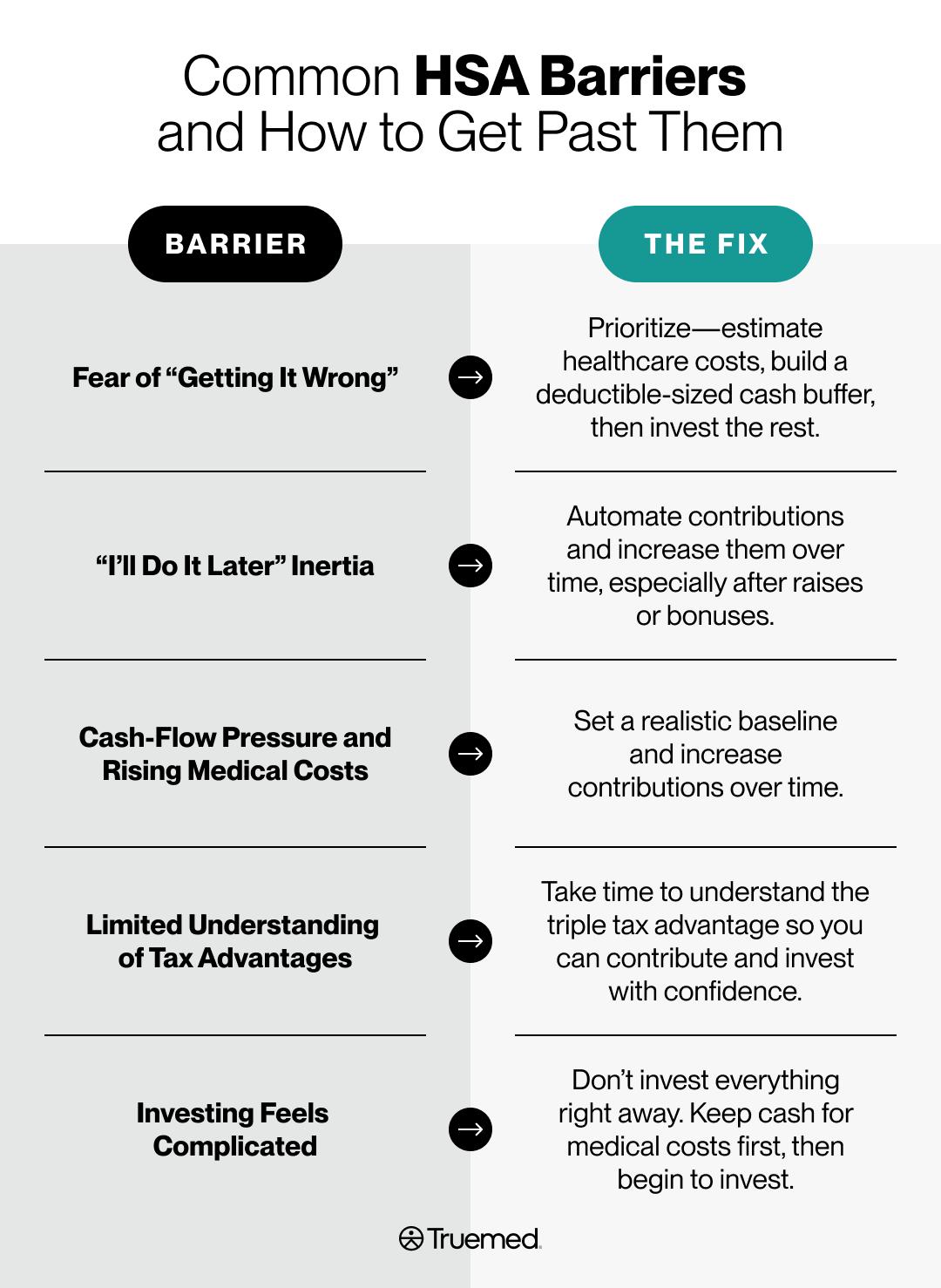
Barrier: Fear of “Getting It Wrong”
Health insurance terms like deductibles, coinsurance, and out-of-pocket maximums can make HSAs feel complicated. When people aren’t sure how the account fits into their health plan—or worry about using the money incorrectly—they may avoid contributing or investing altogether.
The fix: Start with a simple priority order. Estimate your healthcare costs, build a cash buffer roughly equal to your deductible, then invest additional contributions, says Croak (more on this in a moment).
Barrier: “I’ll Do It Later” Inertia
Even people who intend to use their HSA strategically often delay setting up contributions because it requires an extra step during enrollment or payroll setup. And let’s face it—it’s easy to put off.
The fix: Automate payroll contributions so money goes into the account without any effort. Setting a rule to increase contributions each year—especially after raises or bonuses—can also help your savings grow gradually without putting sudden pressure on your budget.
Barrier: Cash-Flow Pressure and Rising Medical Costs
Many households face competing financial priorities (hello, housing costs and student loans), which can make it difficult to prioritize HSA contributions. As a result, contributions often get delayed or skipped altogether.
The fix: Start with a realistic baseline contribution. Even small monthly amounts can add up, making it easier to increase contributions later as your budget allows, says Croak.
Barrier: Limited Understanding of Tax Advantages
Some people simply don’t realize how powerful the tax benefits of an HSA can be compared with other savings accounts. That’s partly because the tax advantages aren’t always clearly explained during benefits enrollment, and many people don’t revisit the details later.
The fix: Take time to understand how the triple tax advantage works and how an HSA fits into your broader financial plan. Even a basic understanding can help you decide how much to contribute and whether investing HSA funds makes sense.
Barrier: Investing Feels Complicated
Investing HSA funds can feel intimidating, especially for people who worry they may need the money for medical expenses in the near future. But investing is often what allows HSA balances to grow meaningfully over time.
The fix: You don’t have to invest everything right away. Start by keeping enough cash in your HSA to cover expected medical expenses or your deductible. Once that cushion is in place, you can begin investing additional funds.
How Much Should I Contribute to an HSA?
A simple way to approach it is to build contributions in stages:
- Cover expected out-of-pocket costs for the year: Start by estimating predictable healthcare expenses—like prescriptions or regular appointments—and contribute enough to cover those costs.
- Build an HSA deductible buffer: Next, aim for a cushion roughly equal to your plan’s deductible. This provides a safety net for unexpected medical bills.
- Move toward the annual max (if possible): If your budget allows, gradually increase contributions toward the annual limit—especially if you plan to leave funds invested.
- Coordinate with employer contributions: If your employer contributes to your HSA, include that amount in your total so you don’t exceed the annual limit.
- Review at open enrollment and mid-year: Revisit your contribution strategy each year or after major life changes to keep it aligned with your healthcare needs and finances.
HSA Catch-Up: Who Qualifies and How to Use It Strategically
If you’re age 55 or older, you may be eligible to make HSA catch-up contributions, which allow you to contribute additional funds each year beyond the standard limit. In 2026, the standard contribution limit is $4,400 for an individual and $8,750 for a family, and catch-up contributions allow an additional $1,000.
These extra contributions can be especially helpful for people who started using an HSA later in their careers and want to build a larger balance before retirement, when healthcare costs often increase.
However, many people in midlife end up using their HSA mainly for current medical expenses instead of letting the balance grow.
“The 40s and 50s crowd are using HSAs as the go-to fund for medical expenses, rather than retirement,” says Croak. “They pay for doctor’s visits, prescriptions, and hospital copays with their HSA, which defeats the purpose of letting the account grow.”
He says the key is to treat catch-up contributions as retirement health savings rather than as near-term spending, and to leave those funds invested when possible.
HSA Investing: When to Start and How to Reduce Risk
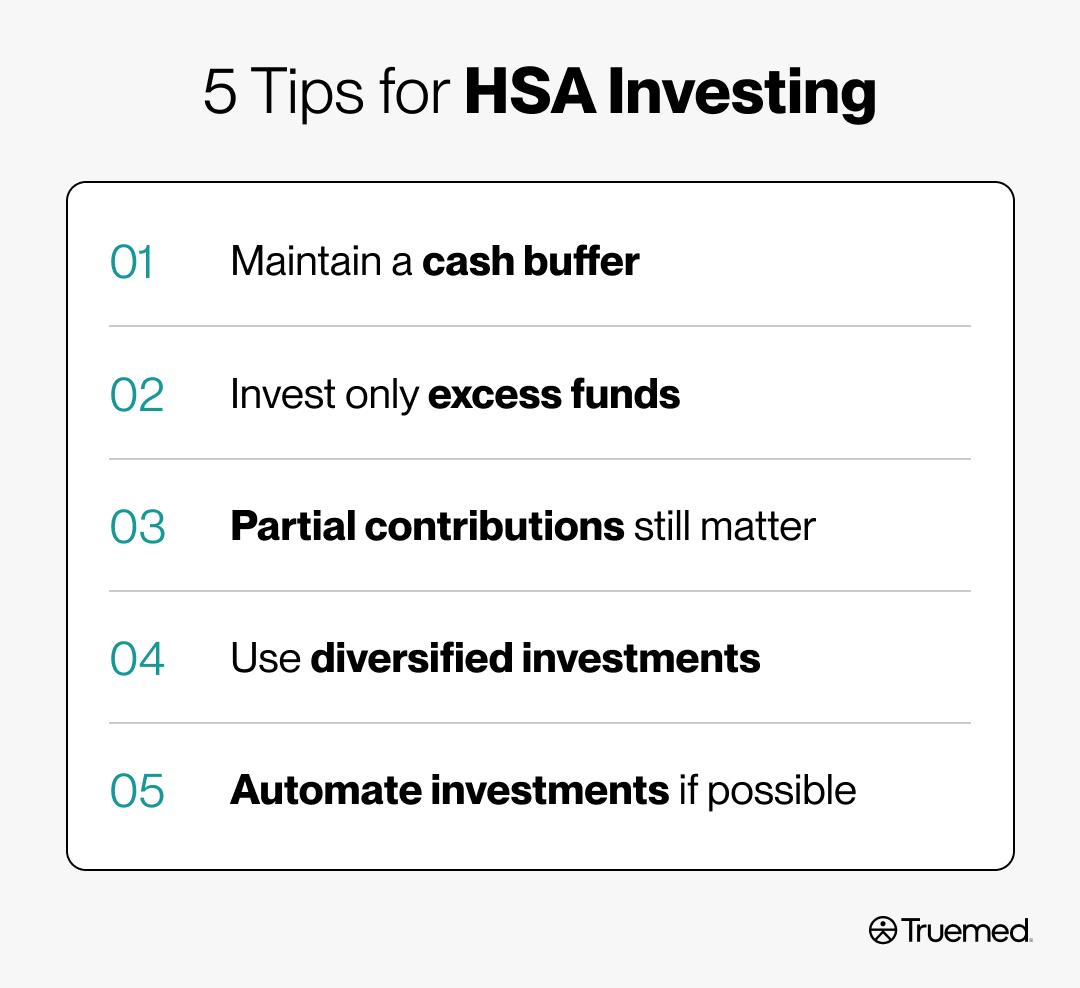
Once you’ve built a cash cushion in your HSA, investing can help the balance grow over time. A few strategies can help reduce risk:
- Maintain a cash buffer: Keep enough in cash to cover your deductible or expected healthcare expenses.
- Invest only excess funds: Once your cushion is in place, invest additional contributions.
- Remember that partial contributions still matter: There’s no reason to halt contributions just because you can’t reach the annual maximum. Even smaller contributions can still grow over time when invested, says Croak.
- Use diversified investments: Many HSA providers offer index funds or diversified portfolios, similar to retirement accounts.
- Automate investments if possible: Automation can help maintain consistency and remove day-to-day decision-making.
Compliance and Documentation
Using HSA or FSA funds often requires documentation. Eligibility can depend on the product or intervention, what’s being treated, and whether a healthcare provider determines the purchase is medically necessary in the treatment or prevention of your condition.
In some cases, customers may be eligible to use HSA or FSA funds when a product is used to address a diagnosed condition and supported by documentation, such as a letter of medical necessity (LMN) from a licensed provider. Plan administrators ultimately make reimbursement decisions.
To keep things simple, save:
- Itemized receipts
- Any relevant medical documentation (such as an LMN)
- Records showing how the purchase relates to a qualified medical expense
How It Works With HSA/FSA and Truemed
For some health-related purchases, qualified customers may be able to use HSA or FSA funds with support from Truemed. There is no additional cost to use Truemed because its services are included in the purchase price.
Here’s how the process works:
- Complete a clinical intake form through Truemed.
- An independent licensed medical practitioner reviews your health information.
- If you qualify, an LMN may be issued connecting the purchase to the prevention, treatment, or mitigation of a health condition.
- Pay with your HSA/FSA card at checkout.
Closing the gap: a 30-day action plan
Closing the HSA participation gap doesn’t require a complete financial overhaul. A few small steps—taken consistently—can make a meaningful difference.
- Week 1: Confirm HSA eligibility, set an annual contribution target, and start payroll contributions if available.
- Week 2: Build a cash cushion in the account—ideally enough to cover expected healthcare expenses or your deductible.
- Week 3: Decide on an investing trigger. Once the cash buffer is in place, begin investing additional funds if your provider offers that option.
- Week 4: Organize documentation, review your contribution plan, and schedule a mid-year check-in to adjust if needed.
Over time, these small steps can help turn an HSA from a rarely used account into a more effective tool for both healthcare spending and long-term savings.
FAQ
The HSA participation gap refers to the difference between people who are eligible for a health savings account and those who actually use one effectively. Many individuals enroll in high-deductible health plans that make them HSA-eligible, but fewer open accounts, contribute regularly, or invest their balances.
Many people treat HSAs as a convenient way to pay for current healthcare expenses like prescriptions or doctor visits. While that’s allowed, spending the balance right away can limit the long-term growth potential that comes from contributing consistently and investing the funds.
The right contribution depends on your healthcare needs and financial situation. A common approach is to first contribute enough to cover expected medical expenses, then build a buffer equal to your deductible. From there, additional contributions can be invested if your budget allows.
Many people begin investing once their HSA balance exceeds their deductible or expected annual healthcare costs. Keeping a cash cushion for near-term expenses while investing additional funds can help balance flexibility and long-term growth.
In some cases, qualified customers may be able to use HSA or FSA funds for certain health-related purchases when a product is used to address a diagnosed condition and supported by appropriate documentation, such as a letter of medical necessity from an independent licensed practitioner. Plan administrators ultimately determine reimbursement eligibility.




See what you can do with your HSA/FSA.
Join 1.5 million Americans who have routed their healthcare dollars toward root cause health via Truemed's HSA/FSA marketplace.
New product announcements
Sales and special offers
Tips for utilizing your HSA/FSA
Editorial Standards
At True Medicine, Inc., we believe better health starts with trusted information. Our mission is to empower readers with accurate and accessible content grounded in peer-reviewed research, expert insight, and clinical guidance to make smarter health decisions. Every article is written or reviewed by qualified professionals and updated regularly to reflect the latest evidence. For more details on our rigorous editorial process, see here.