
FSA Eligible Ecommerce Requirements: What Online Merchants Need to Accept HSA/FSA Payments
Author:Anna Meyer
Published:
May 19, 2026
Last Updated:
September 10, 2026



Key Takeaways
Pre-tax spending boosts conversion without margin loss: Qualifying customers can save around 30% on average using HSA/FSA funds, effectively turning a $300 product into a $180–$210 purchase depending on their tax bracket. This increased purchasing power often drives higher conversion rates and larger average order values, especially for premium items like wearables, recovery tools, and sleep systems — all without the merchant discounting prices.
Dual-use products require a Letter of Medical Necessity (LMN): Some products (blood pressure monitors, thermometers, first-aid supplies) are automatically eligible, but most ecommerce categories — supplements, fitness equipment, mattresses, red light therapy, wearables — fall into the "dual-use" bucket. These need an LMN from a licensed clinician tying the product to a specific medical condition, which is why many brands partner with platforms like Truemed to handle substantiation rather than building it in-house.
Ecommerce payment infrastructure is more complex than retail: Retail pharmacies rely on health-related Merchant Category Codes (MCCs) or IIAS systems with SIGIS registration to auto-validate eligible items. Ecommerce brands typically can't get health MCCs and deal with mixed carts, bundles, subscriptions, and dual-use products — so they need a dedicated payment provider that supports card payments, reimbursement flows, LMN substantiation, and proper transaction documentation.
Compliance and documentation determine long-term success: While IRS audit responsibility largely sits with the customer, merchants must provide itemized receipts and maintain records like LMNs, returns/exchange data, and SKU eligibility info. Common pitfalls include broadly labeling products as "HSA/FSA eligible" without substantiation, poor receipt formatting, unsupported mixed carts, and low approval rates — all of which can frustrate customers and create compliance risk with plan administrators or the IRS.
Key Takeaways
Why Ecommerce Brands Are Adding HSA/FSA Payments
What Makes a Product HSA/FSA Eligible?
HSA/FSA Eligible Ecommerce Requirements for Accepting Payments Online
How HSA/FSA Ecommerce Payments Work
Why Ecommerce HSA/FSA Payments Are More Complex Than Retail
IRS Compliance Requirements Ecommerce Brands Must Understand
Common Mistakes Ecommerce Brands Make
FAQ
Talk to Sales
Ready to unlock HSA/FSA payments for your business?
Why Ecommerce Brands Are Adding HSA/FSA Payments
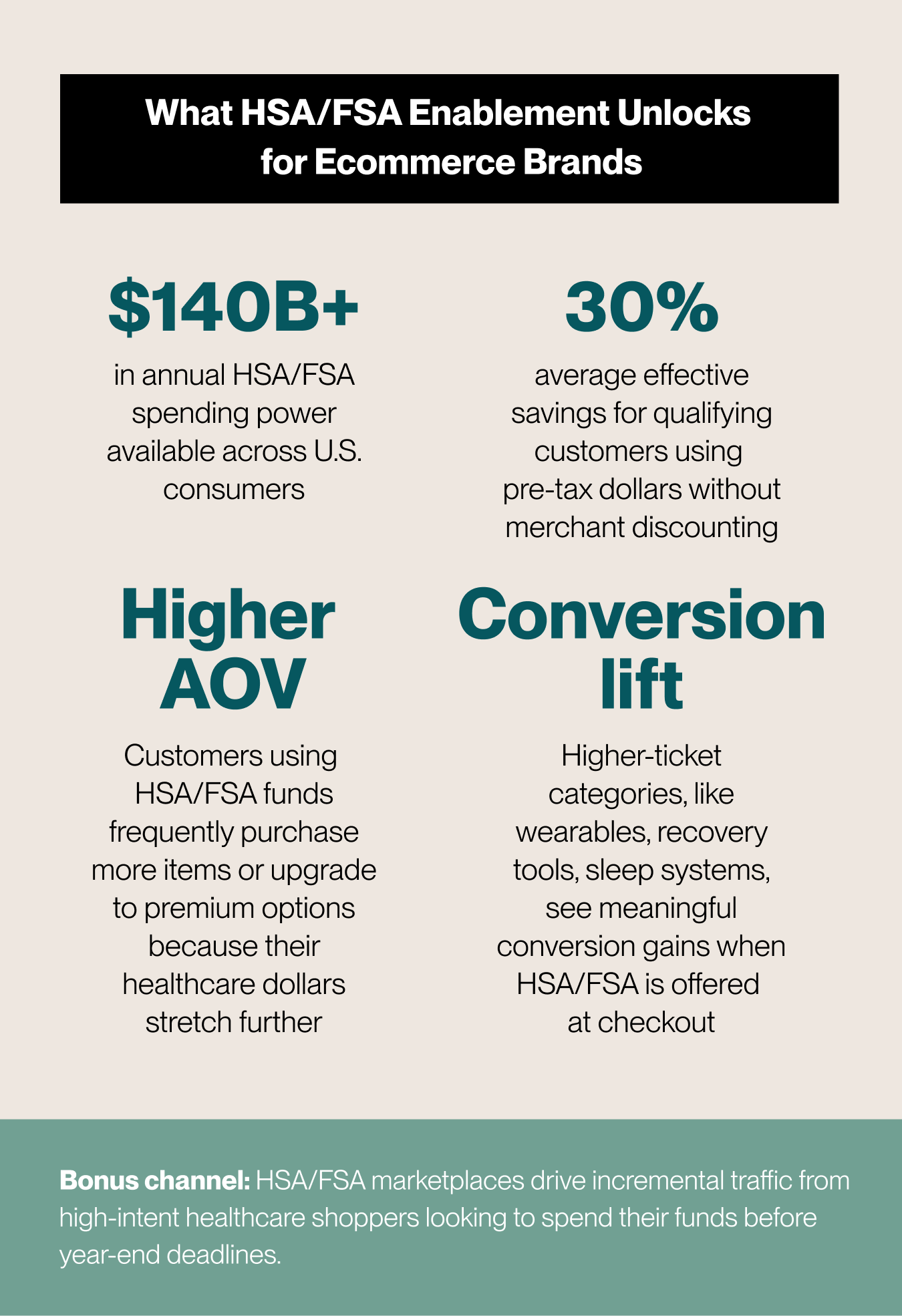
One of the biggest reasons ecommerce brands pursue HSA/FSA enablement is that it increases customer purchasing power without compressing margins.
When qualifying shoppers use pre-tax dollars, a $300 product may effectively feel closer to $180-$210 depending on their tax bracket. That shift can materially change buying behavior, especially for higher-ticket products like wearables, recovery tools, and sleep systems.
Stores also report meaningful increases in average order value. Customers using HSA/FSA funds often purchase more items or move toward premium options because their healthcare dollars stretch further.
Another factor driving adoption is customer acquisition. Many merchants initially approach HSA/FSA as a payment feature, then discover that HSA/FSA marketplaces can become incremental traffic channels, filled with high-intent healthcare shoppers already looking to spend their funds before deadlines expire.
But to benefit from this pre-tax spending benefit, your products need to be eligible.
What Makes a Product HSA/FSA Eligible?
HSA/FSA eligibility is generally based on whether a product qualifies as a medical expense under IRS guidelines.
In simple terms, products intended to diagnose, treat, mitigate, or prevent medical conditions are more likely to qualify. These products are either automatically eligible or are considered dual-use products.
Automatically Eligible Products vs Dual-Use Products
Some products are automatically eligible without additional documentation. These are products that have a clear medical purpose like:
- Blood pressure monitors
- Braces
- Thermometers
- First-aid supplies
Other products fall into a “dual-use” category. These products are typically to support general wellness however, in certain circumstances they can be used to treat or mitigate a medical condition. Common dual-use products include:
- Supplements
- Fitness equipment
- Sleep products
Keep in mind that products that are used purely for general wellness are not eligible for HSA/FSA spending.
When a Letter of Medical Necessity Is Required
A Letter of Medical Necessity (LMN) is a document from a licensed clinician explaining that a product is being used to treat or manage a specific medical condition, and are typically required for dual-use products.
For example, an exercise class would be considered a general wellness service. However, a doctor could prescribe exercise as part of a treatment plan for obesity, making the class a medical necessity and a dual-use service.
For ecommerce businesses who sell dual-use products, the LMN requirement tends to throw a wrench in the works. For this reason, many ecommerce brands partner with third-party HSA/FSA enablement platforms like Truemed* to handle the LMN substantiation part of the process.
Managing eligibility reviews and documentation internally can quickly become operationally difficult so a trusted platform like Truemed could simplify your compliance processes, while also increasing your customers’ spending power. Talk about a win-win situation.
*Truemed is for qualified customers. See terms at truemed.com/disclosures.
Common Ecommerce Products That May Qualify
More and more healthcare providers are warming up to non-pharmaceutical treatments for medical conditions that affect your customers. This shift means more products are now considered dual-use products. Some common ecommerce categories that may qualify as medical expenses include:
- Sleep products like mattresses
- Recovery tools like red light therapy panels
- Fitness equipment, gym classes, and personal trainers
- Supplements like vitamin D, glutamine, and probiotics
- Health wearables like Garmin watches and Oura rings
For a more comprehensive list of eligible products, check out our Ultimate List of 100+ HSA/FSA Eligible Expenses.
HSA/FSA eligibility depends on the specific product and how it is used, so ecommerce stores should avoid broadly labeling products as “HSA/FSA eligible” without proper substantiation workflows set up.
But what would you need in place to accept HSA/FSA payments?
HSA/FSA Eligible Ecommerce Requirements for Accepting Payments Online
Ecommerce brands need a few operational and compliance components in place before accepting HSA/FSA payments.
Eligible Products or Services
The foundation is straightforward. You must sell products or services that qualify under IRS medical expense guidelines. To quickly rehash, this means your product or service must be used to treat or manage a medical condition. Like an iron supplement to treat anemia.
Merchant Category Codes (MCCs)
The easiest product eligibility validation option is a Merchant Category Code or MCC. These are codes issued by card issuers, like Visa and Mastercard, to help them understand what type of business is processing a transaction.
Health MCCs makes it easier for the card processor to identify that you’re selling products that are considered qualified medical expenses which streamlines the product validation process.
The kicker is that you’ll need to be considered a medical provider like a doctor, dental office, optician, pharmacy etc, to get a health MCC.
If you’re an ecommerce store without a health MCC, you’ll need an Inventory Information Approval System (IIAS) with a Special Interest Group for IIAS Standards( SIGIS) registration, to facilitate product eligibility validation.
SIGIS manages the standards for HSA/FSA payment while also providing a running list of eligible products to streamline product verification, while the IIAS automatically verifies products at checkout. You’ll need both of these to enable automatic product validation.
The exception here is if you predominantly or exclusively sell dual-use products. Dual-use products don’t qualify for automatic validation since they have to be accompanied by an LMN to be considered a qualified medical expense.
In this case, you’ll need to incorporate a LMN acquisition component into your checkout flow. You can always ask your customers to go to their medical provider for a LMN however, this is cumbersome. And it may drive your customers to your competitors who have an LMN built into their check out process.
HSA/FSA Payment Processing for Ecommerce Stores
One of the most crucial requirements to accept HSA/FSA payments is your payment infrastructure. Not all payment providers can provide HSA/FSA purchase options though, especially if you’re selling mostly dual-use products.
This is because many payment providers are only able to clear payments for businesses that have a health related MCC. If you sell a mix of eligible and non-eligible products, or dual use products, you’ll need a dedicated payment provider like Truemed to enable HSA/FSA transactions.
Whichever payment provider you choose, they will need to provide compatible payment workflows that can support card payments, reimbursement flows, substantiation flows for LMN’s and the required transaction documents.
Keep in mind that your HSA/FSA payment provider could affect your rejection rates if product validation and LMN acquisition is not up to scratch. And that alone can affect your revenue.
Then there’s the documentation requirements.
Customer Documentation Requirements
IRS compliance for HSA purchases mostly lie with customers which means during an audit, your customer will be required to prove that a purchase was a qualified medical expense. Your customers will typically need itemized receipts, transaction records, and when necessary, a LMN. So your main responsibility is to provide them with the itemized receipts for their own recordkeeping.
Substantiation Components
And finally, you’ll need to ensure that you have the correct substantiation and compliance components in place.Substantiation is the process used to verify that purchases qualify as eligible medical expenses. And for ecommerce brands, this may involve product eligibility verification, health surveys, LMN collection, reimbursement support, and audit documentation retention.
These components are the cornerstone of your HSA/FSA payment system because they determine whether you remain compliant with administrators and the IRS.
Now that you know what you need to get started, you need to choose which payment flow you want to offer your shoppers.
How HSA/FSA Ecommerce Payments Work
There are two primary ecommerce HSA/FSA workflows.
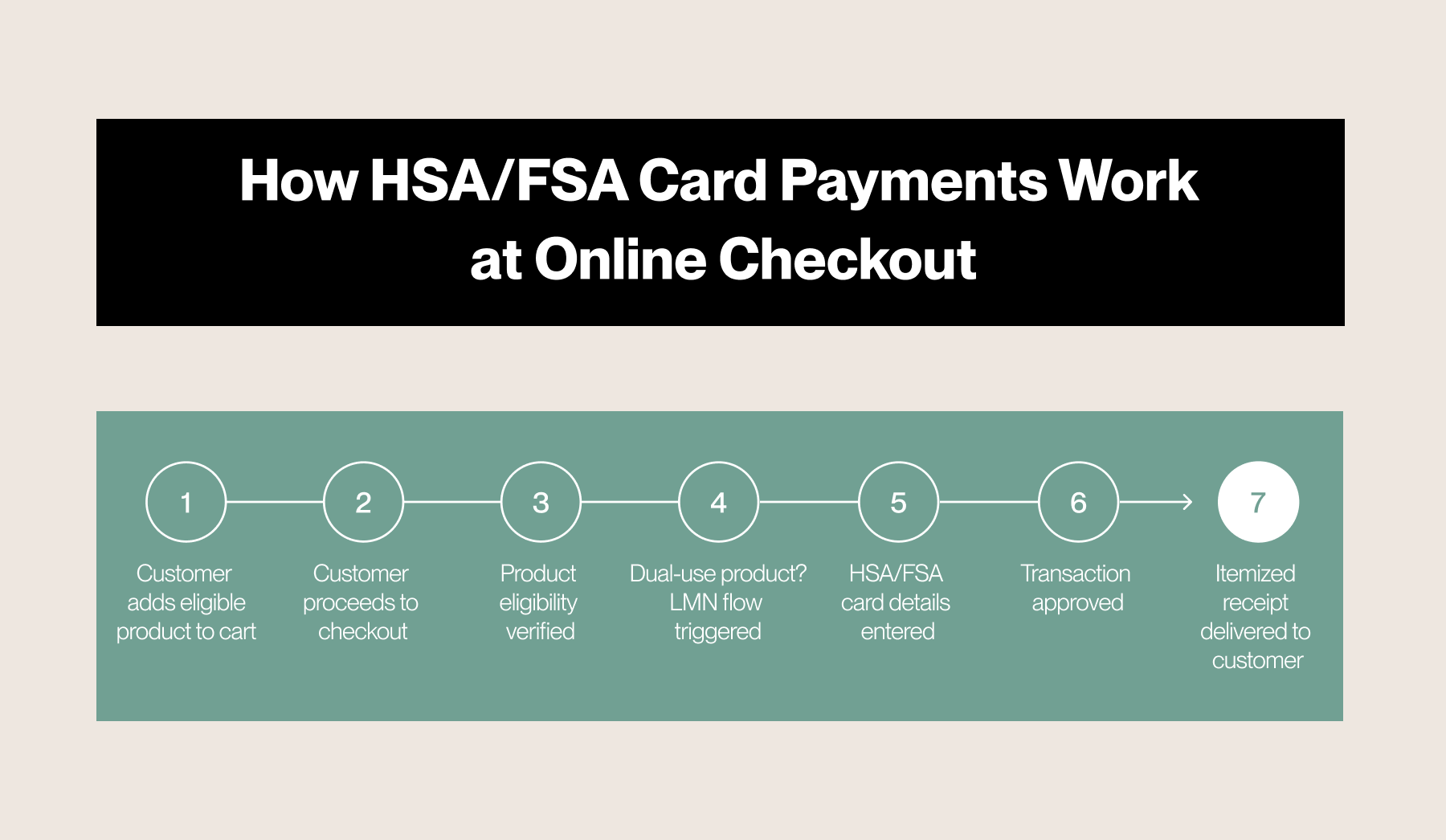
Paying With an HSA/FSA Card at Checkout
In this model, customers use their HSA/FSA cards directly during checkout. So your customers would see “Truemed - Pay with HSA/FSA” listed as one of the payment options.
This option requires integration with a payment processor like Truemed which creates a smoother shopping experience while giving you access to roughly $70 billion in pre-tax spending for qualifying customers.
Pay-and-Reimburse Workflows
Some workflows allow customers to purchase products using a standard debit or credit card, then submit documentation for reimbursement through their HSA/FSA administrator afterward.
This model is common in ecommerce because many products require substantiation before reimbursement approval.
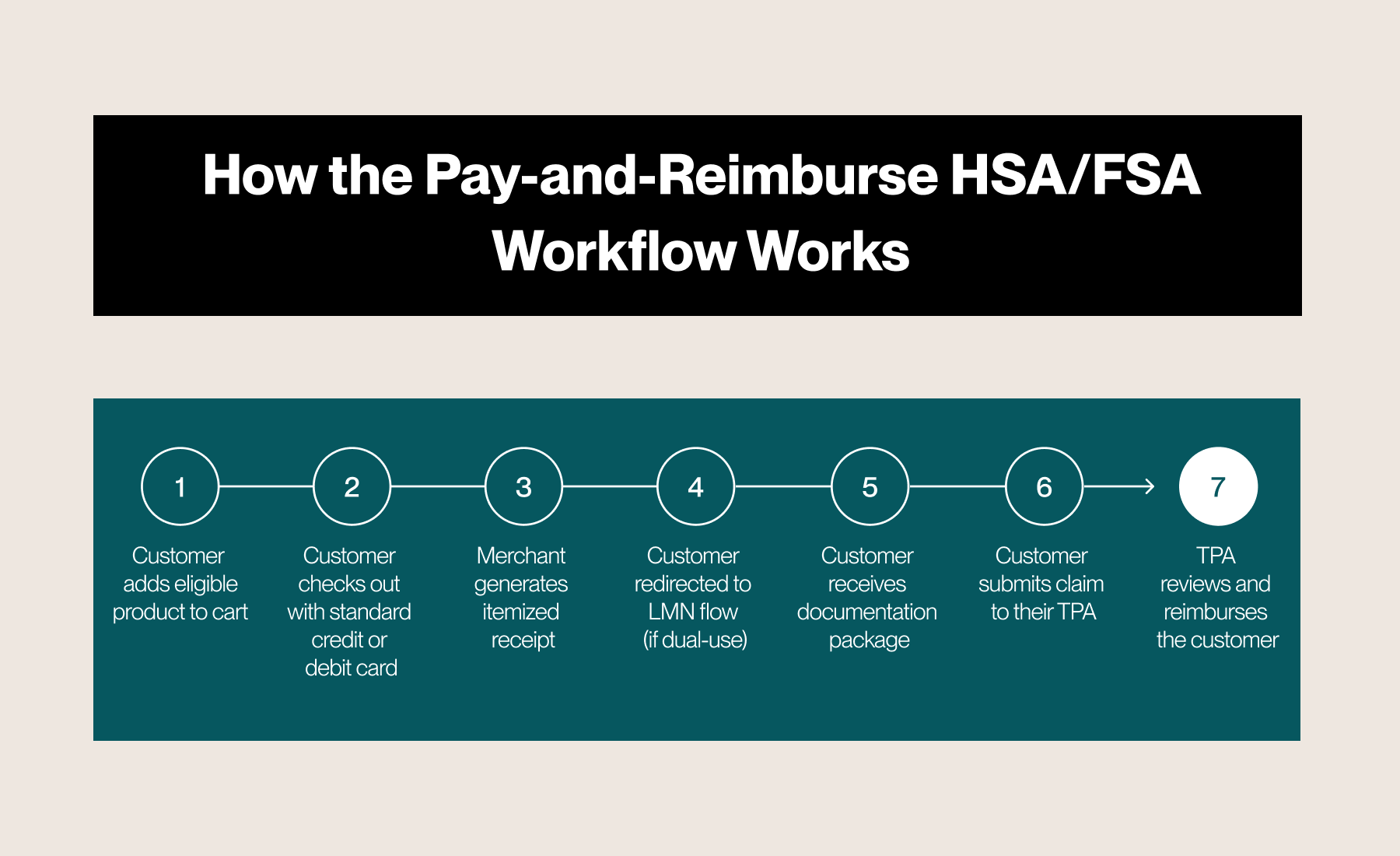
At Truemed, we offer both checkout flows. We can integrate with your ecommerce store to process the payment and facilitate the LMN process as part of the checkout process. Or, you can use our LMN flow which sends your customer to Truemed to complete a health survey for an LMN, which they can submit to their Third Party Administrator (TPA) for a reimbursement.
Why Ecommerce HSA/FSA Payments Are More Complex Than Retail
Retail pharmacies often rely on barcode-level systems and tightly controlled inventories which either includes a health related MCC or an IIAS system.
Ecommerce environments on the other hand are different because ecommerce stores frequently sell mixed carts, bundle options, subscriptions, and dual- use products.
Platforms like Shopify also have limitations around native eligibility validation and checkout-level healthcare logic. Ecommerce platform restrictions means that many merchants have to rely on third-party integrations to manage eligibility reviews, reimbursement support, compliance workflows, and even payment processing.
Refund handling adds another layer of complexity which means that you’ll need systems capable of managing reversals, reimbursements, and transaction tracking while maintaining accurate documentation.
IRS Compliance Requirements Ecommerce Brands Must Understand
Understanding HSA/FSA payment rules for merchants is one of the biggest concerns for founders, finance teams, and legal stakeholders considering HSA/FSA enablement.
At a basic level, you should understand the rules around qualified medical expenses, which is to say you’ll need to know what a qualified medical expense is and whether your products meet the criteria from the IRS.
You’ll also need to understand what systems and processes you need to have in place to accept payments, while remaining compliant. Depending on what products you sell this could include a health-related MCC, an IIAS with a SIGIS registration, or a simple checkout flow that includes a health survey for LMN’s.
Finally you’ll need to understand what your documentation and audit obligations are. Aside from keeping transaction records, you’ll also need to keep itemized receipts, LMN’s, returns and exchange records, and SKU eligibility data to prove your products were HSA/FSA eligible.
Proper documentation matters because HSA/FSA transactions may be audited by plan administrators or the IRS, meaning that product verification and document retention are two of the major compliance requirements you’ll need to address.
Common Mistakes Ecommerce Brands Make
One of the most common mistakes is marketing products as HSA/FSA eligible without proper substantiation processes or marketing items as eligible when they’re not. It’s best practice to tag items individually to avoid confusing your customers and causing an unpleasant shopping experience.
Other frequent issues typically include:
- unclear documentation workflows
- poor customer education
- inadequate receipt formatting
- unsupported mixed-cart checkouts
- hidden transaction costs from providers
- low approval rates that frustrate customers
Some brands also assume that enabling HSA/FSA payments alone will drive growth. In reality, the strongest results often come from combining payment enablement with marketplace visibility and substantiation support. Truemed, for example, offers you the option to accept HSA/FSA cards at checkout while also including an LMN process in the checkout flow. To top it all off, you also get access to a marketplace where health-conscious shoppers can discover that your products may be HSA/FSA eligible.
FAQ
Yes. Ecommerce stores can accept HSA/FSA payments if they sell qualifying products and have a compliant payment and substantiation workflow in place.
Not always. IIAS is more common in retail pharmacy environments while many ecommerce brands use reimbursement and eligibility verification workflows instead.
Yes, although Shopify has limitations around native eligibility validation and mixed-cart handling.
Some common causes include mixed carts, MCC mismatches, insufficient substantiation, and plan administrator restrictions.
Some supplements may qualify if they can be used to treat or mitigate a medical condition but they will need to be supported by an LMN.





Editorial Standards
At True Medicine, Inc., we believe better health starts with trusted information. Our mission is to empower readers with accurate and accessible content grounded in peer-reviewed research, expert insight, and clinical guidance to make smarter health decisions. Every article is written or reviewed by qualified professionals and updated regularly to reflect the latest evidence. For more details on our rigorous editorial process, see here.