
How to Become HSA/FSA Eligible: A Complete Guide for Merchants
Author:Anna Meyer
Published:
May 15, 2026
Last Updated:
September 10, 2026



Key Takeaways
HSA/FSA eligibility is a revenue lever, not just a payment option: Customers using pre-tax dollars effectively get an average ~30% discount without merchants discounting their products, which drives 15–30% AOV lifts and unlocks access to the ~37% of Americans holding HSA/FSA funds (roughly $72B in annual pre-tax spending).
Eligibility depends on product category and IRS classification: Products fall into three buckets: clearly eligible medical products, dual-use products (like supplements or fitness programs), and non-eligible products. Dual-use items typically require a Letter of Medical Necessity tying the purchase to a specific health condition.
There are four main paths to accepting HSA/FSA payments: The right one depends on what you sell: a health-related Merchant Category Code (MCC) for providers like pharmacies and clinics, the 90% rule for pharmacies whose receipts are mostly qualified medical expenses, an IIAS (Inventory Information Approval System) registered through SIGIS for non-dual-use eligible products, or a third-party platform like Truemed for dual-use products that need documentation workflows.
Compliance is ongoing, not a one-time setup: Merchants are responsible for substantiating every transaction with itemized receipts and, where needed, Letters of Medical Necessity. Records must be maintained for potential IRS audits (especially on the FSA side), and failure to comply can lead to denied transactions, lost sales, and reputational damage.
Key Takeaways
What Does HSA/FSA Eligibility Mean for Businesses?
Why Becoming HSA/FSA Eligible Matters for Your Business
What Makes a Product or Service HSA/FSA Eligible?
Step-by-Step: How to Become HSA/FSA Eligible
IRS Substantiation Requirements for Businesses
Real-World Examples of HSA/FSA Eligibility
FAQ
Talk to Sales
Ready to unlock HSA/FSA payments for your business?
What Does HSA/FSA Eligibility Mean for Businesses?
At a basic level, HSA and FSA eligibility allows qualified customers to use pre-tax dollars to purchase your products or services.
To offer HSA/FSA payment options, your products or services must meet IRS eligibility criteria and your checkout and compliance systems must support substantiation. To substantiate HSA/FSA purchases, you’ll need to validate that purchases are qualified medical expenses and provide documentation to prove the same. These substantiation documents typically include itemized receipts and Letters of Medical Necessity, depending on the products or services purchased.
As a merchant, eligibility means unlocking a new payment channel backed by pre-tax dollars.
Why Becoming HSA/FSA Eligible Matters for Your Business
HSA/FSA eligibility changes how customers think about price.
When customers use pre-tax dollars, they are effectively getting a 30 percent discount on average*, without you lowering your price.That shift alone can increase conversion rates.
*Truemed is for qualified customers. HSA/FSA tax savings vary. Learn more at truemed.com/disclosures.
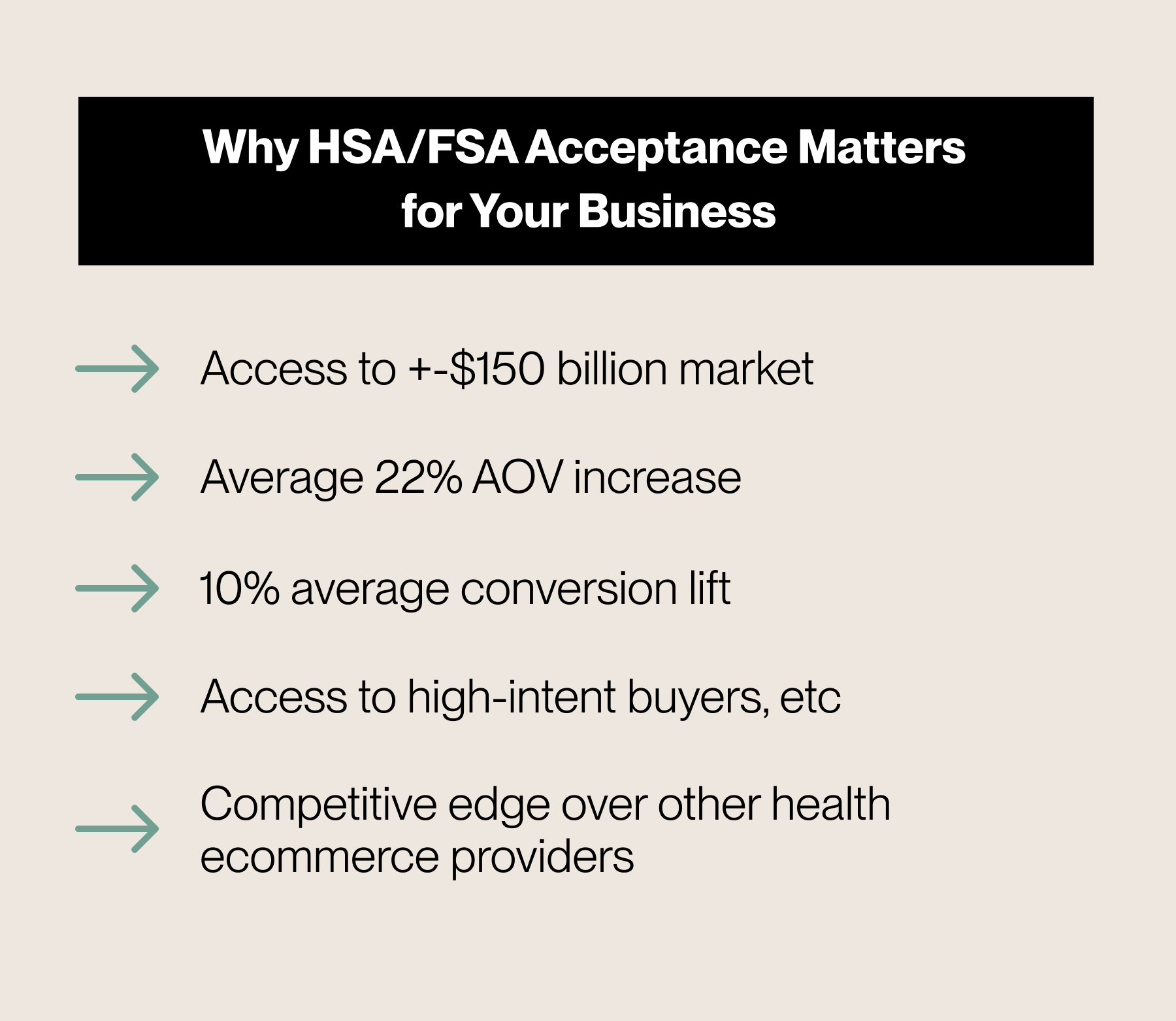
There are also several measurable revenue impacts:
- Higher average order value: Customers who have the option to pay with HSA/FSA cards, tend to buy more and choose higher-priced options. This translates to an average AOV lift of 15% to 30%.
- Access to new demand: Roughly 37 percent of Americans have an HSA or FSA, representing about $174 billion in assets and around $72 billion in annual pre-tax spending.
- Incremental acquisition: Businesses who are focused on FSA shoppers bring in customers who are already looking to spend these funds since FSA funds don’t roll over.
For many brands, this becomes a growth channel rather than just a payment option.
What Makes a Product or Service HSA/FSA Eligible?
The IRS defines eligible expenses as those used to diagnose, treat, mitigate, or prevent a medical condition.
Some products are clearly eligible, such as medical devices or first aid supplies while others fall into a gray area, especially dual-use products like supplements or fitness programs.
In those cases, eligibility often depends on how the product is used, not just what it is.
If a product is broadly medical, it may qualify directly but if it has both general and medical uses, it may require additional documentation such as a Letter of Medical Necessity.
For a deeper breakdown of IRS rules, read our IRS Requirements for HSA and FSA Purchases guide.
But how do you get your product HSA/FSA approved?
Step-by-Step: How to Become HSA/FSA Eligible
Step 1: Determine Your Eligibility
IRS HSA/FSA eligibility depends on whether your product or service has a clear medical purpose or can be used to treat, cure, or mitigate a health condition. So your first step is to categorize your product range into one of three categories:
- Clearly eligible medical products
- Dual-use products
- Non-eligible products
This step is critical for both compliance and commercial planning because it determines how much of your catalog can realistically be unlocked.
Eligibility is only one piece of the puzzle though.
Step 2: Align With IRS HSA/FSA Eligibility Rules
Once you’ve categorized your products you need to validate each product against the IRS’s eligibility criteria. Publication 502 from the IRS provides the full criteria to validate your products but you can also check if your products are on the eligibility list we’ve put together.
This step is more about dotting the i’s and crossing the t’s to ensure you don’t face compliance issues and penalties later on.
Step 3: Identify If You Need MCC Code, 90% Registration, IIAS, or a Third-party Platform
Depending on what you offer, you’re either going to need a Merchant Category Code (MCC), a 90% rule exemption, an Inventory Information Approval System (IIAS) set up, or a third party platform to handle the documentation workflow.
MCC’s are for businesses like doctors, dentists, vision care offices, hospitals, pharmacies, and other healthcare providers. If you fall into this category your payment provider will assign this code to you, but you’ll need to ensure that you’ve been classified correctly.
If you’re a pharmacy, you can also register for the 90% rule which states that you can accept HSA/FSA cards if 90% of your store’s gross receipts during the prior taxable year, were qualified medical expenses.
If you don’t fall into either of these categories but you sell products that are eligible, you can opt for an Inventory Information Approval System (IIAS). This system validates in real time whether products purchased with FSA/HSA cards are eligible health expenses. Keep in mind these products can’t be dual-use products and you’ll need to register with the Special Interest Group for IIAS Standards (SIGIS) in order to use an IIAS.
And finally, if you sell dual-use products you’ll need to manually substantiate the products or partner with a platform like Truemed to handle the documentation workflows for you. Partnering with a platform like Truemed allows you to accept HSA/FSA payments without registering with SIGIS ,and setting up an IIAS system.
This option is ideal if you predominantly sell dual-use products that need Letters of Medical Necessity.
Step 4: Register With SIGIS (Optional)
The Special Interest Group for IIAS Standards, known as SIGIS, manages the ecosystem for HSA/FSA retail compliance. This means if you plan to use IIAS you’ll need to register with SIGIS first.
You can skip this step if you’re planning on using a dedicated payment processor like Truemed or have a health-related MCC.
Step 5: Implement IIAS or an Alternative Solution
The Inventory Information Approval System allows eligible items to be automatically approved at checkout and without it most transactions will require manual substantiation, which creates friction for customers. An IIAS is typically implemented by payment processors, POS system providers, and third-party compliance vendors.
If you don’t want to use an IIAS, you can use alternative solutions that handle eligibility and documentation without requiring full IIAS implementation. Ideally you want a platform like Truemed that can also streamline your LMN process in addition to verifying eligibility.
Step 5: Submit Products to the Eligible Product List (EPL)
If you’re using an IIAS you’ll need to add your eligible products to the EPL so they can be recognized at checkout. Keep in mind that this step only applies if you are using an IIAS system.
Step 6: Enable HSA/FSA Payments at Checkout
Options to enable HSA/FSA payments at checkout will depend on whether you have an MCC, 90% rule exemption, or IIAS. If your business has a health-related MCC or you registered for the 90% rule, you’ll be able to automatically process HSA/FSA cards using a payment processor like Stripe.
If you’re using an IIAS (without 90% exemption), you’ll need to register with Visa and Mastercard to enable auto-substantiation and then contact your payment processor to set up HSA/FSA payments as an option.
If you don’t have a health MCC or meet the 90% rule requirement, and you don’t want to use an IIAS, you’ll need to partner with a dedicated HSA/FSA payment processor like Truemed to handle the payments for you.
The goal here is a checkout experience that feels no different from a standard card payment.
Step 7: Ensure Ongoing Compliance and Recordkeeping
Eligibility is not a one-time setup. You’ll need to maintain accurate product classifications, store transaction records, and ensure that you can provide the necessary documents for IRS audits. And if you use an IIAS you’ll need to submit new products to the EPL as you add them to your store.
IRS Substantiation Requirements for Businesses
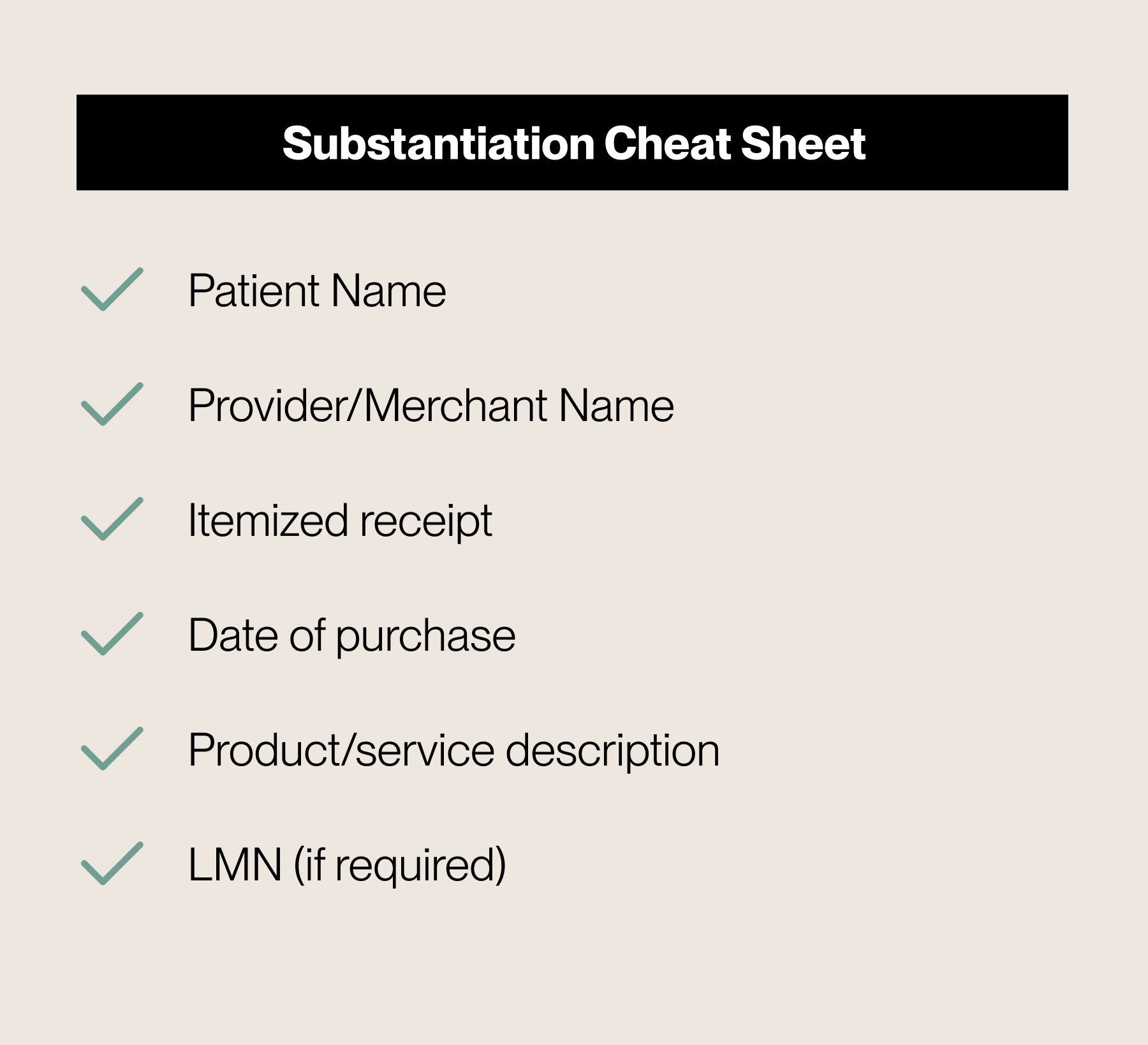
The IRS requires that all HSA/FSA transactions be substantiated which means you must be able to prove that each purchase qualifies as a medical expense.
Your main responsibilities as a merchant is to implement systems that confirm eligibility prior to purchase and to maintain accurate records for each transaction. Your records should include an itemized receipt with the product details, customer details, and your company details. Where necessary you’ll also need to keep Letters of Medical Necessity.
In the case of FSA purchases, you’ll need to ensure that you are prepared to provide your purchase records and eligibility documents in the event of an IRS audit.
Typically merchants aren’t audited for HSA purchases. However, keeping purchase records and LMN’s on hand for HSA purchases may improve your customer’s brand experience if they are audited and don’t have copies to provide the IRS.
Failure to meet these requirements can result in rejected transactions or compliance issues which could tarnish your reputation, affect your ability to accept FSA payments, and cause sales losses.
Real-World Examples of HSA/FSA Eligibility
Many modern health brands are using HSA/FSA eligibility as a growth lever, with over 3000 brands partnering with Truemed to unlock HSA/FSA payments at checkout.
Here are two brands that have successfully unlocked HSA/FSA eligibility for their customers:
Apothékary
In 2024, herbal supplements brand Apothékary, partnered with Truemed to enable HSA/FSA payments for their online store. Being a supplement brand that sells mostly dual-use products, they needed support with both the eligibility validation process and the payment processing aspect. By the end of Q1, they saw a 122% increase in sales, showing the impact of HSA/FSA payment acceptance on revenue. By combining eligibility, documentation, and access to pre-tax spending, the partnership transformed HSA/FSA from a passive benefit into a meaningful revenue driver.
Amazfit
Amazfit, a leading smart wearable brand, also partnered with Truemed to unlock the purchasing power of HSA/FSA cards. By enabling eligibility through Truemed’s documentation workflow, Amazfit allowed customers to use pre-tax dollars for products that support health tracking and preventative care. Within months of implementation, the brand saw a 32% increase in average order value, with Truemed transactions accounting for 14% of direct online revenue.
These are just two examples out of thousands of brands who chose increased revenue, improved compliance, and access to a dedicated marketplace.
FAQ
No. Products must meet IRS criteria for medical expenses and products that are considered dual-use may require a Letter of Medical Necessity.
Timelines vary depending on your setup. Basic implementations can take less than a week while full IIAS integration may take longer. It also depends on which payment provider you partner with.
Not always. IIAS is required for automated approval of certain products for non-healthcare brands, but alternative solutions can support eligibility through documentation workflows.
Yes, but usually only with a Letter of Medical Necessity tied to a specific condition. For example, a Vitamin D supplement may be HSA/FSA eligible if your customer has a diagnosed Vitamin D deficiency and a letter from their healthcare provider confirming the same.
Transactions may be denied, and your business could face compliance risks if proper documentation is not maintained.



Editorial Standards
At True Medicine, Inc., we believe better health starts with trusted information. Our mission is to empower readers with accurate and accessible content grounded in peer-reviewed research, expert insight, and clinical guidance to make smarter health decisions. Every article is written or reviewed by qualified professionals and updated regularly to reflect the latest evidence. For more details on our rigorous editorial process, see here.