
The 10 Best Magnesium Supplements of 2026
Author:Jennifer Chesak
Reviewed By:Michaela Robbins, DNP
Published:
April 24, 2026
Last Updated:
October 06, 2026
Truemed writers and editors independently evaluate all our product recommendations. If you make a purchase through any affiliate links we provide, we may receive compensation. Learn more.



Key Takeaways
Magnesium is essential: Magnesium supports hundreds of enzymatic reactions involved in processes including muscle and nerve function, blood pressure, glucose metabolism, bone health, and energy production.
The best form depends on your goals: Different forms of magnesium have different absorption rates and effects, so the right supplement depends on why you’re taking it.
10 HSA/FSA-eligible options: We’ve rounded up 10 magnesium supplements that may be eligible for HSA/FSA spending when used to address a specific medical condition and applicable requirements are met.
Magnesium is a magnificent mineral that’s necessary for hundreds of enzymatic reactions in the body. It’s not an optional nutrient — it’s essential. But nearly one-third of people globally don’t consume enough magnesium through their diet and are deficient.
And not all magnesium is the same. With several forms available, choosing the right supplement can be confusing.
In this guide, we’ll cover the best magnesium supplements, the benefits of different forms, and what to consider when choosing one.
How to Choose the Best Magnesium Supplement
The best magnesium supplement for you will depend on why you are considering adding more magnesium. Each type of magnesium has a different absorption level.
“One type isn’t necessarily best overall,” says Avery Zenker, MAN, RD, a contributor for MyCrohn’sAndColitisTeam. “But each type is best for different scenarios. The best type of magnesium depends on the individual, their goals and preferences, and their health status.”
For example, if you’re choosing a magnesium supplement to relieve constipation, you’ll want a form of the mineral with poor absorption, so that more of it stays in your gut. Conversely, if you’re choosing a magnesium supplement to counteract a deficiency or borderline deficiency, you’ll want a form that’s highly absorbed.
The best course of action is to check whether supplementation is right and safe for you and to get a recommendation from your doctor. But below, we explore some of the common reasons for supplementation and what you need to know about magnesium type.
Top 10 HSA/FSA Eligible Magnesium Supplements for 2026
We pulled together this list of clinically-backed magnesium brands, in no particular order, so you can easily explore the different magnesium products that may fit your needs.
AlgaeCal describes this product as formulated to calm the nervous system and support restful sleep.
- Best for: Sleep-related magnesium needs
- Why it qualifies: May be eligible with an LMN for diagnosed sleep disorders or documented magnesium deficiency
A chelated glycinate formula that We Heart Nutrition describes as absorption without digestive discomfort.
- Best for: Sleep and muscle function support
- Why it qualifies: May be eligible with an LMN for muscle cramps, sleep disorders, or magnesium deficiency
Combines three bioavailable forms — glycinate, citrate, and amino acid chelate — at 400mg per serving.
- Best for: Higher-dose, multi-form supplementation
- Why it qualifies: May be eligible with an LMN for magnesium deficiency or muscle-related conditions
A bis-glycinate tablet that Metagenics describes as designed for daily use.
- Best for: Sensitive stomachs and daily maintenance dosing
- Why it qualifies: May be eligible with an LMN for diagnosed sleep-wake cycle disruption or muscle-related conditions
Combines five bioavailable forms of magnesium in one formula.
- Best for: Broad-spectrum magnesium support
- Why it qualifies: May be eligible with an LMN for magnesium deficiency, digestive conditions, or sleep disorders
A practitioner-brand formula combining two chelated forms of magnesium for bioavailability.
- Best for: Customers already working with a practitioner on supplementation
- Why it qualifies: May be eligible with an LMN for documented magnesium deficiency
Pairs magnesium bisglycinate with organic lemon balm extract.
- Best for: Sleep and muscle relaxation with a botanical component
- Why it qualifies: May be eligible with an LMN for diagnosed sleep disorders
A vegan formula combining four types of magnesium.
- Best for: Vegan customers and digestive support
- Why it qualifies: May be eligible with an LMN for IBS or other diagnosed digestive conditions
Uses Magtein, a form of magnesium studied for its ability to cross the blood-brain barrier. NSF Certified for Sport.
- Best for: Athletes and customers focused on cognitive support
- Why it qualifies: May be eligible with an LMN for diagnosed cognitive or sleep-related conditions
A whole-food, plant-based magnesium sourced from an organic sea vegetable complex.
- Best for: Customers who are looking for whole-food supplement sources
- Why it qualifies: May be eligible with an LMN for magnesium deficiency or muscle-related conditions
Magnesium Supplement Comparison
| Supplement | Magnesium Form | Best for |
|---|---|---|
| AlgaeCal Magnesium Relax | Blend | Sleep support |
| We Heart Nutrition Wholesome Magnesium Glycinate | Glycinate | Sleep + muscle function |
| JSHealth Advanced Magnesium+ | Glycinate, citrate, amino acid chelate | Higher-dose support |
| Metagenics Magnesium Glycinate 100mg | Glycinate | Sensitive stomachs |
| Just Ingredients Magnesium Complex | 5-form blend | Broad-spectrum support |
| Designs for Health Magnesium Glycinate Complex | Glycinate blend | Practitioner-guided use |
| Promix Relax: Magnesium Complex | Bisglycinate + lemon balm | Sleep + relaxation |
| WeNatal Rest + Digest Magnesium | 4-form blend | Vegan + digestive support |
| Momentous Magnesium L-Threonate | L-Threonate (Magtein) | Cognitive support, athletes |
| Triquetra Plant Magnesium | Whole-food, plant-based | Whole-food preference |
Top Magnesium Benefits
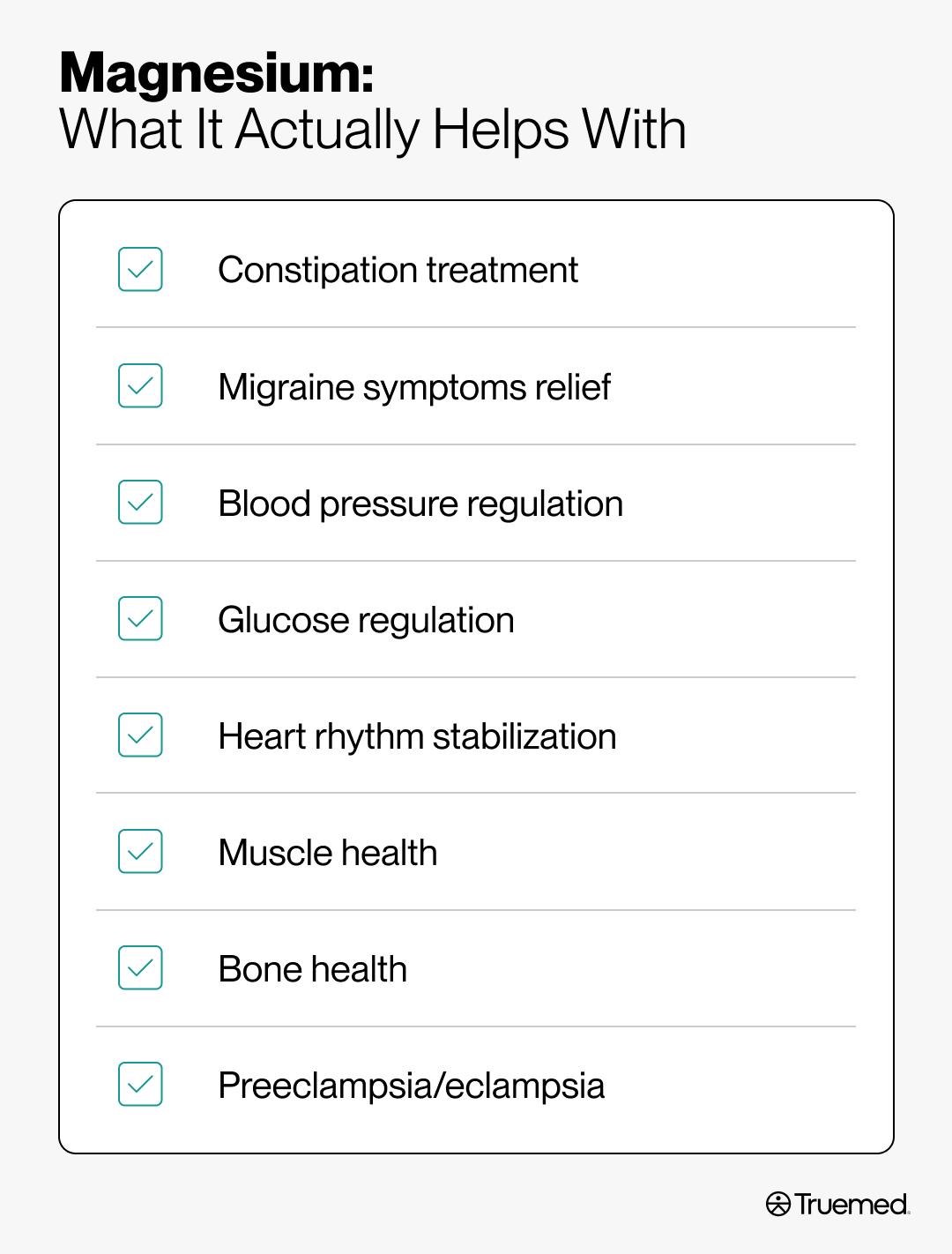
The evidence for magnesium supplementation is strongest for the following benefits.
- Constipation treatment: Some forms of magnesium help draw water into the intestines to soften stool and stimulate a bowel movement.
- Migraine symptoms relief: Magnesium may help reduce migraine attack frequency and symptom severity. It helps prevent the overactivation of excitatory neurotransmitters in the brain and may combat neuroinflammation, among other processes.
- Blood pressure regulation: Magnesium may help relax the muscles in your artery walls, which can encourage better blood flow and alleviate pressure.
- Glucose regulation: Type 2 diabetes is associated with magnesium deficiency. Research suggests that supplementation may help lower fasting blood sugar and boost insulin sensitivity.
- Heart rhythm stabilization: Magnesium is crucial for supporting your heart’s electrical activity. Some research suggests that supplementation may play a role in managing heart arrhythmias. However, more research needs to be done, and using magnesium for this purpose requires a conversation with your doctor.
- Muscle health: Magnesium supports muscle by aiding with muscle mass, muscle strength, and exercise recovery.
- Preeclampsia/eclampsia: Preeclampsia is a complication that can arise in pregnancy, leading to dangerously high blood pressure and even organ damage. Eclampsia is when the condition progresses to include seizure or even coma. Magnesium is used as a potential treatment. But this should only be done under the care of a health care provider.
Comparing Common Forms of Magnesium
The different forms of magnesium can make choosing a type a bit overwhelming. The table below lists magnesium types, ranging from the least absorbed to most, along with best use cases.
| Type | Absorption/bioavailability | Best uses |
|---|---|---|
| Magnesium Oxide | Low | Constipation, migraine prevention |
| Magnesium Carbonate | Low (orally), high (intravenously) | Constipation (when taken orally) might be given intravenously for eclampsia |
| Magnesium Citrate | Moderate | Constipation, migraine prevention, general magnesium supplementation |
| Magnesium Orotate | Moderate | Heart health, glucose metabolism |
| Magnesium Malate | Moderate | Muscle support |
| Magnesium L-Threonate | Moderate (brain-accessible) | Cognitive support, brain health |
| Magnesium Glycinate | High | Magnesium deficiency,muscle health,support |
| Magnesium Chloride | High | Magnesium deficiency |
Magnesium oxide
“Magnesium oxide has low bioavailability, meaning that only a small amount of what you consume is actually absorbed,” says Zenker. “Because it’s poorly absorbed, it creates an osmotic gradient that pulls more water into the intestines, which moistens and softens stool. This makes it helpful for promoting normal bowel movements and combating constipation.”
Magnesium glycinate
Magnesium glycinate comes out on top for combating a magnesium deficiency and supporting muscle health and mental health. “It’s well-absorbed by the body and gentle on the stomach, meaning it’s less likely to cause digestive issues like diarrhea,” says Rachael Ajmera, MS, RD, and founder of nutrimental.
Learn more about the differences between these forms in our guide to Magnesium Glycinate vs. Citrate.
Magnesium L-threonate
Magnesium L-threonate shows benefit in research for supporting sleep and cognitive function. “It’s been studied specifically for its ability to cross the blood-brain barrier and is often used to improve memory, brain function, and sleep quality,” Ajmera adds.
Safety, Side Effects, Interactions, and When to Seek Care
Magnesium supplementation does require some safety considerations. Talking to your provider before adding any supplement to your routine is a good idea. This is especially true if you have underlying conditions or take medications.
“Magnesium supplements may interact with certain medications like diuretics, antibiotics, or proton pump inhibitors,” Zenker explains.
“Taking excessive magnesium [in] supplemental form can cause diarrhea, nausea, and abdominal cramping in some individuals,” adds Grecea. “Very high doses can lead to toxicity, which can cause low blood pressure, vomiting, difficulty breathing, irregular heartbeat, cardiac arrest, and others as well.”
How It Works with Truemed
You might be able to purchase a magnesium supplement with your HSA or FSA dollars. Magnesium supplements might be eligible expenses for these health benefit accounts if you’re using the product to address a specific medical condition. If approved by an independent licensed clinician, such conditions might include the following: migraine, chronic constipation, and more.
You might need a letter of medical necessity (LMN). An LMN is a formal document from a licensed healthcare provider that explains why a certain product, treatment, or service is necessary to treat, mitigate, or prevent a medical condition.
Certain health products and services may be eligible for qualified customers with an LMN issued by an independent practitioner when the item is used to address a specific medical condition.
Truemed* specializes in helping you maximize your HSA and other health-related benefits (such as an FSA):
- First, you can check whether a product or service is normally considered a qualifying medical expense or whether you might need an LMN.
- Complete a health intake survey that will be reviewed by an independent licensed clinician.
- Buy the item; either pay directly with your HSA/FSA card at checkout, or pay with a regular credit/debit card and seek HSA/FSA reimbursement afterward.
- The independent licensed practitioner will review your medical history, and if you qualify, will issue an LMN. Truemed itself does not make eligibility determinations.
- Truemed also offers support in the event you get a denial of reimbursement and need to provide substantiation documentation.
*Truemed is for qualified customers. HSA/FSA tax savings vary. Learn more at truemed.com/disclosures
FAQ
You can get enough magnesium through your diet to support your body’s needs. However, some people take magnesium supplements if they need extra magnesium to help manage chronic conditions. These might include irritable bowel syndrome with constipation (IBS-C), migraine, postural orthostatic tachycardia syndrome (POTS), and more. Additionally, highly active people or those who spend time in the heat, may need extra magnesium, since it is an electrolyte that can be lost through sweat.
Any time you’re considering adding a new supplement to your routine, you should talk to your healthcare provider about it. This is especially true if you have underlying conditions or take medications. Magnesium can interact with certain medications.
NIH's Office of Dietary Supplements recommends 400-420 mg per day for adult men and 310-320 mg per day for adult women, with slightly higher amounts recommended during pregnancy. The daily upper limit from supplements and medications alone is 350 mg for adults; talk to your practitioner before exceeding it.
Yes, you can take magnesium every day, provided your doctor has given you the go-ahead to do so and you keep your total daily intake from diet and supplements within safe upper limits.





See what you can do with your HSA/FSA.
Join 1.5 million Americans who have routed their healthcare dollars toward root cause health via Truemed's HSA/FSA marketplace.
New product announcements
Sales and special offers
Tips for utilizing your HSA/FSA
Editorial Standards
At True Medicine, Inc., we believe better health starts with trusted information. Our mission is to empower readers with accurate and accessible content grounded in peer-reviewed research, expert insight, and clinical guidance to make smarter health decisions. Every article is written or reviewed by qualified professionals and updated regularly to reflect the latest evidence. For more details on our rigorous editorial process, see here.