
Vibration Plate Benefits: Do These Cool Gadgets Really Help?
Author:Kathleen Ferraro
Reviewed By:Michaela Robbins, DNP
Published:
June 14, 2026
Last Updated:
August 04, 2026
Truemed writers and editors independently evaluate all our product recommendations. If you make a purchase through any affiliate links we provide, we may receive compensation. Learn more.


Key Takeaways
There are several potential benefits to vibration plates: They may help support balance, muscle activation, circulation, mobility, and low-impact movement, but the evidence is mixed depending on the goal and the person using them.
Research is mixed: Evidence is strongest for things like balance, physical function, and movement support rather than dramatic weight-loss or “passive exercise” claims.
Vibration plates aren't a magic fix: Vibration plates generally work best when paired with regular exercise and realistic expectations, not used as a standalone fitness solution.
Start small: Starting with shorter, lower-intensity sessions can help reduce the risk of dizziness, discomfort, or balance issues.
You could use HSA funds: For qualified customers, certain vibration plates may be eligible for HSA/FSA spending through Truemed.
Key Takeaways
Vibration plate benefits: what they may help with
What does a vibration plate do in the body?
Do vibration plates work? What the evidence actually says
Who may benefit most from vibration plate exercise
Risks, limits, and when to be cautious
How to use a vibration plate safely and realistically
Recommended Truemed products related to vibration plates
How it works with HSA/FSA and Truemed
Compliance & documentation
Bottom line
Deep dive recommendations
FAQ
Shop Eligible Products
Ready to unlock your HSA/FSA funds for qualified medical expenses?
Vibration plates seem to promise everything: better circulation, stronger muscles, weight loss, recovery, and improved balance. But when it comes to vibration plate benefits, the reality is more middle-of-the-road.
Whole-body vibration plates may help support things like muscle activation, weight loss, balance, mobility, recovery, and circulation for some people (particularly when they’re used consistently alongside regular exercise). But the research is mixed. Some claims are much stronger than others, and not every vibration plate is built the same.
In this article, we’ll break down what vibration plates actually do, where the evidence looks strongest, who may benefit most, and how HSA/FSA eligibility may work for qualified customers through Truemed.
Vibration plate benefits: what they may help with
Research on the benefits of vibration plates is mixed. But there are a few areas where the evidence looks more promising than others, according to Clarissa Aguirre, PT, DPT, a licensed and board-certified physical therapist.
These potential benefits include:
- Muscle activation and strength support: The rapid vibrations force your muscles to repeatedly contract to keep you stable. This can dial up muscle activation, potentially increasing muscular engagement during exercises like squats, lunges, and planks.
- Balance and stability: Whole-body vibration may help challenge balance and proprioception (your body’s awareness of where it is in space), particularly for older adults or those seeking lower-impact movement options.
- Circulation support: All those tiny muscle contractions may help get your blood pumping, “enhancing circulation for oxygen delivery throughout the body,” says Aguirre. That’s why some people like vibration plates for recovery or post-workout soreness, though the long-term effects still aren’t totally clear.
- Flexibility and muscle relaxation: The vibrations may help relax tight muscles by repeatedly contracting and releasing them. Research here is still fairly limited, but some studies suggest whole-body vibration may modestly improve flexibility and mobility.
- Gentle movement support: Vibration plates may offer a lower-impact way to challenge muscles and stability without the joint stress of activities like running. That may make them more realistic for older adults, people recovering from injuries, or anyone who struggles with higher-impact workouts.
- Digestive support: Some people swear vibration plates help get things moving in the morning, and there may be some science to back it up. Limited research suggests whole-body vibration could help stimulate intestinal movement to relieve constipation, though the study is older and far from definitive.

There are also a few areas where the marketing gets ahead of the science. Research on long-term weight loss, metabolism, and major body composition changes remains mixed overall. Some studies show modest benefits, while others show very little difference.
Bone health is another big one. While researchers are exploring whether vibration training could help support bone density in certain populations, the evidence is still far from strong enough to treat vibration plates like some kind of osteoporosis shortcut.
What does a vibration plate do in the body?
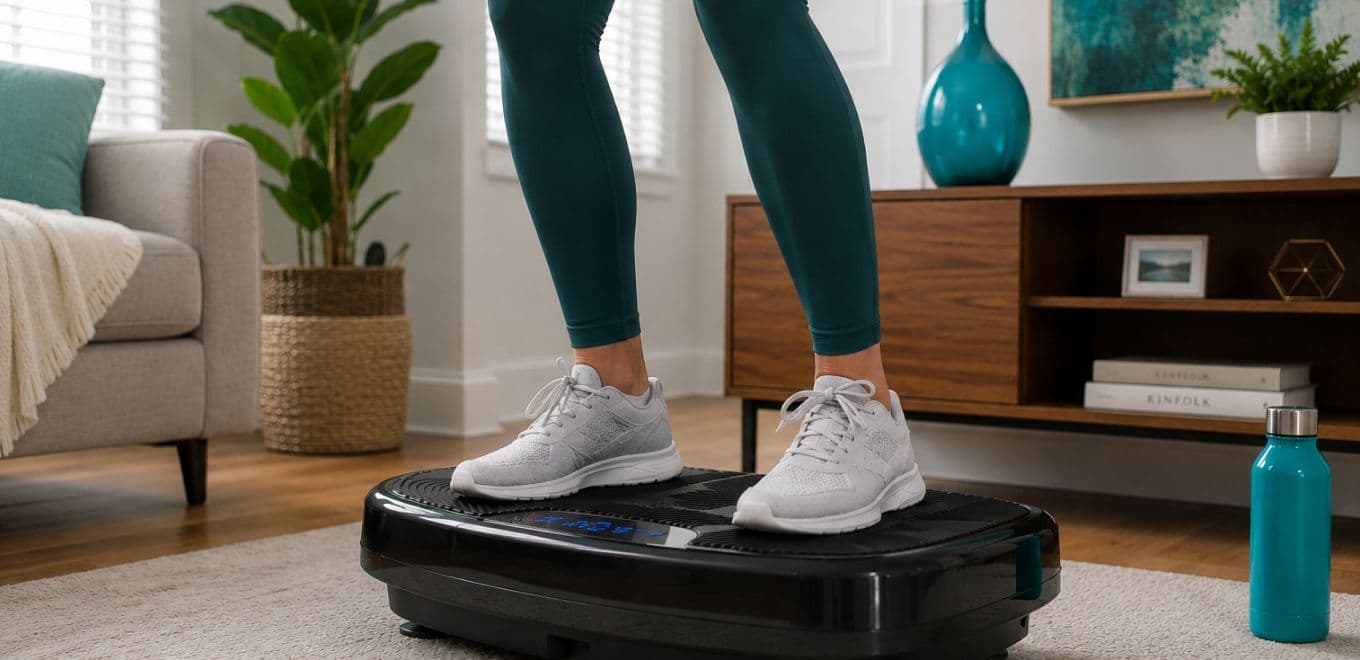
Vibration plates create rapid vibrations that force your muscles to repeatedly contract and relax in order to keep you stable. Even if you’re simply standing on the platform, your body is constantly making tiny adjustments to keep you balanced, explains Aguirre.
Over time, that repeated muscle activation may support things like balance, circulation, muscle engagement, and physical function.
But not all vibration plate workouts are the same. The intensity depends on things like:
- Frequency: How fast the platform vibrates
- Amplitude: How far the platform moves
- Duration: How long you stay on the plate
- Stance and posture: Whether you’re standing, squatting, planking, lunging, etc.
- Plate type: Some platforms move up and down, while others oscillate side to side
That’s part of why the research can feel inconsistent: Studies use different vibration settings, workout styles, session lengths, and groups of people. It also explains why marketing claims can spiral quickly—standing on a vibration plate for a few minutes is very different from regularly exercising on one.
Do vibration plates work? What the evidence actually says
The short answer: They may help in some situations, but the research is mixed.
Some use cases have stronger evidence behind them than others. Here’s where vibration plates seem most promising:
- Balance and stability support, particularly in older adults
- Physical function and mobility support
- Muscle activation during exercises like squats or lunges
- Low-impact movement for people who struggle with traditional exercise
- Modest improvements in flexibility or strength when combined with regular training
- Recovery and circulation support, though evidence here is still developing
There are also several areas where the claims tend to get much shakier:
- Significant weight loss from vibration plates alone
- Major muscle gain without regular strength training
- Broad metabolism-boosting claims
- “Passive exercise” claims that imply you can replace movement altogether
- Dramatic bone-density improvements in the general population
Part of the confusion is that vibration plate studies are all over the place. Many are small, short-term, or use completely different vibration settings, exercises, and groups of people. This makes it hard to compare results apples-to-apples or make sweeping claims about vibration plate benefits.
Who’s using the plate matters, too. Someone recovering from an injury, an older adult working on balance, and an athlete trying to build strength may all experience very different results.
Who may benefit most from vibration plate exercise
Vibration plates tend to make the most sense if you’re looking for a lower-impact way to support movement, not if you want a magic shortcut.
Some of the people who may benefit most include:
- Older adults or peri and post menopausal women working on strength, balance, stability, or mobility
- People who struggle with higher-impact workouts because of joint pain or physical limitations
- People recovering from injuries or surgery
- People who want short, approachable at-home workouts
- Exercisers looking to add more balance or muscle-activation challenge to moves like squats, lunges, planks, or calf raises
Consistency matters more than intensity for most people. A few short sessions per week alongside basics like walking, strength training, and mobility work will likely do more than occasionally hopping on a vibration plate expecting dramatic results.

Risks, limits, and when to be cautious
Vibration plates are generally low-risk for healthy adults. But they’re not for everyone, and the marketing often oversells what they can realistically do.
Certain people should also check with a healthcare provider before using a vibration plate to make sure it’s safe, says Aguirre. This is especially important for for at includes those with conditions like:
- Pregnancy
- Injuries
- Risk for blood clots
- Seizure disorders
- Cardiovascular conditions
- Neuropathy
- Spinal fusions
- Joint implants
- Any other chronic condition
There are also some signs that you should stop using the vibration plate and check in with a healthcare provider, including:
- Chest pain
- Severe dizziness
- Worsening pain
- Falls
- Numbness
- Weakness during use
- New onset lowe back pain
Ultimately, while vibration plates may support some health and fitness goals, they’re not a replacement for medical treatment, rehab, or a personalized exercise plan.
How to use a vibration plate safely and realistically
If you’re new to vibration plate exercise, start small. “Minimize initial use to 5-10 minute, low-intensity sessions,” advises Aguirre. This gives you a chance to see how your body reacts.
It’s also important to focus on stability and form. Aguirre suggests slightly bending your knees to absorb some of the vibration. And if you’re doing movements like squats, lunges, planks, calf raises, or step-ups on the plate, prioritize controlled movement over cranking the machine to its highest setting.
She also recommends having support nearby if balance is a concern, and stopping immediately if you develop symptoms like dizziness, tingling, or pain.
For most people, vibration plates work best as a supplement to the basic health habits that matter most, like regular movement, strength training, sleep, and nutrition. The plate itself is probably less important than whether it helps you move more consistently overall.
It may also help to track progress through functional goals instead of focusing only on the scale. Feeling steadier during workouts, moving more comfortably, or improving balance and mobility are often more realistic outcomes than dramatic body-composition changes.

Recommended Truemed products related to vibration plates
The right vibration plate depends on your goals, space, budget, and how you plan to use it, but these are a few strong options worth considering.
Added bonus: For qualified customers, certain vibration plate purchases may also be eligible for HSA/FSA spending (more on that in a moment).
Lifepro Waver Vibration Plate
The Lifepro Waver Vibration Plate ($199.99) is a solid entry-level option designed for general at-home use. It may be a good fit for people looking to support circulation, mobility, recovery, or light vibration training without diving into a super intense setup.
Its compact size and wide range of vibration settings also make it feel approachable for beginners who want some flexibility without a huge learning curve.
Lifepro Rumblex Plus 4D Vibration Plate
The Lifepro Rumblex Plus 4D Vibration Plate ($399.99) has a wider platform and sturdier build, which may feel more stable and comfortable for balance work or exercises.
It’s also a solid option if you want a more intense whole-body vibration experience for muscle activation, recovery, circulation support, or more intense workout sessions.
Lifepro Waver Mini Vibration Plate
The Lifepro Waver Mini Vibration Plate ($149.99) is a smaller, more portable option that works well in tight spaces or if you just want something a little simpler.
Because of its smaller footprint, this option may appeal most to those looking for gentle mobility work, circulation support, or short recovery sessions.
Power Plate Personal Power Plate
If you’re looking for the best home gym equipment, the Personal Power Plate ($1,836) is a premium option from one of the best-known brands in the vibration plate category.
Its compact design may appeal to people who want a higher-end at-home setup for things like recovery, guided workouts, everyday movement, or full-body vibration training without taking up a ton of space.
Hypervibe G14 Home V3
The Hypervibe G14 Home V3 ($3,199.20) is a more advanced vibration machine designed for people who want a wider range of settings, training options, and guided programs.
It may be a good fit if you’re planning to use a vibration plate more consistently for balance training, full-body workouts, recovery, or circulation support. It’s also designed to feel more like a long-term home setup than a basic entry-level platform.
How it works with HSA/FSA and Truemed
Qualified customers may be able to use HSA/FSA funds for certain vibration plates if the device is prescribed for a diagnosed medical condition and supported by appropriate documentation.
Truemed* makes that process simpler. There’s also no additional cost to use Truemed—the service is included in the purchase price.
Here’s how Truemed works:
- Start by checking Truemed’s health tech hub to see whether a vibration plate qualifies as an eligible medical expense or whether a letter of medical necessity (LMN) is needed.
- Complete a health intake survey that’s reviewed by an independent licensed clinician.
- If you qualify, the clinician may issue an LMN based on your medical history and health needs. Truemed itself does not make eligibility determinations.
- You can then either pay with your HSA/FSA card at checkout or pay out of pocket and submit for reimbursement afterward.
- If your reimbursement request is denied and you need to provide documentation, Truemed also offers support.
*Truemed is for qualified customers. HSA/FSA tax savings vary. Learn more at truemed.com/disclosures.
Compliance & documentation
Not every vibration plate purchase automatically qualifies for HSA/FSA reimbursement. But some products may be eligible for HSA use, depending on the specific device, your medical needs, your plan requirements, and whether you have the right documentation.
In many cases, that documentation includes an LMN from a licensed provider, along with receipts or reimbursement paperwork. An independent licensed clinician determines whether you qualify for an LMN, while your plan administrator makes the final reimbursement decision (not Truemed*).
*Truemed is for qualified customers. HSA/FSA tax savings vary. Learn more at truemed.com/disclosures.
Bottom line
While vibration plates aren’t the miracle machines marketing would like you to believe, they’re not total gimmicks either. Research suggests they may support balance, mobility, circulation, muscle activation, and low-impact movement for some people.
And for qualified customers using a vibration plate to support a diagnosed medical condition, certain devices may also be eligible for HSA/FSA spending through Truemed when backed by appropriate documentation.
Deep dive recommendations
- https://www.webmd.com/fitness-exercise/vibration-plates
- https://www.mayoclinic.org/healthy-lifestyle/fitness/expert-answers/whole-body-vibration/faq-20057958
- https://www.mdanderson.org/cancerwise/vibration-plates-are-there-health-benefits.h00-159781179.html
FAQ
They may help in certain situations, particularly for balance, muscle activation, mobility, and low-impact movement support. But the research is mixed overall, and vibration plates generally work best when paired with regular exercise rather than used as a standalone solution.
Potential vibration plate benefits may include improved bone health, balance, and/or circulation support, muscle activation, flexibility, recovery support, and low-impact movement. Some claims—especially around dramatic weight loss or metabolism—are much less supported by research.
Possibly, but probably not in the dramatic way social media ads often suggest. Some studies have found modest body-composition benefits when you combine vibration plate exercise with regular movement and strength training, but vibration plates alone are unlikely to create major weight-loss changes.


See what you can do with your HSA/FSA.
Join 1.5 million Americans who have routed their healthcare dollars toward root cause health via Truemed's HSA/FSA marketplace.
New product announcements
Sales and special offers
Tips for utilizing your HSA/FSA

Editorial Standards
At True Medicine, Inc., we believe better health starts with trusted information. Our mission is to empower readers with accurate and accessible content grounded in peer-reviewed research, expert insight, and clinical guidance to make smarter health decisions. Every article is written or reviewed by qualified professionals and updated regularly to reflect the latest evidence. For more details on our rigorous editorial process, see here.