
The 6 Best Running Shoes and How to Save on Your Purchase
Author:Kathleen Ferraro
Reviewed By:Bo Hickey, CSCS
Published:
March 02, 2026
Last Updated:
October 06, 2026


Key Takeaways
The best shoe varies: Good running shoes feel comfortable, fit your foot shape, and match how you actually run or walk.
Start with the basics: Start with your runner profile and focus on fit and comfort before worrying about brand names or advanced features.
Consider all factors: Cushioning, support, weight, and drop all involve tradeoffs—there’s no single “best” option for everyone.
Long runs require dedicated shoes: Long runs demand extra attention to toe room, durability, and late-run comfort.
You can save money: Shop last year’s models, keep an eye out for sales, use smart try-on strategies, and buy from retailers with strong return policies.
You could use your HSA/FSA: Using HSA/FSA funds for running shoes may be possible in specific, medically necessary cases for qualified customers, but it isn’t automatic.
Key Takeaways
Best Running Shoes: Start With Your Runner Profile
The Non-Negotiables for Fit and Comfort
Comfortable Running Shoes: Cushion vs Support
Long-Distance Running Shoes: What Matters When Miles Add Up
Top-Rated Running Shoes: Features That Actually Change the Experience
Best Running Sneakers
How to Save on Your Purchase: The Smart Discount Playbook
Where to Buy (and Avoid Buyer’s Remorse)
Can You Use HSA/FSA for Running Shoes? What’s Realistic
Compliance & Documentation (HSA/FSA)
How It Works with HSA/FSA and Truemed
FAQ
Shop Eligible Products
Ready to unlock your HSA/FSA funds for qualified medical expenses?
Shopping for the best running shoes can get overwhelming fast. There are endless models, constant updates, and no shortage of “top-rated” lists telling you that this year’s version is dramatically better than the last.
But in reality, most runners and walkers just need shoes that fit well, feel comfortable, and hold up to their routine—whether that’s daily walks, treadmill miles, or long weekend runs.
Here, you’ll learn how to narrow down options and how to spot red flags before you buy. We’ll also cover realistic ways to save on running shoes, including when your purchase may qualify for HSA/FSA use.
Best Running Shoes: Start With Your Runner Profile
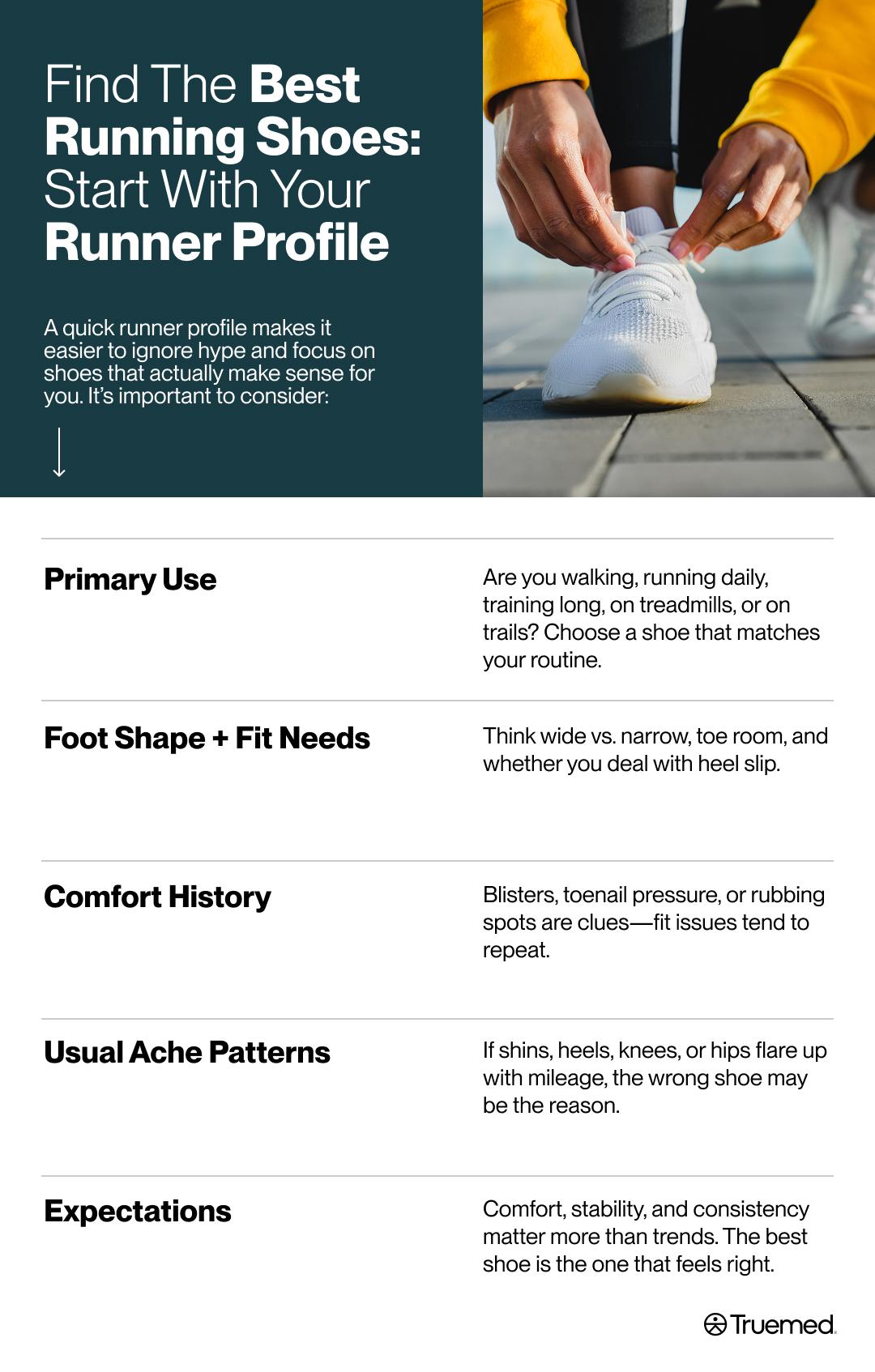
Before you scroll reviews or compare specs, take a few minutes to size up your situation. A quick runner profile makes it easier to ignore hype and focus on shoes that actually make sense for you.
According to Mike Daniels, MD, a podiatrist and founder of WeTreatFeet Podiatry, it’s important to consider:
- Your primary use: Are you mixing walking and jogging, running easy miles, training for longer distances, mostly on a treadmill, or heading onto trails? Many people do best with a versatile daily trainer, while others benefit from a more specific category if their routine is consistent.
- Your foot shape and fit tendencies: Consider whether you typically need wide or narrow shoes, prefer more toe room, or struggle with heel slip.
- Your comfort history: Past shoes leave clues. If you always blister in the same spot, feel pressure on your toenails, or notice rubbing along the arch or heel, pay attention. Those patterns tend to repeat unless something meaningfully changes in fit or shape.
- Your usual ache patterns: Do your shins, heels, arches, knees, or hips tend to complain when mileage goes up? “When the shoe is wrong, the body will let you know,” says Daniels. “When it’s right, everything feels a little easier, and problems settle down instead of piling up.”
- Your expectations: The best running shoe is different for everyone. A shoe that feels comfortable, stable, and easy to move in will beat a trendy model that looks impressive but feels off. Fit and consistency matter more than chasing whatever is popular this season.
The Non-Negotiables for Fit and Comfort
If a shoe fails on fit or comfort, nothing else about it really matters. Here are the baseline factors to consider so you can steer clear of a bad purchase:
- The right size: Foot size can change with age, weight shifts, hormones, and activity level. And one study found that up to 72% of people were wearing the wrong shoe size. That’s why Milica McDowell, DPT, a physical therapist, exercise physiologist, and coach at US Physical Therapy, recommends getting your feet measured once a year. That gives you a much more reliable starting point before you try anything on.
- A wide, natural toe box: Your toes should be able to spread and move, not stack on top of each other. Cramped toes interfere with your stride and can contribute to a range of foot problems, says McDowell.
- Secure heel: “Your heel has to feel locked in without being squeezed,” says Daniels. “If you feel any rubbing on the back of the heel when you jog or walk briskly, that shoe is already on my ‘no’ list.”
- Space at the front: “I want a thumb’s width of space between your longest toe and the end of the shoe when you’re standing, and I want you to be able to wiggle your toes freely without pressure on the toenails,” says Daniels. That way, your shoes can comfortably accommodate natural foot swelling during longer walks and runs.
- Gentle midfoot support: The right shoe should feel like a light, supportive hand under your arch, not a hard rock or floppy slipper, according to Daniels. Immediate pressure under the arch is a common red flag, especially for people with a history of plantar fasciitis or arch pain.
- No hot spots in the first few minutes: Pressure over a bunion, the outside of the foot, or the top of the toes during a short walk test will almost always worsen with mileage. Daniels advises spending at least 30 minutes walking in a shoe before committing.
- Fit with socks and lacing you’ll actually use: Sock thickness and lacing patterns change how a shoe fits. Try on shoes the same way you plan to run or walk in them.
- Comfort now, not after breaking them in: Modern running shoes should feel good in the store. Minor softening is normal, but pain or obvious discomfort rarely disappears with time, says Daniels.
Comfortable Running Shoes: Cushion vs Support
Most shoe descriptions make cushioning and support sound complicated. In practice, it’s much simpler: It’s about how the shoe feels under your feet and when you move. A few considerations can help you narrow things down, including:
- Cushioning level: Cushioning ranges from minimal to plush. Heavier runners, people who run mostly on concrete or asphalt, or those with a history of stress fractures often feel better in moderate to higher cushioning that’s protective but not mushy, says Daniels. Ultra-soft shoes can feel amazing at first, but over time, they may make your calves and stabilizing muscles work harder than necessary.
- Support and stability: Some people benefit from extra structure, especially if the foot tends to collapse inward or the ankle feels unstable. Daniels recommends looking for shoes that feel sturdy and resist excessive twisting, with a wider base that gently supports the foot. This could be a classic stability shoe or a neutral shoe that simply feels stable and well-balanced underfoot.
- Heel-to-toe drop: Heel-to-toe drop is the height difference between the heel and the front of the shoe. Shoes with a higher heel can take some pressure off your calves and Achilles, while flatter shoes put a bit more work on those areas. If you’ve had Achilles or calf issues, Daniels suggests being cautious about switching to very flat shoes and easing into any change slowly.
- Weight and responsiveness: Lighter shoes often feel quicker and more “snappy,” which some runners love for faster workouts. Heavier, more cushioned shoes usually feel softer and more protective, which can be more comfortable for easy runs and longer distances.
Not sure where to start? Many people do well with shoes that have a wide toe box, minimal-to-moderate cushioning, reasonably flat soles, and good flexibility, says McDowell. “Less is more,” she explains. “Today’s shoes are over-engineered, and the over-engineering sacrifices your foot health and ideal biomechanics.”
A good gut check: If you feel balanced, supported, and comfortable from the first few steps, you’re probably in the right category.
Long-Distance Running Shoes: What Matters When Miles Add Up
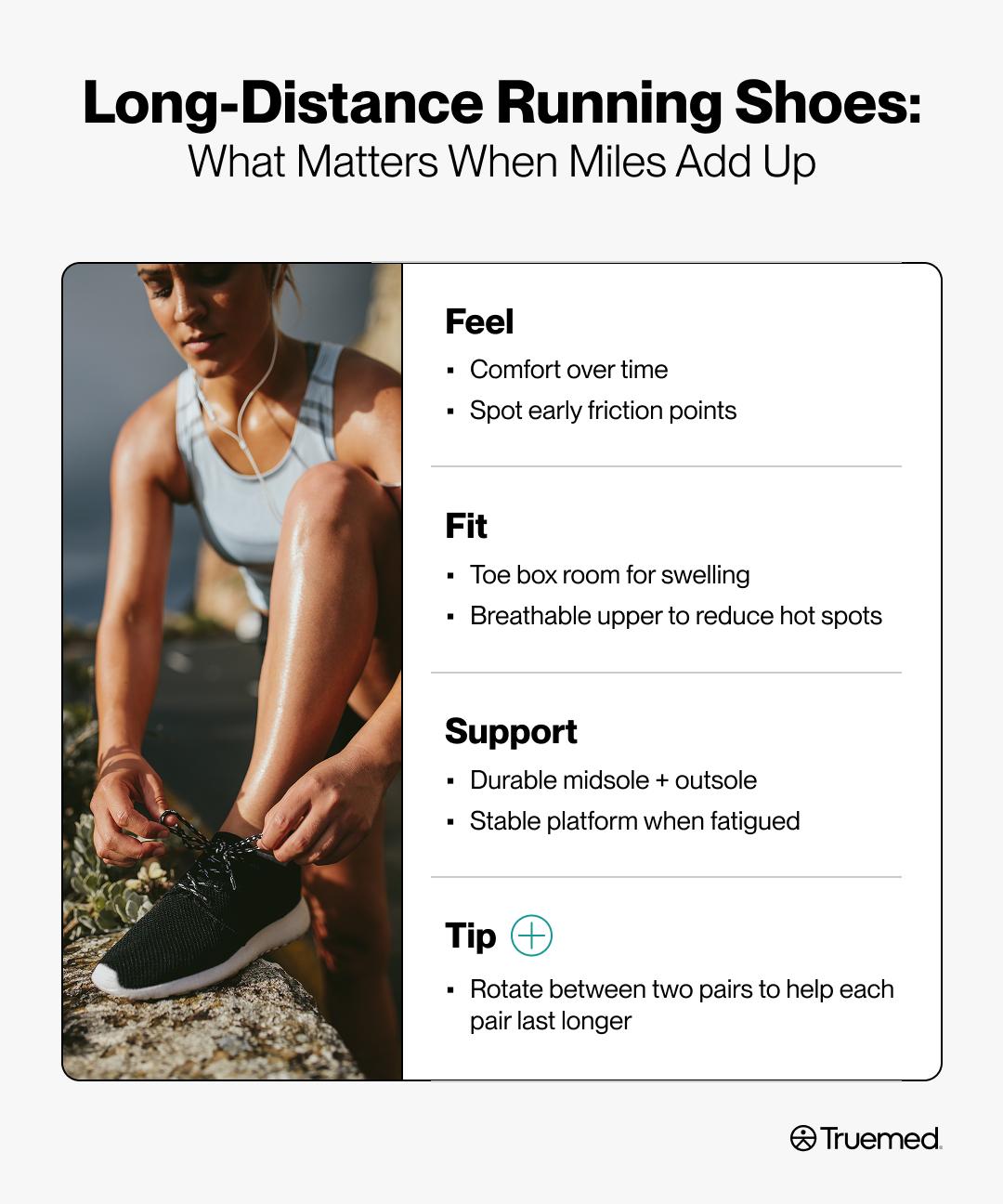
Shoes that feel fine for a short jog can start to feel very different after an hour or two. According to Daniels, here are the features worth paying attention to if you’re logging longer mileage:
- Comfort over time matters most: For long runs, how the shoe feels at an easy, steady pace is more important than how fast or exciting it feels. Daniels recommends looking for shoes that feel “almost boringly comfortable” early on and still acceptable deep into a run. If a shoe only feels good when you’re running fast, it’s probably better suited to shorter workouts.
- Room for natural foot swelling: Feet often swell as mileage increases. Extra toe box space and the right length become even more important to prevent black toenails, numb toes, and hot spots.
- Durable midsole and outsole: Many modern foams feel great out of the box, but lose their structure quickly. For marathon training, Daniels recommends shoes that hold their feel for roughly 300–400 miles of mixed training. In-store, gently bend and twist the shoe (it should feel resilient, not flimsy) and look for solid rubber coverage in high-wear areas. Reviews can also hint at how a shoe holds up past the first few weeks.
- Stable platform when you’re fatigued: Toward the end of long runs, a slightly more stable shoe can help limit late-run collapse, which may matter for runners with a history of IT band pain, hip issues, or recurrent shin splints.
- Breathable upper and reduced hot spots: Long runs amplify friction. Shoes that let heat escape and don’t press or rub in obvious spots can go a long way toward preventing blisters and sore areas.
- Feel for friction points. Often, new shoes will leave temporary red marks on your feet where the friction points are. For example, you might see a red mark on your pinky toe and the inside of the ball of your foot. Those little red marks can provide imporant signals of where you might feel discomfort during long runs. They may work just fine for shorter distances, but it’s something to keep in mind based on volume.
- Rotate at least two pairs: Daniels suggests alternating between two different pairs, which you can switch between based on your type of run: one more cushioned (for long runs) and one a bit lighter (for technique and speed on shorter runs). This gives your body a slightly different feel from run to run, and can also help each pair last longer.
Top-Rated Running Shoes: Features That Actually Change the Experience
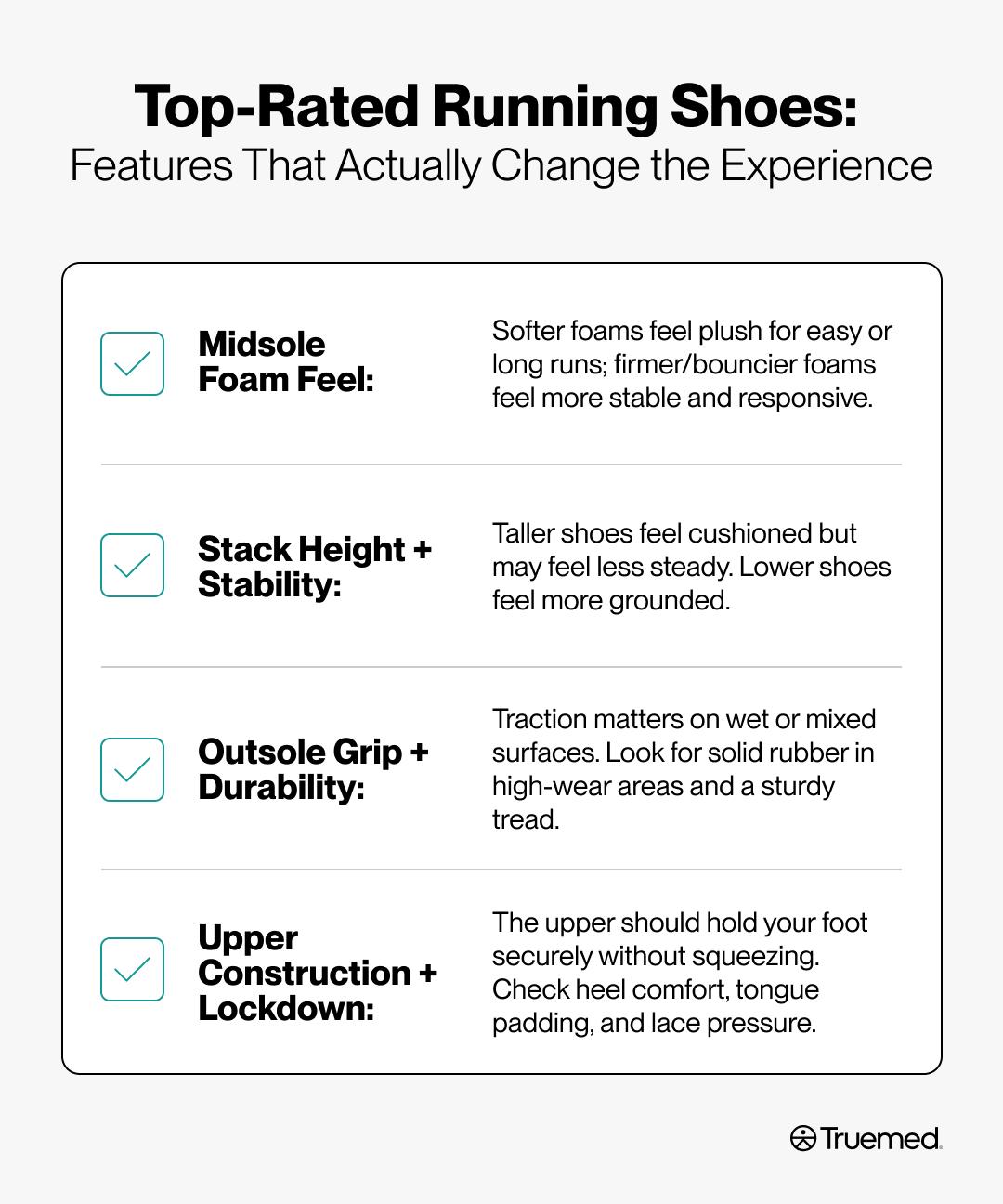
Specs and buzzwords are everywhere. But only a handful of features truly change how a shoe feels once you’re moving, including:
- Midsole foam feel: Softer foams can feel more comfortable for easy runs and long distances, while firmer or bouncier foams can feel more stable or responsive. The “best” foam is the one that feels good to you when you jog around the store.
- Stack height and overall stability: Stack height is how tall the shoe feels underfoot. Taller shoes can feel cushioned and bouncy, but some runners feel less steady in them. Lower-profile shoes often feel more grounded. If you feel wobbly standing or jogging in place, that shoe may not be a great match.
- Outsole grip and durability: If you run on wet pavement, sidewalks, or mixed surfaces, traction matters. Look for visible rubber on the bottom in high-wear areas and a tread pattern that doesn’t look paper-thin.
- Upper construction and lockdown: The upper (AKA the fabric and structure that wraps over the top of your foot) should hold your foot in place without squeezing. Pay attention to heel collar comfort, tongue padding, and whether the laces dig into the top of your foot. You shouldn’t feel like you’re fighting the shoe to stay centered.
In practice, start with fit and comfort. If a shoe feels good, stable, and easy to move in, it’s already ahead of most “top-rated” options, regardless of how flashy the feature list looks.
Best Running Sneakers
With so many running shoes to choose from, we pulled together a curated list of standout picks for the most common needs.
Best Daily Trainer: Brooks Adrenaline GTS 24
Best for: Everyday running, overpronation, and runners who want extra structure
The Brooks Adrenaline GTS 24 ($99.95) is a stability-focused daily trainer with plush cushioning and Brooks’ Guiderails system, which helps keep joints aligned during runs and walks. Daniels often points patients toward this model when they want a comfortable, reliable shoe that works for a wide range of mileage and feels supportive without being harsh. It’s also frequently praised for feeling comfortable right out of the box and holding up well for all-day wear.
Best Long-Run Shoe: ASICS Novablast 5
Best for: Long-distance running, marathon training, and runners who want a plush but stable ride
The ASICS Novablast 5 ($150) is a popular option among Daniels’ marathon-training patients. It offers strong impact protection with a slightly rockered shape that helps keep you moving forward late in runs, without feeling unstable or overly soft. It’s a good choice if you want cushioning that feels protective but still responsive.
Best Speed/Tempo Shoe: Saucony Endorphin Speed 5
Best for: Tempo runs, intervals, and faster-paced workouts
The Saucony Endorphin Speed 5 ($175) blends responsiveness with versatility thanks to a nylon plate and a geometry designed to encourage quicker turnover. Daniels recommends it for runners who want a faster-feeling shoe that’s more forgiving than full carbon-plated racers, making it usable for workouts and some longer sessions.
Best Trail Running Shoe: Saucony Peregrine 15
Best for: Trail running, mixed terrain, and runners who want reliable grip
The Peregrine 15 ($99.95) offers a comfortable, slightly cushioned feel while still staying flexible underfoot. According to Daniels, the grippy rubber bottom helps you feel more secure on dirt, gravel, and rocky trails, making it a solid choice if you want one dependable trail shoe that works in a variety of conditions.
Best Walking-to-Runnning Hybrid Shoe: Altra Escalante 4
Best for: Walking, everyday movement, and beginner runs
The Escalante 4 ($130) has become one of Altra’s most popular road models because it balances cushioning, flexibility, and comfort in a lightweight package. Its roomy toe box lets your toes spread naturally, and the knit upper feels forgiving underfoot, according to McDowell. The Escalante is versatile enough for daily errands, treadmill workouts, and short runs, bridging the gap between walking shoes and dedicated running shoes.
Best Hands-Free Walking Shoe: Skechers Slip-ins Summits
Best for: Walking, everyday wear, and anyone who wants easy on/off
For people who can’t—or don’t want to—bend over to tie laces, Skechers Slip-ins Summits ($55) use a structured heel design that allows hands-free entry. They feature a stretchy knit upper and a cushioned memory-foam insole, making them a comfort-first adaptive footwear option for daily walking and casual wear.
How to Save on Your Purchase: The Smart Discount Playbook
Running shoes can get expensive quickly. Here are a few strategies that reduce the chances of overpaying (or buying the wrong pair altogether):
- Take advantage of your HSA/FSA: For qualified customers, using HSA or FSA funds for eligible items can save an average of 30% because you’re paying with pre-tax dollars. Eligibility depends on the product, your situation, and proper documentation (more on that below).
- Shop last year’s model: Most brands update colorways and minor details every year, not complete overhauls. Buying the previous version can save 20–40% with little real-world difference for many runners.
- Time your purchase: Big sales tend to cluster around holiday weekends, end-of-season clearances, and brand anniversary events. If you’re not in a rush, waiting a few weeks can pay off.
- Stack small discounts: Sign up for brand newsletters, look for student/teacher/medical-worker discounts, and use cash-back portals. Individually, they’re small, but together they add up.
- Prioritize strong return policies: The ability to return or exchange after an indoor try-on protects you from expensive mistakes.
- Use a two-pair strategy: When you find a shoe that fits well, consider buying one pair at full price and a second pair later at a discount. You lock in your good fit and save on your backup.
Where to Buy (and Avoid Buyer’s Remorse)
Where you shop can matter almost as much as what you buy. Here’s where to look:
- Specialty running stores: Local running shops often offer professional fitting, help with sizing and width, and guidance on lacing and sock choices. Some have treadmills or space to jog briefly in-store, which can reveal issues quickly.
- Online retailers: Online stores usually have a wider selection and more frequent discounts. If you buy online, prioritize retailers with generous return or exchange policies so you can test shoes indoors.
A smart try-on strategy can also save you a lot of frustration. If you’re torn between sizes or models, consider ordering two or three options. Try them on indoors with the socks you’ll actually wear, and spend a few minutes walking and lightly jogging. Notice any rubbing, pressure points, heel slip, or spots that feel uncomfortable.
Keep the tags on and packaging intact until you’re sure, then return what doesn’t feel right. And don’t forget to keep receipts and order confirmations—they’re helpful for returns and important to have on hand if you’re reimbursed by your HSA/FSA.
Even with a good plan, a few common pitfalls can still lead to buyer’s remorse. Look out for:
- Final-sale shoes that can’t be returned or exchanged
- Deals that seem too good to be true, especially on third-party marketplaces
- Counterfeit or previously worn shoes
- Ignoring early discomfort and hoping the shoe will “break in”
Can You Use HSA/FSA for Running Shoes? What’s Realistic
It’s common to assume that because running shoes support your health, they automatically qualify for HSA or FSA reimbursement. But in most cases, they don’t—they’re usually considered personal expenses.
However, there are situations where you may be able to use HSA or FSA funds if you’re purchasing running shoes to help manage a diagnosed medical condition. This can sometimes apply to people dealing with:
- Musculoskeletal or foot-related issues like plantar fasciitis
- Achilles or tendon problems
- Gait abnormalities
- Bone issues like heel spurs or bunions
- Chronic foot, knee, hip, or back pain that’s tied to biomechanics
What usually makes or breaks reimbursement is paperwork. Many plans want a letter of medical necessity (LMN) from a licensed healthcare provider that explains your condition, why a certain type of shoe is part of your treatment, and how it helps. You’ll also want to hang onto an itemized receipt and the product details.
Before you buy, it can help to ask your plan administrator:
- Does my plan cover athletic or orthopedic footwear with an LMN?
- What documentation is required for reimbursement?
- Does the LMN need to mention a specific diagnosis or medical purpose?
- Do I submit a reimbursement request after purchase, or can I use my HSA/FSA card at checkout?
This quick check can save you time, money, and frustration later.
Compliance & Documentation (HSA/FSA)
If you plan to use your HSA or FSA funds for running shoes, a little organization goes a long way. Clean documentation makes it easier to submit for reimbursement and respond if your plan asks follow-up questions. Here’s what to keep in mind:
- Save itemized receipts and invoices: Receipts should clearly show the product name, price, date of purchase, and retailer.
- Save your LMN (if applicable): Store a copy of the LMN along with your receipts. Many plans require it to be current and tied to the specific purchase.
- Follow your plan’s rules: Each HSA/FSA plan sets its own reimbursement policies. Coverage, documentation requirements, and timelines can vary.
- Understand who makes the final call: Even with proper documentation, the plan administrator—not the retailer or Truemed—decides whether an expense is reimbursable.
- Avoid double-dipping: Don’t claim the same expense for reimbursement and also deduct it elsewhere.
How It Works with HSA/FSA and Truemed
If you think you may qualify to use HSA or FSA funds for running shoes based on medical necessity, Truemed can help guide you through the process.
For qualified customers, here’s what that typically looks like:
- Complete Truemed’s health intake form.
- An independent licensed practitioner reviews your information and may issue an LMN when appropriate.
- If approved, you can use your HSA/FSA card at checkout or save your receipt and submit for reimbursement, depending on your plan’s process.
Eligibility depends on your individual situation, the product, and your plan’s rules. Final reimbursement decisions are always made by your plan administrator.
FAQ
There isn’t a single top-five list that works for everyone, because fit, foot shape, and running style vary so much. Instead of chasing rankings, it’s more helpful to look for shoes that match your needs—such as a daily trainer, long-run shoe, speed/tempo shoe, or trail shoe—and then choose the option that feels most comfortable and stable on your feet.
No brand is universally “best,” but some brands are known for design approaches that work well for many runners. For example, Altra is often recommended for its wide toe boxes and lower heel-to-toe drop options, while brands like Brooks, ASICS, and Saucony are popular for their broad range of fits and cushioning levels. The best brand for you is the one that consistently fits your foot and feels good when you run.
Most people do well with a daily trainer that offers moderate cushioning, a stable feel, and enough durability for regular use. From there, some runners add a lighter shoe for faster workouts or a more cushioned option for long runs. Trail runners should look for shoes specifically designed for off-road terrain.
Comfortable running shoes are ones that fit properly, allow your toes to move, feel good from the first step, and don’t create pressure points. A shoe should feel comfortable in the store—pain or obvious discomfort is a sign to keep looking.
In most cases, running shoes are not automatically eligible. You may be able to use HSA or FSA funds in specific, medically necessary situations when a licensed provider documents that the shoes are part of treatment for a diagnosed condition. Requirements vary by plan, and final reimbursement decisions are made by your plan administrator.



See what you can do with your HSA/FSA.
Join 1.5 million Americans who have routed their healthcare dollars toward root cause health via Truemed's HSA/FSA marketplace.
New product announcements
Sales and special offers
Tips for utilizing your HSA/FSA
Editorial Standards
At True Medicine, Inc., we believe better health starts with trusted information. Our mission is to empower readers with accurate and accessible content grounded in peer-reviewed research, expert insight, and clinical guidance to make smarter health decisions. Every article is written or reviewed by qualified professionals and updated regularly to reflect the latest evidence. For more details on our rigorous editorial process, see here.