
The Best Treadmill for Your Home
Author:Kathleen Ferraro
Reviewed By:Bo Hickey, CSCS
Published:
December 18, 2025
Last Updated:
September 10, 2026


Key Takeaways
There's no single "best" treadmill: Instead, the best treadmill for your home is the one that fits your pace, space, and comfort needs.
Specs matter: Motor power, deck size, cushioning, and stability are the key features that affect safety and durability.
Consider your primary exercise: Walkers can choose simpler models, while frequent runners benefit from dedicated running treadmills built for speed and higher mileage.
Incline is a worthwhile feature: A treadmill with incline adds intensity without extra joint stress.
You could pay with HSA/FSA funds: If a provider deems it medically necessary, you may be able to purchase a treadmill with HSA/FSA dollars.
Key Takeaways
How This Guide Helps You Choose the Best Home Treadmill
Why a Home Treadmill Can Support Better Health
Key Decisions Before You Shop (Space, Budget, and Goals)
Buying Guide: What to Look For in the Best Treadmill
Running Treadmill vs Walking Treadmill: Matching the Machine to Your Pace
Top Picks – Best Treadmills for Running and Home Use
Features That Really Matter (and What’s Mostly Extra)
Safety, Setup, and Maintenance for a Home Treadmill
How It Works with HSA/FSA and Truemed
When to Talk to a Healthcare Provider Before Using a Treadmill
FAQ
Searching for the best treadmill for your home can get overwhelming fast. There are hundreds of top-rated treadmills, endless specs to compare, and price tags all over the map—yet it’s not always clear what the best treadmill for your home is.
For many, a home treadmill is the key to unlocking consistent cardio without relying on perfect weather, a commute to the gym, or crowded machines.
The problem? It’s easy to buy the wrong machine. Noise issues, cramped belt size, underpowered motors, and joint discomfort are all potential problems that only show up after delivery.
This guide keeps things simple. We break down treadmill specs so you can find the best option without overthinking it. By the end, you’ll know exactly what to look for so you can choose a treadmill that fits your life (and actually gets used).
How This Guide Helps You Choose the Best Home Treadmill
This guide is made for all you home exercisers: The walkers, joggers, and runners out there who want dependable cardio without getting lost in specs and sales hype. Whether your goal is daily movement or training on one of the best treadmills for running, we’ll help you choose a machine that fits how you actually plan to use it.
You’ll start by looking at your space, pace, comfort needs, and noise limits, then we’ll dive into the specs to look out for. We’ll clarify the differences between walking treadmills, all-purpose models, and true running treadmills, and show where a treadmill with incline can add challenge without extra joint strain.
By the end, you’ll have an easy, practical way to choose the best treadmill for your home—one that fits your goals, space, and everyday life.
Why a Home Treadmill Can Support Better Health
A home treadmill removes major barriers to exercise (like bad weather, limited daylight, busy schedules, and gym logistics), making it easier to stay consistent. Short daily walks, quick 10-minute sessions, or brief intervals between tasks become far more realistic when your workout is always within reach.
Over time, that consistency matters: Regular aerobic activity has been linked to better heart health, lower blood pressure, and a reduced risk of conditions like heart disease, type 2 diabetes, and certain cancers.
A treadmill with incline adds even more benefit by letting you increase intensity without increasing joint impact. Incline walking boosts cardiovascular demand and muscle strength while staying gentler on knees and hips, which can be especially helpful for people easing back into exercise or following clinician-guided routines.
For some people, treadmill use is part of a treatment or rehab plan recommended by a healthcare provider for weight management, heart health, or recovery. In those situations, a treadmill may qualify as an eligible medical expense with proper documentation, which we’ll explain later in this guide.
Key Decisions Before You Shop (Space, Budget, and Goals)
Before comparing models or hunting for deals on the best treadmill for your home, take a few minutes to clarify the essentials.
These factors narrow your options fast and help you avoid overspending or underbuying:
- Your main goal: Do you plan to walk most days, mix jogs and intervals, or run regularly? “Different goals require different features,” says UESCA-certified running coach James Rodgers. “For rehabilitation or casual fitness, a more basic model may suffice. If you're training for races, you may need higher speeds and incline capabilities.”
- Your space: Measure your floor area and make sure you have at least six feet of clearance behind the belt for safe step-offs. Check ceiling height too, especially if you’ll run or use incline. If you’re in an apartment or share walls, quieter motors and cushioned decks matter. Folding treadmills save space when stored, but as Rodgers notes, non-folding models tend to be sturdier for serious training.
- Your budget: Home treadmills typically range from $700–$1,500 for walking and jogging models and $1,500+ for higher-end machines built for frequent running, according to Portia Page, CPT, NCPT, PMA, an ACE- and AFAA-certified fitness instructor. “A stronger motor ensures smoother operation, handles higher speeds without strain, and will last longer,” she says—one of the main reasons serious running treadmills carry higher price tags.
- Your users: Decide whether the treadmill is just for you or for multiple people in the household. More users or higher body weights increase wear on the frame and motor. Look for a weight capacity at least 50 pounds higher than the heaviest user’s weight to support stability and long-term durability, says Page.
Buying Guide: What to Look For in the Best Treadmill
Now you’re ready to look at the specs. These features separate a treadmill that lasts for years from one that ends up gathering dust or breaking down early.
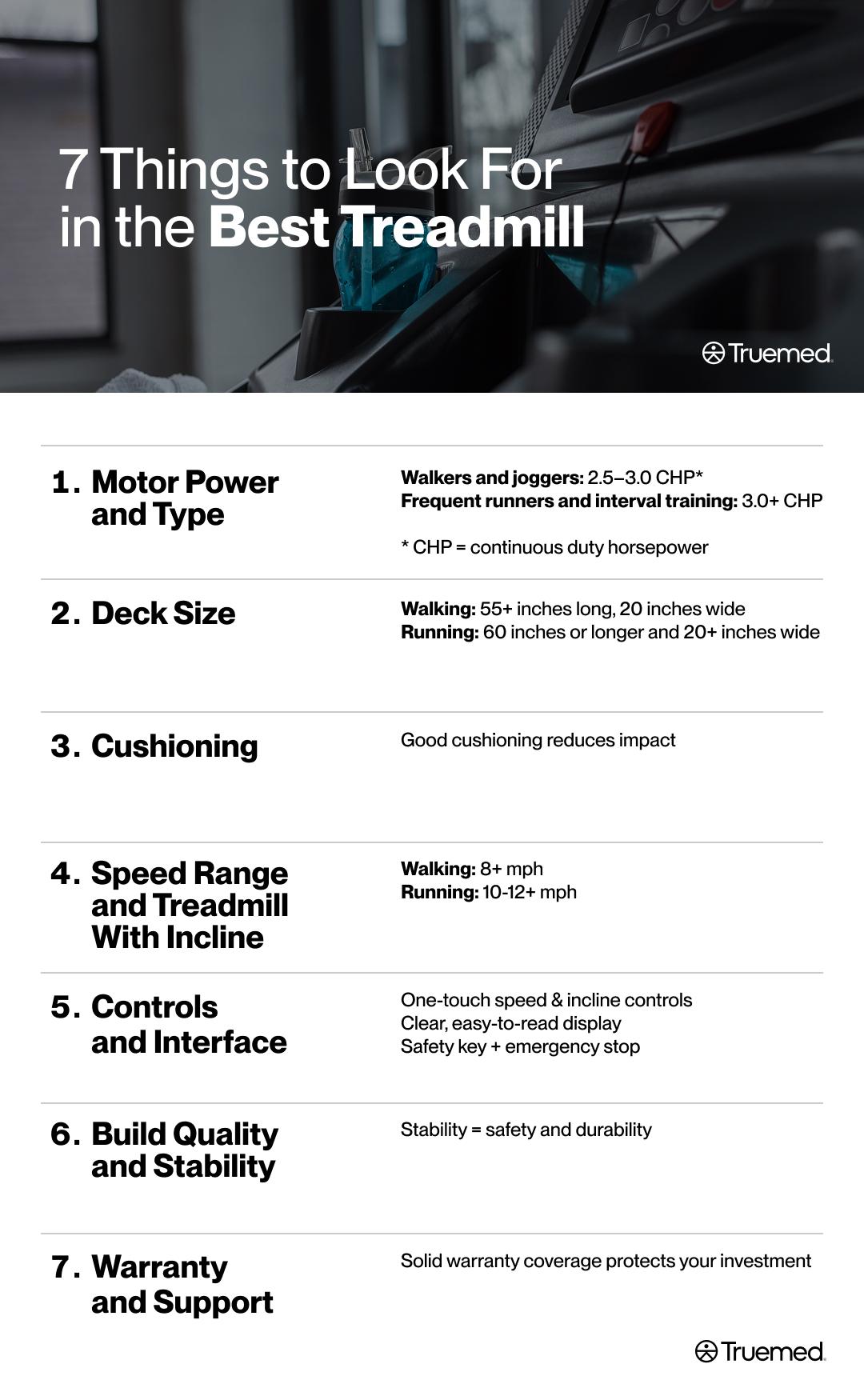
Motor Power and Type
The motor is the heart of your treadmill. Look for the continuous duty horsepower (CHP) rating rather than peak horsepower, which is mostly a marketing number. CHP indicates how much power the motor can sustain during real workouts without overheating or slowing down, says Page. Here are the CHPs she recommends based on your activity:
- Walkers and light jogging: Aim for 2.5–3.0 CHP for smooth, steady operation.
- Frequent runners and interval training: Look for at least 3.0 CHP, and 3.5+ CHP for heavier mileage or higher speeds.
A stronger motor not only handles higher speeds better; it also lasts longer and runs quieter, which is a big plus for home use, says Page.
Deck Size
Deck size determines how safe and natural your stride feels. “Enough belt length and width help prevent tripping or having to adjust your stride unnaturally,” says Page, making deck size a major comfort and safety factor.
Here are the belt sizes she recommends based on your activity:
- Walking: At least 55 inches long and 20 inches wide
- Running: 60 inches or longer and 20+ inches wide
Cushioning
Good cushioning reduces impact on your knees, hips, and lower back, says Page, which is particularly important if you’re running or using the treadmill several times per week. While cushioned decks don’t eliminate impact altogether, they can significantly soften the landing compared with road running or cheaper, rigid treadmills.
If you have joint sensitivity, are returning from injury, or plan high weekly mileage, prioritize models known for shock absorption, she adds. Many mid- and premium-tier machines build cushioning directly into the deck for more consistent support across the entire belt.
Speed Range and Treadmill With Incline
Even if you’re not sprinting, having adequate top speed and incline keeps your workouts versatile and future-proof. Rodgers recommends the following top speeds based on your preferred exercise:
- Walking: 8 mph or higher
- Running: 10-12 mph or higher
He also suggests a maximum 10–15% incline, regardless of your cardio habits or fitness levels. Incline gives you options: Walking uphill boosts intensity without pounding your joints, while runners can use it to build strength and simulate outdoor terrain, says Page.
Controls and Interface
Even the best treadmill won’t do you much good if it’s frustrating to use. Rodgers recommends looking for user-friendly features like:
- One-touch speed and incline buttons, dials, or trackball for quick adjustments and easier transition between speed, incline, etc.
- Clear displays showing pace, distance, time, and incline
- A safety key and emergency stop so the belt stops immediately if you slip
Build Quality and Stability
A stable treadmill feels solid underfoot—no shaking, rattling, or bouncing at higher speeds. Stability is especially important for runners and heavier users because, as Page puts it, “stability = safety and durability.”
Check:
- Belt integrity. A belt with low tension can result in additional torsion on the knee.
- Frame weight: Heavier frames usually mean better stability, which is especially important for runners. “When you're running at threshold pace or doing intervals, any wobble or shake in the frame is really annoying and can be dangerous,” explains Rodgers.
- Weight capacity: Aim for a rating that’s 50 pounds higher than the heaviest user’s weight to boost the longevity of your treadmill.
- User reviews: Browse customer reviews to see what real users have to say about stability and quality.
Warranty and Support
Solid warranty coverage protects your investment and gives peace of mind that your treadmill will be supported if issues come up, says Page.
She recommends looking for:
- Lifetime warranties on the frame and motor
- 2–3 years or more on parts and electronics
- At least 1 year of labor coverage
Rodgers advises shoppers to pay close attention here: “Look for comprehensive warranties,” he says. “Equally important is responsive customer support. Check reviews to see how the company handles issues, replacement parts, and service requests.”
Running Treadmill vs Walking Treadmill: Matching the Machine to Your Pace
Not all treadmills are built for the same type of movement. One of the biggest mistakes buyers make is choosing a machine that doesn’t match their pace—either paying for more treadmill than they need or buying underpowered equipment that can’t handle their workouts.
Here’s how the main categories break down so you can match the machine to your pace, according to the experts:
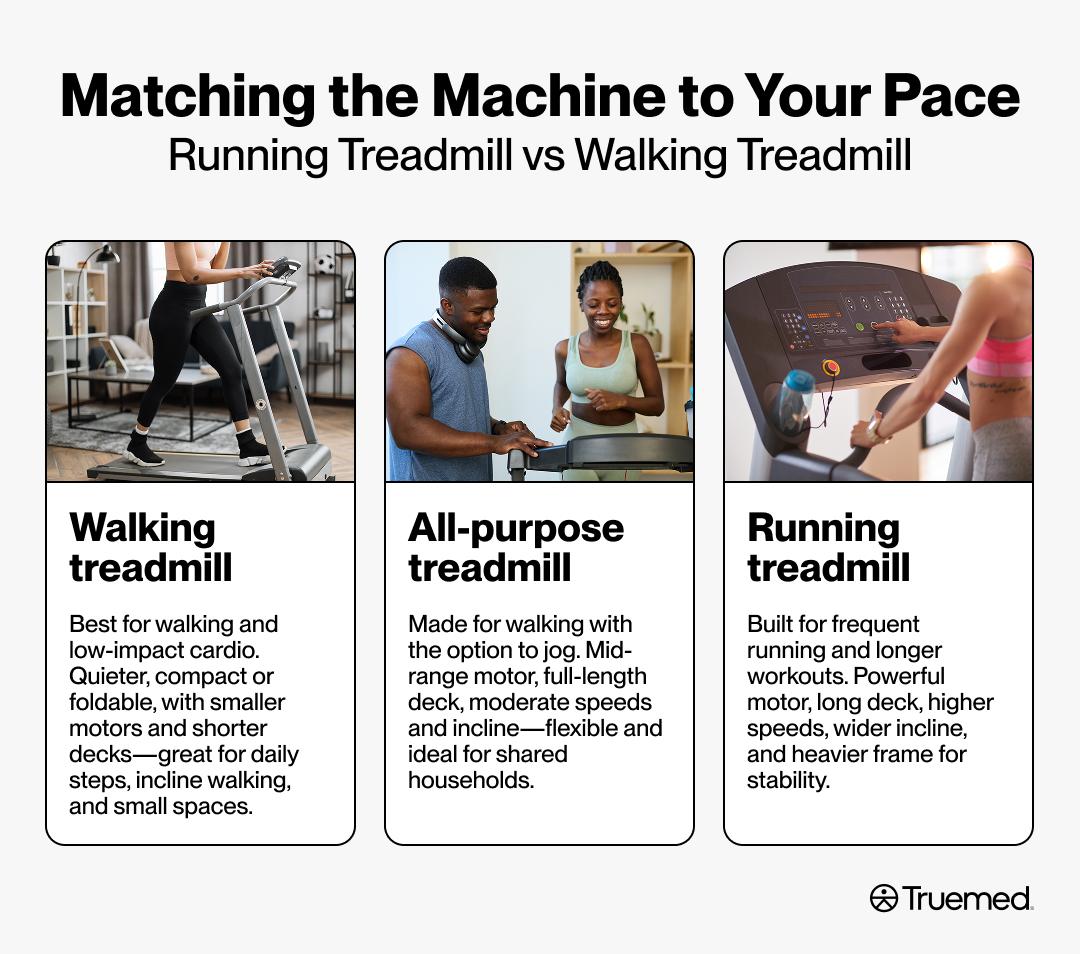
- Walking treadmill: These are best for steady walking, gentle jogging, and low-impact cardio. These models usually have 2.5–3.0 CHP motors, 55-inch decks, good cushioning, and quieter operation. They’re often more compact or foldable, making them a smart fit for smaller spaces and apartments. Walking treadmills work well for daily steps, incline walking, and building a consistent movement routine without needing higher speeds.
- All-purpose treadmill: This option is ideal for people who walk most days but want the option to jog or do occasional interval workouts. These machines typically feature 3.0 CHP motors, 60-inch decks, 10–12 mph top speeds, and 10–12% incline ranges. They offer the most flexibility and are a solid choice for households with multiple users.
- Running treadmill: These are designed for frequent running, faster speeds, and longer sessions. True running treadmill models use 3.5+ CHP motors, 60-inch or longer decks with robust cushioning, 12+ mph top speeds, wider incline ranges, and heavier frames for maximum stability.
If your pace stays mostly in the walking or light jogging range, an all-purpose or walking treadmill is often the smarter and more space-efficient option. According to Rodgers, splurging on one of the best treadmills for running is typically worth the investment if you:
- Run three or more times per week
- Perform interval workouts or hill training
- Sustain faster-than-average running speeds
- Want a treadmill that can last through high weekly mileage
The bottom line: Buy for how you’ll use the machine most often, not how you hope to use it occasionally. Matching your treadmill to your true pace helps ensure safety, comfort, longevity, and overall satisfaction with your home setup.
Top Picks – Best Treadmills for Running and Home Use
It’s easy to get overwhelmed by all the options out there, so we curated a list of standout treadmills that fit the most common home needs.
Everyday Best Home Treadmill: Sunny Health & Fitness Premium Foldable Auto Incline Smart Treadmill
Best for: Daily walking, light jogging, and smaller spaces
This foldable Sunny Health & Fitness treadmill ($649.99) is a strong all-around choice for most home users. It offers a cushioned 20-inch deck, automatic incline for adding intensity, and a foldable frame that works well in apartments or multipurpose rooms. It keeps things simple while still providing enough performance for consistent cardio routines.
Best Treadmill for Serious Runners: Gronk Fitness Spirit XT685 Commercial-Grade Treadmill
Best for: High-mileage training, faster speeds, and maximum durability
Built for performance, the Spirit XT685 Commercial-Grade Treadmill ($3,199) is designed to handle frequent running without strain. Its strong motor, spacious deck, and stable frame support speed workouts, tempo runs, and long sessions with minimal vibration or belt hesitation. For the serious runner, ability to adjust controls seamlessly will be important, and this model delivers.
Best Compact / Folding Treadmill with Incline: XTERRA TRX3500 Folding Treadmill
Best for: Tight spaces that still need incline training
For shoppers prioritizing storage flexibility, a true folding treadmill with incline is essential. The XTERRA TRX3500 ($1,799.99) offers compact storage alongside automatic incline for hill-style walking workouts and moderate jogs. It’s a good fit for condos or spare rooms where floor space is limited but training variety still matters.
Best Budget-Friendly Treadmill: Sunny Health & Fitness Active 400 Smart Auto Incline Wi-Fi Treadmill
Best for: Walking routines and cost-conscious buyers
Designed for steady walking and light jogging, this foldable smart treadmill ($599.99) provides basic cushioning, reliable performance, and convenient foldaway storage without the higher price tag of hardcore running machines. It’s a smart entry-level option if your goal is daily movement without paying for upgraded speed ranges or oversized motors you won’t use.
Best Smart / Connected Treadmill: Aviron Victory Treadmill
Best for: Guided workouts, interactive training, and built-in motivation
The Aviron Victory ($3,599) stands out for its immersive programming, which combines scenic routes, coach-led workouts, and automatic pace or incline adjustments. It’s a great fit for people who thrive on structure or variety and find interactive experiences make workouts more consistent.
Premium Commercial-Style Pick: Life Fitness Club Series Treadmill
Best for: Gym-quality performance at home
The Life Fitness Club Series Treadmill ($7,425) mirrors the fitness equipment used in top commercial fitness centers. With a smooth, cushioned deck and durable construction designed for heavy use, it’s ideal for serious exercisers who want maximum reliability and minimal maintenance concerns over the long term.
Features That Really Matter (and What’s Mostly Extra)
Not every treadmill “upgrade” actually improves your workouts. According to Rodgers and Page, these are the features that directly impact how your treadmill performs day to day:
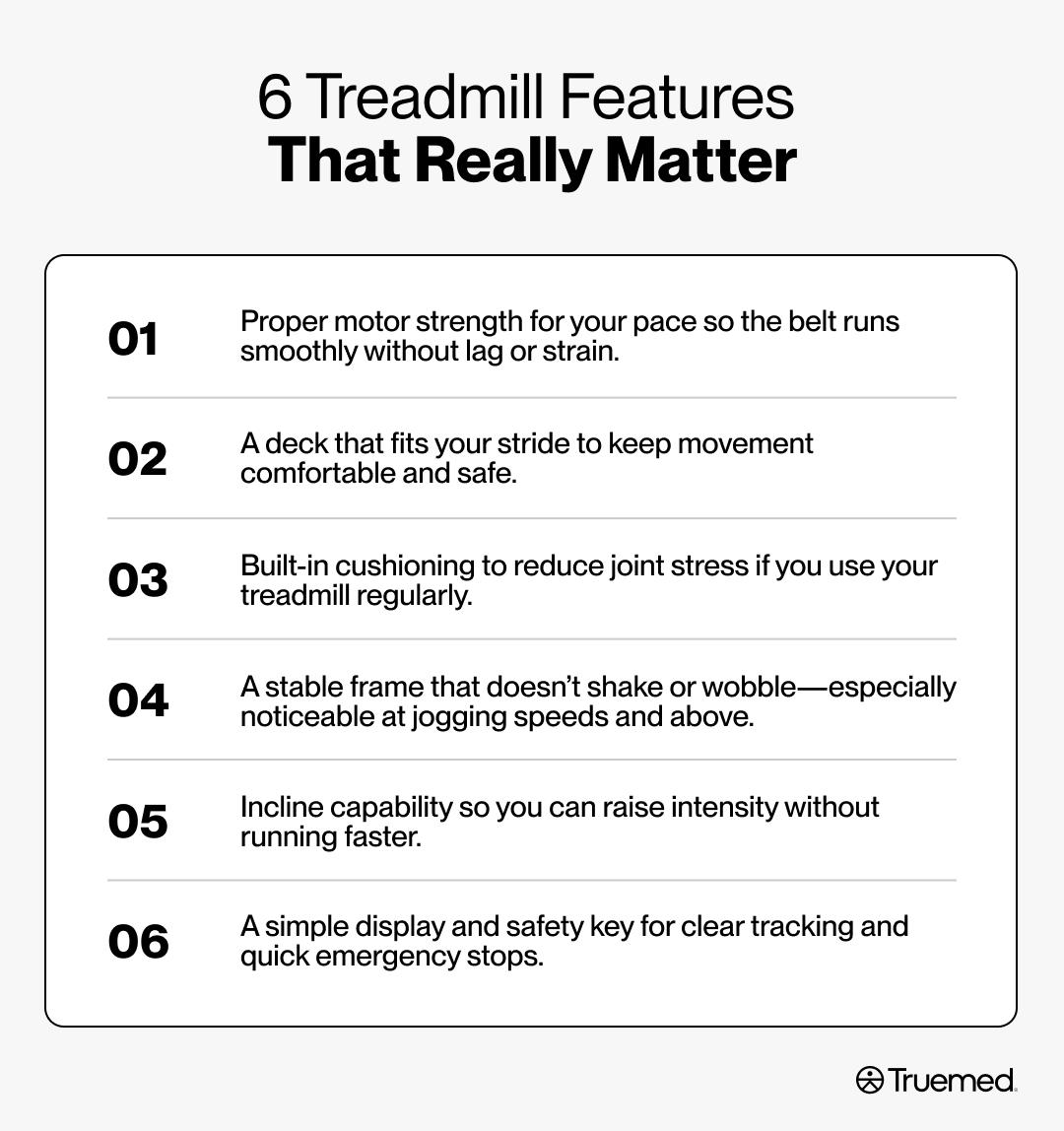
- Proper motor strength for your pace so the belt runs smoothly without lag or strain.
- A deck that fits your stride to keep movement comfortable and safe.
- Built-in cushioning to reduce joint stress if you use your treadmill regularly.
- A stable frame that doesn’t shake or wobble—especially noticeable at jogging speeds and above.
- Incline capability so you can raise intensity without running faster.
- A simple display and safety key for clear tracking and quick emergency stops.
There are also certain nice-to-have features that can boost motivation, but shouldn’t outweigh performance basics:
- Built-in workout programs or virtual classes
- Bluetooth pairing and heart-rate syncing
- Cooling fans, speakers, or tablet holders
- Larger touchscreens
“[These features] can make longer, easier runs more enjoyable,” says Rodgers. “However, be careful not to put this above mechanical quality.”
Finally, some “upgrades” tend to add cost without materially improving workouts. These include:
- Oversized entertainment screens
- Subscription-heavy app platforms
- Novelty attachments or “recovery” add-ons
- Social or leaderboard features you’re unlikely to use
The golden rule: Prioritize motor quality, deck size, cushioning, and stability over entertainment or smart add-ons. Those are the features that keep your treadmill safe, comfortable, and reliable long after the novelty of built-in tech wears off.
Safety, Setup, and Maintenance for a Home Treadmill
With simple setup, consistent safety habits, and basic maintenance, your treadmill stays more comfortable to use, quieter in operation, and safer for daily workouts. That way you get the most value from your investment.
According to Rodgers and Page, start with proper placement to protect both you and your equipment:
- Allow at least six feet of clearance behind the belt so you have room to step off safely if you lose balance.
- Set the treadmill on a level surface to prevent wobbling and uneven belt wear.
- Use a floor mat to protect flooring and reduce vibration or noise transfer.
- Plug into a surge protector to help shield electronics from power spikes.
- Avoid extreme environments like garages with big temperature swings or high humidity, which can damage motors and electronics.
Once you’re ready to go, prioritize safety. According to Page, that looks like:
- Always use the safety key and clip it to your clothing so the belt stops immediately if you slip.
- Warm up and cool down with 3–5 minutes of easy walking at the start and end of each session to reduce injury risk.
- Maintain proper posture—eyes forward, shoulders relaxed, elbows near 90 degrees—and try to land softly with your feet under your hips. This helps prevent injury while improving endurance and strength.
- Stay hydrated and keep distractions to a minimum, especially when increasing speed or incline.
- Keep kids and pets away while the treadmill is running.
Finally, regular upkeep keeps even top-rated treadmills safer and quieter for the long run. Here’s what Rodgers recommends:
- Wipe down sweat after each workout, as sweat can damage the electronics, frame, and belt over time.
- Use clean running shoes to avoid dragging dirt and small debris onto the belt or into the motor.
- Check belt alignment and lubrication according to the manufacturer’s schedule to prevent excess friction or slipping.
- Vacuum or sweep under the machine regularly to keep dust from building up around the motor area.
- Consider professional servicing (if recommended by the manufacturer) to keep everything running smoothly.
How It Works with HSA/FSA and Truemed
Treadmills aren’t automatically eligible for HSA or FSA spending. They may qualify under IRS §213(d) only when a licensed provider documents that the treadmill is medically necessary to treat or manage a diagnosed condition—not for general fitness.
Eligibility typically depends on whether your provider recommends treadmill use for conditions like cardiovascular disease, obesity, type 2 diabetes, joint issues, or injury recovery. And to use HSA/FSA funds, you must have a letter of medical necessity (LMN) from a licensed provider that documents your diagnosis and explains why a treadmill supports your treatment plan.
Truemed can help you do it. Here’s what to expect:
Complete Truemed’s health intake form.
A provider will review your form and provide an LMN if appropriate.
Use your HSA/FSA card at checkout or save your receipt and request reimbursement from your plan.
Final approval for your treadmill purchase always rests with your plan administrator, so confirm eligibility requirements before you complete your purchase.
When to Talk to a Healthcare Provider Before Using a Treadmill
Treadmills are safe for most people, but check with a healthcare provider first if you have heart conditions, significant metabolic concerns, joint injuries or chronic pain, balance issues, or a history of falls.
Stop exercising and seek medical care if you experience any of the following symptoms:
- Chest pain or pressure
- Unusual shortness of breath
- Dizziness or lightheadedness
- Fainting
- Heart palpitations
Your provider can also help tailor safe treadmill settings like speed, incline, and workout duration so your routine supports your health goals without increasing injury risk.
FAQ
There’s no single “best” brand for everyone—it depends on how you plan to use the treadmill. Brands like Sunny Health & Fitness work well for walking and light jogging in smaller spaces. Spirit (Gronk Fitness) and Life Fitness are known for durability and stability, making them strong choices for frequent runners or higher-mileage training. Connected brands like Aviron appeal to people who prefer guided workouts and built-in motivation.
The 3:30 rule refers to walking at 3 miles per hour for 30 minutes. It’s a popular low-impact workout that raises your heart rate without requiring jogging, making it approachable for beginners or anyone easing into a fitness routine. The 12-3-30 variation adds a 12% incline to increase intensity and calorie burn while still keeping the workout joint-friendly.
Neither is “better,” they just serve different needs. Outdoor walking adds variety and natural terrain, while a treadmill offers consistency, safety, and weather-proof workouts. Many people use both: Walking outside when conditions allow and relying on the treadmill to stay active year-round.
Yes, regular treadmill workouts can support fat loss as part of an overall healthy routine. Cardio helps burn calories and improve metabolic health, and consistent movement contributes to overall fat reduction, including abdominal fat.
Most quality walking treadmills fall in the $700 to $1,500 range. Less expensive options may work for occasional use, but tend to have smaller motors, shorter decks, and less durability. If you plan to walk regularly, investing in a treadmill built for steady daily use usually pays off in comfort and longevity.


Editorial Standards
At True Medicine, Inc., we believe better health starts with trusted information. Our mission is to empower readers with accurate and accessible content grounded in peer-reviewed research, expert insight, and clinical guidance to make smarter health decisions. Every article is written or reviewed by qualified professionals and updated regularly to reflect the latest evidence. For more details on our rigorous editorial process, see here.