
We Interviewed 5 CPAs about HSAs. Here's What They Said
Author:Mia Taylor
Reviewed By:Michaela Robbins, DNP
Published:
May 08, 2026
Last Updated:
September 10, 2026



Key Takeaways
Use your HSA strategically: There's a big difference between opening a health savings account (HSA) and using it strategically. Understanding the difference is a key step in making the most of your HSA savings efforts and getting the maximum possible benefit from these valuable accounts.
Know annual contribution limits: One of the most common areas of confusion related to HSA account holders is annual contribution limits, which encompass both your individual contributions and any contributions made by an employer.
Don't miss out on the triple tax advantage: HSAs offer a 'triple tax advantage,' but many account holders fail to understand the full suite of tax benefits associated with their accounts and as a result, may not make the most of them.
HSAs are a valuable retirement account: HSAs can be an extremely valuable tool to save for healthcare needs that arise during retirement. Money that you allow to remain in an HSA (rather than using it for present expenses) is able to keep earning interest year after year and that growth will keep compounding tax-free.
Maintaining documentation of expenses is key: Maintaining proper documentation and receipts for qualified medical expenses is critical if you plan to pay out of pocket for those expenses now, and seek reimbursement at a later date.
Key Takeaways
What 5 CPAs say most people misunderstand about HSAs
CPA takeaway #1: know the 2026 HSA contribution limits before you plan around them
CPA takeaway #2: the real HSA tax benefits go beyond one tax deduction
CPA takeaway #3: the best hsa tax savings strategy is often “pay now, reimburse later”
CPA takeaway #4: how to use an HSA for retirement
CPA takeaway #5: most HSA mistakes are compliance and timing mistakes
How It Works with HSA/FSA and Truemed
The bottom line
FAQ
There's a big difference between opening a health savings account (HSA) and using it strategically. Understanding that difference is important if you want to make the most of your HSA, ensuring that you not only get the maximum possible benefit from these valuable accounts, but also avoid missteps related to eligibility, contribution limits, qualified expenses and more.
To help break down some of the HSA ins and outs, including common mistakes to avoid, we spoke with five CPAs, gathering their expert insights and practical advice surrounding HSA best practices, use and management. Read on to find out what CPAs wish people understood better.
What 5 CPAs say most people misunderstand about HSAs
Confusion and misunderstanding surrounding HSAs runs the gamut from eligibility basics to what constitutes a qualified expense and how to use an HSA as a long-term tax and savings tool. Unfortunately, misunderstandings tied to HSAs often result in missed opportunity with regard to money saved, interest earned, or retirement readiness (or some variation of all of the above.)
"HSAs are simple once you understand the basics. The biggest mistake is not using them strategically," says Jamelle Nelson, CPA, CEO and founder of Nelson & Associates Corp. "If you stay eligible, follow the rules, and let the money grow, it can become one of the most valuable accounts you have."
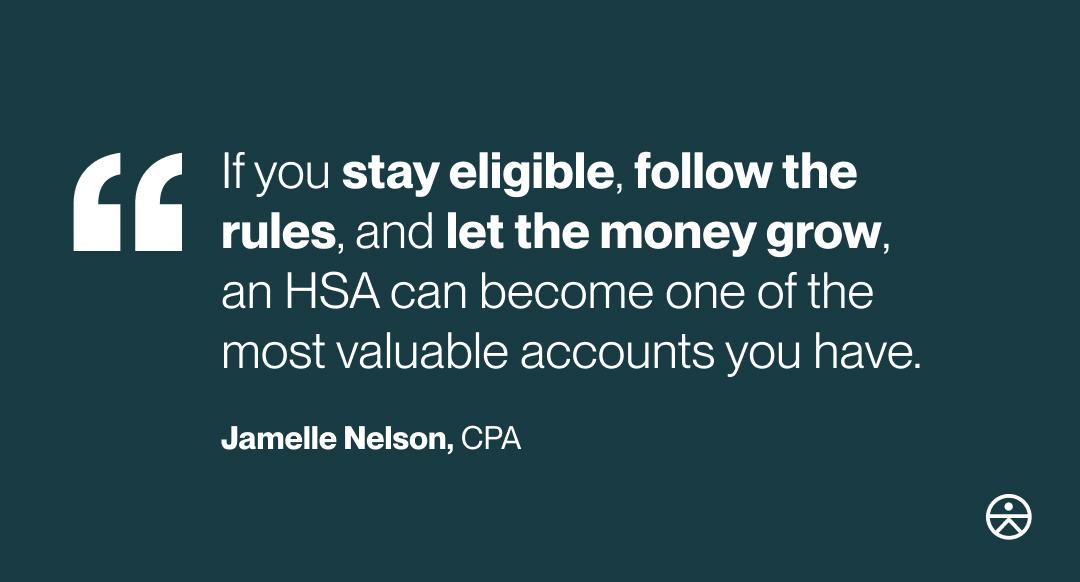
Don't miss the three important points Nelson is making in her comment: stay eligible, follow the rules and let your money grow. But how best to achieve those goals?
This guide was created to serve as a valuable resource, covering the basics Nelson is referring to along with some of the most common areas of confusion and addressing each one with expert CPA insights. So bookmark this page and be sure to refer to it whenever you have questions.
CPA takeaway #1: know the 2026 HSA contribution limits before you plan around them
One of the most common areas of confusion for HSA account holders is annual contribution limits, meaning the total amount of cash you can set aside in an HSA during a given tax year, as established by the IRS.
For 2026, the annual contribution limit is $4,400 for self-only HSA accounts and $8,750 for family HSAs. These annual limits apply to total HSA contributions from all sources. Translation: The contribution limits set by the IRS not only encompasses deposits made by you, but also funds your employer may kick-in.
"The thing that trips people up the most is money their employer puts into their Health Savings Account. Whatever your employer puts in counts toward the limit. So if your employer puts $1,200 into your Health Savings Account and you have self- coverage you can only put $3,100 into it yourself. A lot of people do not realize this," says George Dimov, CPA, of Dimov Tax.
Equally important to note, individuals who are 55 or older have a different annual contribution limit. The IRS allows for an additional $1,000 in annual contributions, (often referred to as catch-up contributions.)
If you accidentally surpass the annual contribution limit, there are financial consequences in the form of a 6% penalty tax on excess contributions, according to the IRS. This fine can be avoided by withdrawing the excess funds in a timely manner. If you neglect to remove the extra cash from the account, you'll face a penalty for the year you overcontributed, as well as each subsequent year in which the extra money remains in the account.
Another important (and easily overlooked nuance) with regard to annual HSA contribution limits: Any midyear coverage changes related to your health insurance and HSA eligibility can affect how much money you're allowed to contribute to your HSA account. In other words, you may not actually be allowed to contribute the full $4,400 for a self-only account or $8,750 for a family account. This is known as the partial-year rule.
"If you were on a high-deductible health plan for part of the year you can only deposit part of the annual contribution limit, unless you use the last-month rule," continues Dimov. "The last-month rule lets you put in the amount if you are eligible on December 1st, but then you have to stay on the high-deductible health plan for all of the next year or you will have to pay taxes and a penalty on the extra money."
CPA takeaway #2: the real HSA tax benefits go beyond one tax deduction
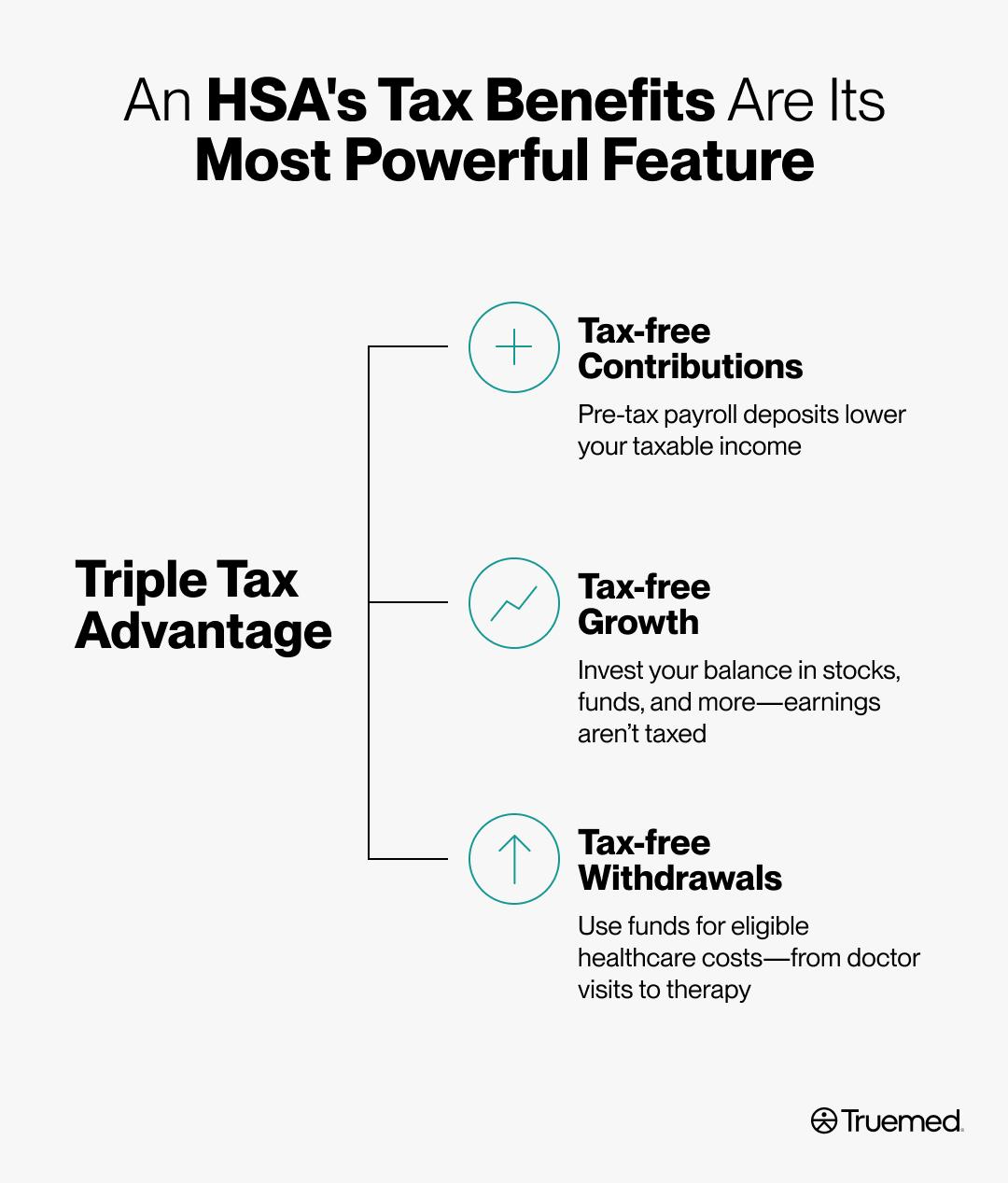
An HSA's tax benefits are its most powerful feature. And we're not talking about just one tax benefit. There are three. And they're known as an HSAs 'triple tax advantage.' These advantages include:
- Tax-free contributions: Do you make contributions to your HSA via payroll deductions? If the answer is yes, here's the good news: That money is being deposited into your HSA completely tax-free, meaning before taxes are deducted from your paycheck. This reduces your taxable income. In addition, HSA contributions are exempt from Social Security and Medicare taxes.
- Tax-free growth: Benefit number two provided by HSAs is the ability to invest the money you've saved in stocks, mutual funds and more without being required to pay taxes on your earnings.
- Tax-free withdrawals on qualified expenses: The money accumulated in your HSA can be tapped into tax-free to cover qualified health expenses. That includes expenses like doctor visits, hospital services, lab bills, and prescription drugs prescribed by a health care provider, as well as expenses you may not initially realize may be eligible for coverage for qualified individuals, such as therapy, supplements, sleep tech, and even gym memberships.
Many account holders fail to understand the full suite of tax benefits associated with an HSA and as a result, may not make the most of them. This is especially true with regard to the valuable, long-term investment opportunities that many HSAs provide.
"The important part here is the investment component," says Phillip Zagotti, JD, CPA, founder, North Star Law Firm. "People treat the account like a checking account [regularly withdrawing money], instead of letting the balance compound for decades."
Jason Hope, CPA, CFA, and founder of Hope Financial Consulting, agrees, stressing that HSAs offer immense growth potential, a factor that's often overlooked.
"HSAs are the best retirement plans available," says Hope. "You should set one up with a brokerage account, so you can invest in appreciating assets like stocks and bonds and then let the money grow until you retire, hopefully 20-plus years from when you contribute."
CPA takeaway #3: the best hsa tax savings strategy is often “pay now, reimburse later”
One of the most important strategies for maximizing your HSA savings and benefits is known as the "pay now, reimburse later" approach and it's a tactic that CPAs almost always recommend. This approach basically involves paying out of pocket for your qualified medical expenses (rather than turning to your HSA funds) and saving all of your receipts for those expenses to be used years later to seek reimbursement.
"This approach allows HSA funds to stay invested and grow tax-free. It effectively turns the HSA into a long-term, tax-advantaged asset," explains Daniel Roccanti, CPA, with James Moore & Co.
This strategy can be employed for years, even decades, as there is no deadline for seeking HSA reimbursement of qualified medical expenses. Leaving the maximum balance possible in an HSA year after year allows you to achieve the most substantial growth.
"This is my favorite thing about Health Savings Accounts and almost nobody does it," says Dimov. "There is no time limit on when you can reimburse yourself from your Health Savings Account. You can pay for an expense out of pocket, save the receipt and then reimburse yourself from your Health Savings Account 10 or 20 years later tax-free. This is powerful because it lets your Health Savings Account money keep growing and earning interest."
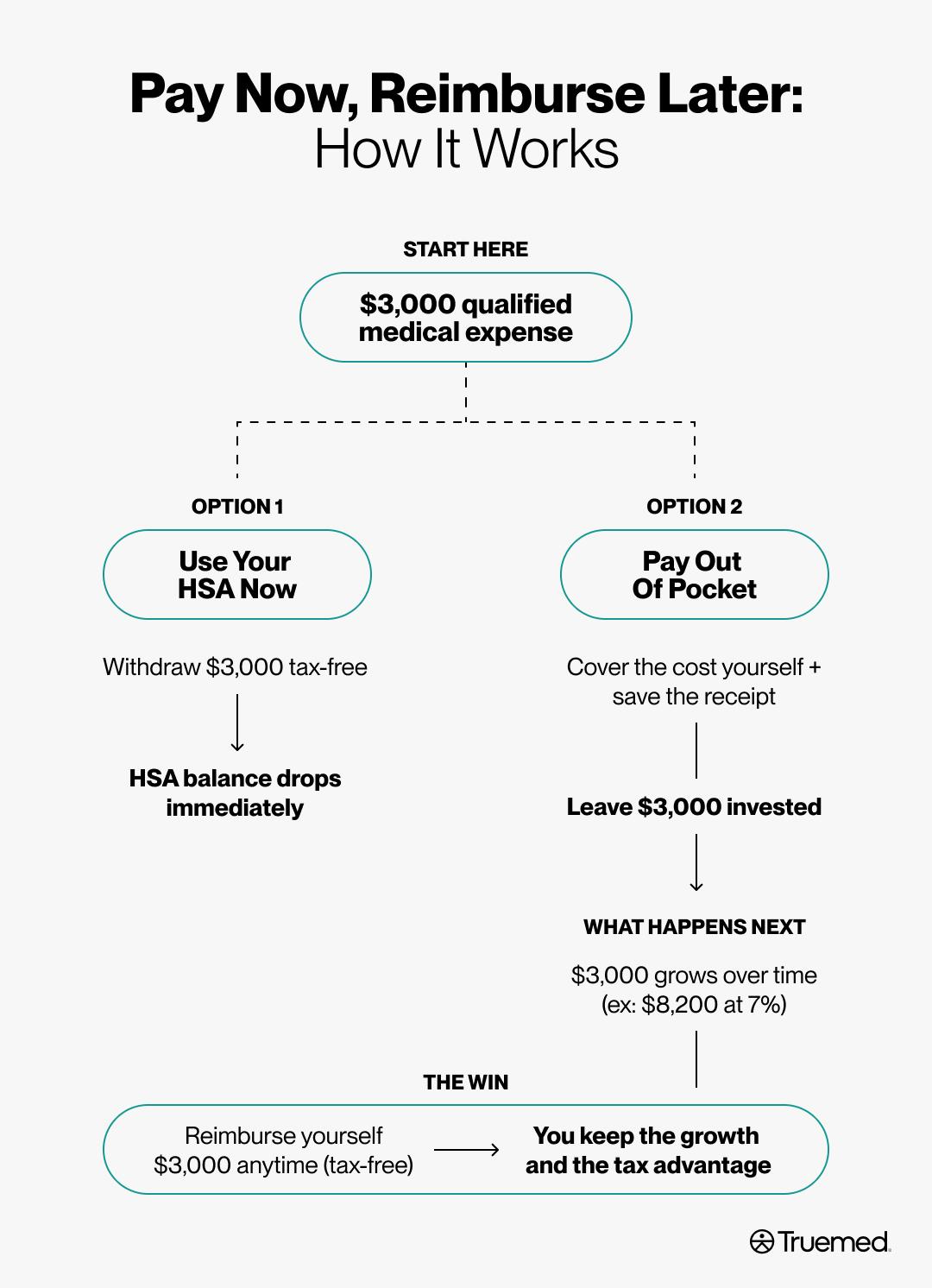
How does this work in practice exactly? Let's say you have a $3,000 qualified medical expense this year. You have two options for addressing that expense.
Scenario one: You could take the money out of your Health Savings Account immediately to cover that cost. If the expense is indeed qualified, you won't pay any taxes on the withdrawal. But you will have drawn down your HSA balance by $3,000.
Scenario two: Instead of withdrawing the money to cover the expense now, you opt to pay the bill out of pocket and hang onto the receipt for the qualified medical expense, using it to seek reimbursement at a later date. Meanwhile, you let the $3,000 in your HSA keep growing for 15 years, for example. "If it earns a 7% return, that $3,000 could become $8,200," explains Dimov. "Then you can reimburse yourself $3,000 tax- free whenever you want. You get to keep the growth and you still get the tax-free withdrawal."
A critical caveat here however is that this strategy only works if you're diligent about maintaining receipts justifying the expense for as long as you plan to wait before seeking reimbursement. Without receipts, this strategy falls apart because you will not have the required paper trail documenting that the expenditure was qualified (should the IRS ever request it.)
"The strategy depends on sufficient documentation, meaning scanning and saving every receipt and Explanation of Benefits (EOB) with the date of service, because a box of crumpled thermal paper receipts will not be useful in five years," says Zagotti.
CPA takeaway #4: how to use an HSA for retirement
HSAs often come up during conversations with retirement planning professionals and for good reason. As we've touched upon throughout this discussion, they can be an extremely effective and valuable tool when it comes to aggressively saving for healthcare expenses that you incur during retirement.
Money set aside in your HSA that remains untouched, (rather being used for present expenses) is able to keep earning interest year after year. What's more, that growth will keep compounding tax-free—and voilà, your HSA is effectively functioning like a long-term, tax-free investment vehicle.
"HSAs are great for the future, especially since healthcare gets expensive as you get older," says Nelson. "If you keep contributing and don’t spend it right away, you can build up a solid amount just for medical costs later in life."
Once you reach 65, all of that disciplined savings effort pays off in a few different ways. To begin with, withdrawals for qualified medical expenses will be tax-free. But that's not all. Once you turn 65, you're also able to withdraw money from your HSA for non-qualified medical expenses without incurring a penalty. (You will still be required to pay income taxes on the withdrawals, however.)
"You can use it for medical expenses tax-free or use it for anything, you’ll just pay regular income tax and no penalty," continues Nelson. " It can act like both a healthcare fund and a backup retirement account."
CPA takeaway #5: most HSA mistakes are compliance and timing mistakes
Before wrapping up this HSA discussion, let's just briefly underscore a few of the highlights we've covered. Some of the most common mistakes associated with HSAs relate to compliance and timing.
This includes overcontributing to an HSA, surpassing the annual contribution limits established by the IRS, which as noted above are $4,400 for self-only HSA accounts in 2026 and $8,750 for family HSAs.
Maintaining compliance with this rule can be especially tricky if your eligibility for an HSA does not cover a full calendar year. (In order to be eligible for an HSA, you must have a high deductible health plan (HDHP.) And if your insurance coverage changes at some point during the year and you're no longer eligible for an HSA or conversely, you suddenly become eligible for one, you cannot still contribute the maximum $4,400 or $8,750 allowed by the IRS for a full calendar year.
"You have to pro-rate the maximum contribution by the percentage of the year your HSA eligible plan was in effect in 2026," explains Hope.
Another all-too-common pitfall is assuming that every health-related purchase is automatically qualified for HSA coverage. This of course, is not true. There are specific rules around what is, and what is not covered. The tax code defines medical expenses as “amounts paid for the diagnosis, cure, mitigation, treatment, or prevention of disease, or for the purpose of affecting any structure or function of the body.” When in doubt, check with your plan administrator first before spending money on something, only to find out it's not a qualified expense.
And finally, failing to save receipts or backup documentation that supports the reason for your HSA spending can be a costly and frustrating mistake.
"You have to keep all your receipts. If the IRS ever asks, you must be able to prove that the expense was for a valid reason and that you had not already been reimbursed," explains Dimov. "I tell my clients to scan all their receipts into a special folder."
How It Works with HSA/FSA and Truemed
So where does Truemed fit into this discussion? Whether you opt to use your HSA savings now or later in life, Truemed specializes in helping qualified customers explore whether certain health products may be eligible for HSA coverage.
Here's how it works: First, using the Truemed platform, you can browse products or services that may qualify for HSA coverage. Once you've found an item or service you're interested in learning more about, simply click on the "Shop Now" button to be taken to the brand's own website.
As part of this process, you will be directed to complete a health intake survey, which a licensed clinician will review to determine whether you're eligible for HSA spending.
If it's determined that the purchase or service you're considering is medically necessary to treat or prevent a medical condition, based on your health information, a document known as a Letter of Medical Necessity (LMN) will be issued. The LMN will be sent to the email address you provide to be saved for your records.
It's also important to note that there is no additional cost to use Truemed when making purchases with your HSA funds. The cost of Truemed's services is included in the item's purchase price.
The bottom line
HSAs are a very valuable, tax-advantaged savings vehicle that can help you pay for qualified medical expenses now and save for future expenses incurred during retirement. But in order to make the most of the benefits associated with these accounts, it's important to understand the strategies, rules and restrictions that apply to HSAs. And no matter when you plan to use your HSA funds, Truemed can help you make the most of those dollars.
FAQ
For 2026, the annual contribution limit for HSAs is $4,400 for self-only HSA accounts and $8,750 for family HSAs. These limits apply to contributions to an HSA from all sources, which includes deposits made by you, as well as any funds your employer may kick-in.
HSAs offer what's known as a 'triple tax advantage,' meaning a triple tax benefit. Those benefits include allowing tax-free contributions to your HSA account, tax-free growth on earnings from investments made with your HSA dollars, and tax-free withdrawals for qualified medical expenses.
No, HSA funds must be spent on qualified health expenses. In cases when you spend HSA funds on ineligible expenses prior to age 65, there's a 20 percent withdrawal penalty. And that's not all. You'll also be required to pay applicable income taxes on the money withdrawn. However, once you're 65 or older, you can tap into HSA funds for ineligible expenses penalty free. But even here, you'll still be required to pay income taxes on the withdrawals.



Editorial Standards
At True Medicine, Inc., we believe better health starts with trusted information. Our mission is to empower readers with accurate and accessible content grounded in peer-reviewed research, expert insight, and clinical guidance to make smarter health decisions. Every article is written or reviewed by qualified professionals and updated regularly to reflect the latest evidence. For more details on our rigorous editorial process, see here.