
What Is an HSA and How Does It Work?
Author:Mia Taylor
Reviewed By:Katherine Janosz, MD
Published:
December 02, 2025
Last Updated:
October 06, 2026



Key Takeaways
With its triple tax advantage: a health savings account (HSA) can be a very valuable part of your overall financial planning efforts.
HSAs allow you to: save and invest money that can be used to pay for qualified medical expenses and they offer a variety of tax benefits in the process.
HSAs are portable accounts that belong to you. : If you leave an employer, the account and the funds contributed by both you and your employer, go with you.
If you have multiple HSA accounts, you can : consolidate the funds into a single account by initiating either a rollover or a trustee-to-trustee transfer.
Key Takeaways
What is an HSA?
How Does an HSA Work?
Eligibility Checklist (Before You Contribute)
Contributions and Limits
Using Your HSA: Card vs Reimburse Later
Investing & Cash Buffer (Growth Options)
Transfers & Rollovers
Life Events, Medicare, and Job Changes
Documentation & Compliance Tips
Common Mistakes & Easy Fixes
How Truemed Helps
FAQ
If you're enrolled in a high-deductible health plan, you may be considering signing up for a health savings account (HSA) to help defray some of your out-of-pocket medical expenses. Establishing an HSA can indeed be a smart move.
But before you open this type of account, it's important to understand exactly how HSAs work, including how they're funded, how to spend and invest the money you save in an HSA and how much money you're allowed to contribute to an HSA annually.
What is an HSA?
A health savings account (HSA) is a tax-advantaged savings and investment account that can be a very valuable part of your overall financial planning efforts. These accounts allow you to save money that can be used to pay for qualified medical expenses and they offer a variety of tax benefits in the process.
HSAs can be opened by self-employed freelancers and small business owners who have high-deductible health plans. In addition, many employers offer HSA programs to employees as part of a broader benefits package.
Considering signing on for an HSA? This guide will cover everything you need to know about how HSAs work, from eligibility to how money is deposited into an HSA account and how to spend and invest your HSA savings. Before wrapping up, we'll also cover some of the pitfalls to avoid with HSAs.
How Does an HSA Work?
To begin with, it's important to understand some of the basics surrounding how HSAs work including their very valuable tax benefits, which are also referred to as an HSA's 'triple tax advantage.' What does that mean exactly?
- Tax benefit number one: HSAs can be funded on a pre-tax basis, meaning you can deposit money you've earned but not yet paid taxes on.
- Tax benefit number two: The money you accumulate in your HSA savings is allowed to grow and accumulate interest tax-free
- Tax benefit number three: You can withdraw money from an HSA tax-free, so long as it's used to pay for qualified medical expenses.
"HSAs, if used correctly, are a powerful financial tool," says Jason Brown, creator of The Brown Report and author of Five-Year Millionaire: A Roadmap for Investing in the Stock Market, Wealth Accumulation and Financial Independence. "This is because you can put money in pre-tax, especially if you have a pre-planned medical event or if you are in need of a medical device in the future. You can also withdraw the money tax-free for qualified medical expenses. Depending on your HSA provider, you can also invest the money into mutual funds, stocks, and ETF’s, and the growth is tax-free. This is where the term triple tax-free account comes from."
It's also important to understand how you access the cash in an HSA when you need it. There are two primary ways to do that. Many HSAs, for instance, come with a debit card that can be used very much like those issued by a bank to pay for purchases at the point-of-sale.
You can also pay for medical expenses out-of-pocket and save the receipt (as documentation that the money was actually spent on a qualified expense). Using this approach, you can reimburse yourself from your HSA savings at a later date.
Many HSAs offer both options for spending the funds in your HSA account, allowing you to choose the method that works best.
One more important feature of HSAs: These accounts belong to the account holder. Meaning, if you initially established an HSA through an employer, and you later leave that job, the HSA leaves with you. The funds and the account are not forfeited simply because you change jobs. We'll talk more about that later.
Eligibility Checklist (Before You Contribute)
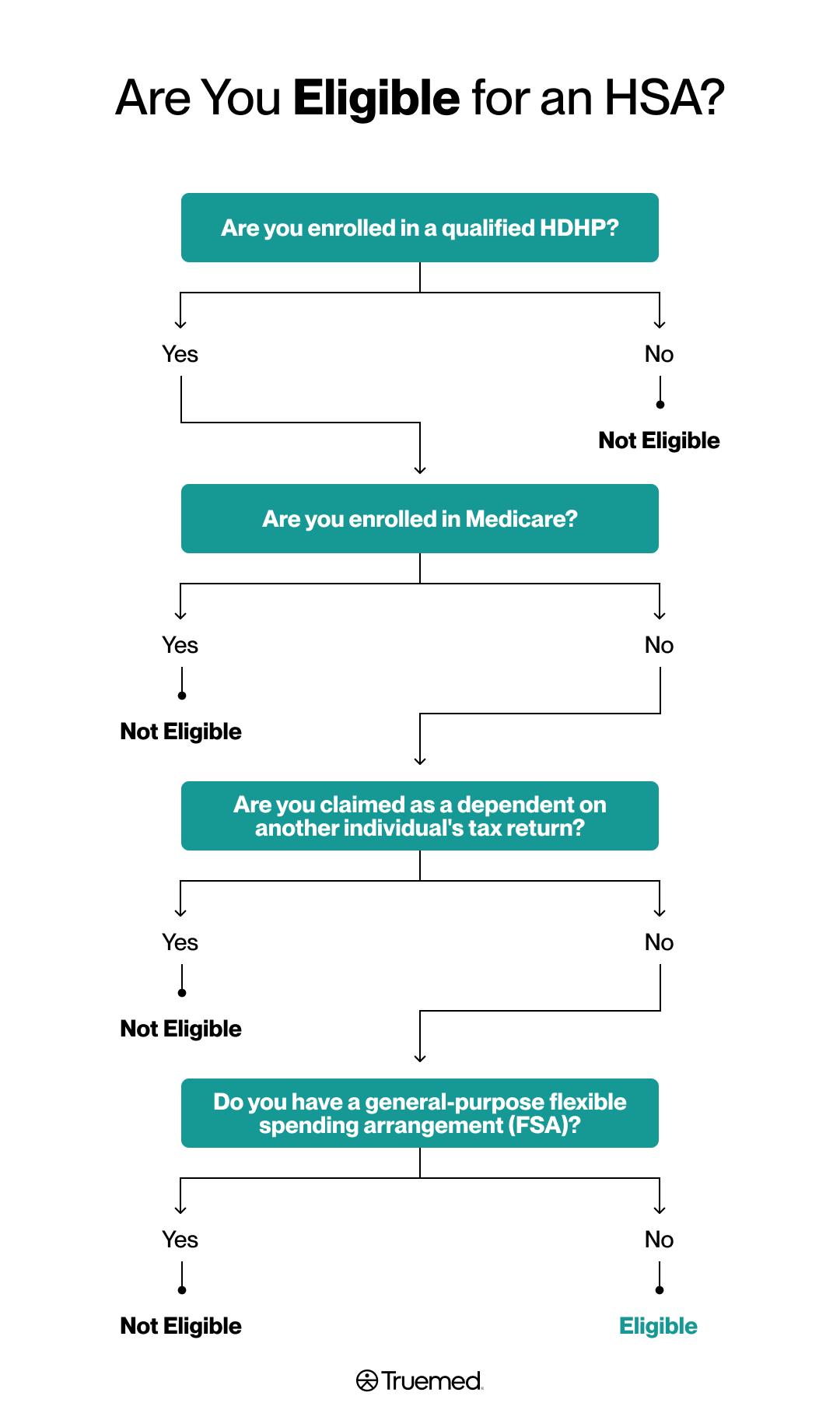
If you're interested in moving forward with an HSA, the next step is confirming that you're actually qualified to open this type of account. The following qualification check-list can help you answer that all-important question:
- Are you enrolled in a qualified HDHP? In order to be eligible for an HSA, you must be "covered by a high-deductible health plan (HDHP) on the first day of the month," according to the IRS.
- Are you enrolled in Medicare? The IRS stipulates that if you're enrolled in Medicare, you're not eligible to open an HSA.
- Are you claimed as a dependent on another individual's tax return? If the answer to this question is yes, then you cannot open an HSA, per the IRS.
- Do you have a general-purpose flexible spending arrangement (FSA)? If you already have a general purpose FSA, then you're not eligible to open an HSA. (However, it is possible to pair a Limited-Purpose FSA with an HSA.
One last point about eligibility: It's possible to open an HSA if you have a health reimbursement arrangement (HRA), but there are specific IRS rules surrounding how you use the funds from these two accounts. In particular, you cannot pull cash from your HSA in order to pay for medical expenses that were already reimbursed by your HRA.
Contributions and Limits
HSAs are designed to allow you to set aside money for qualified medical costs, but there's a limit to how much cash can be deposited into these accounts each year. For 2026, the limit set by the IRS is $4,400 for an individual HSA and $8,750 for a family HSA. The $8,750 contribution limit must also be divided between spouses if both spouses are HSA eligible, according to the IRS.
If you're just getting started with your HSA savings efforts and are 55 or older, the good news is that the IRS also allows for making an additional annual catch-up contribution of $1,000 annually.
There are also various ways to make contributions to your HSA. For instance, if you're participating in an HSA offered by an employer, the money is directly deducted from your paycheck on a pre-tax basis and deposited into the account.
It's also possible, however, to make after-tax contributions to your HSA, meaning deposit money you earned that's already been taxed. If you want to do this, you can still receive a tax benefit by deducting the post-tax HSA contribution when filing your annual tax return.
One last note when it comes to your HSA contributions, be careful not to deposit more than the annual IRS limit allows. If you do make excess contributions from your paycheck, the money will appear on your W-2 as taxable income.
And no matter how you make those excess contributions, whether from your paycheck or after tax, the IRS will charge a 6 percent tax on the excess contributions. That tax will also be charged on any interest you happen to earn on the excess contribution.
The good news is you can avoid these costly penalties by simply withdrawing the excess contribution before the annual tax return deadline of April 15.
Using Your HSA: Card vs Reimburse Later
There's two primary ways to access and spend your HSA savings on qualified medical expenses. One of the most convenient ways to use your HSA money is by paying for eligible expenses at the point-of-sale with your HSA debit card (if the account provides one).
"Most HSA custodians issue a debit card that pulls funds directly from your HSA," says Ethan Pickner, insurance broker and owner of Arizona Health Insurance Brokers. "You can use it at doctors’ offices, pharmacies, dentists, and other providers for qualified expenses. As long as the purchase qualifies under IRS rules, that payment is automatically treated as tax-free."
If you'd rather leave your savings in the account to grow and earn interest, you can pay for HSA-eligible expenses out-of-pocket and save the receipt to reimburse yourself at a later date. But keeping your receipt is critical when using this approach, to ensure you have proof that the expense was eligible for HSA reimbursement should you ever be audited by the IRS.
"As long as the expense occurred after your HSA was opened and you have documentation, you can reimburse yourself—even years later," says Pickner. "Many people use this method strategically to let their HSA balance grow tax-free and invest the funds longer."
Investing & Cash Buffer (Growth Options)
Beyond the triple tax benefits already discussed, one of the most valuable features of an HSA is the ability to invest the money you're saving in stocks, mutual funds and index funds, in order to help it grow faster.
In order to begin investing your HSA funds, many accounts require that you establish a minimum balance first, such as $1,000. Though it can be a good idea to shop around for HSA accounts that have no minimum balance requirements, so that you can begin investing sooner and accelerate the growth of your savings.)
It's also important to maintain a cash balance in your HSA and not invest the entire savings you've accumulated.
"Keeping a cash buffer is critical," says Michael Rodriguez, founder and lead planner at Equanimity Wealth. "You don't want to be forced to sell investments at the worst possible time just to pay a medical bill. Ideally, you should keep two to three years' worth of routine medical expenses in cash. If you typically spend $1,000 annually on medical costs, maintain $2,000 to $3,000 in cash."
Transfers & Rollovers
One of the most important and valuable benefits of an HSA is its portability. If you open an HSA with an employer and then leave that job, the money accumulated in your HSA is portable, meaning you keep the contributions you've made along with the contributions your employer made.
"When you leave your employer, you can take that account with you," says Lisa Cummings, of Cummings & Cummings Law, an attorney who specializes in employee benefits.
What's more, if you have several HSAs from previous employers, you can consolidate those funds into a single HSA account in order to streamline your financial portfolio and avoid paying fees across multiple accounts.
There are two ways you can move money from one HSA to another:
HSA Rollover: An HSA rollover involves telling your HSA account provider or custodian that you'd like to close the account and move the funds. When you make this request, the custodian can either send you a check for the balance in your HSA account or directly deposit the balance into a bank account in your name. After that, the money must be deposited into your new HSA account.
The good news is this process does not count toward the annual HSA contribution limit established by the IRS. However, you'll also need to be sure to deposit the disbursed HSA funds into the new HSA account within 60 days, per the IRS rules.
"A 60-day rollover occurs when you receive an HSA distribution and redeposit it into another HSA within 60 days," explains Cummings. "Missing the 60-day window turns the [money] into taxable income and may trigger penalties if you are under age 65."
The IRS will assess a 20 percent penalty if you fail to deposit the HSA funds into a new account within the specified timeline. In addition, the IRS only allows HSA accounts to receive one rollover contribution annually.
Trustee-to-Trustee transfers: A trustee-to-trustee transfer follows a slightly different path than a rollover. Rather than the HSA funds in the account you're closing being disbursed to you, the money is transferred directly to your new account. To initiate this process, you must contact the account custodian and let them know you'd like to transfer the funds. The benefit of this approach (compared to a rollover) is that you can make unlimited direct transfers each year. There is no annual cap.
"The IRS doesn't limit how often you are able to do this," says Rodriguez. "These are non-reportable transactions, don't require tax forms, and don't count toward annual contribution limits. This method is the safest, fastest, and most straightforward way to move HSA funds between providers."
Life Events, Medicare, and Job Changes
It's not unusual to experience a life event that impacts your continued eligibility to contribute to an HSA account. And it's important to know which life events have this ramification.
Most notably, if you enroll in Medicare at any point while also having an HSA account, you can no longer contribute funds to your HSA.
"Enrolling in any part of Medicare stops you from making further HSA contributions after the month of enrollment, although you may keep and spend the existing HSA balance," explains Cummings.
Leaving one job and going to a new employer who offers a different benefits package also has the potential to impact your continued eligibility to contribute to an HSA account. This might occur if your new employer's health plan is not a HSA qualified high-deductible health plan. Should this happen, the existing HSA remains yours and you can still use the savings you accumulated to pay for eligible medical expenses. However, you will no longer be able to continue contributing to the account.
Documentation & Compliance Tips
When you have an HSA, it's important to manage it effectively. That includes maintaining an organized archive of any receipts documenting that HSA funds were spent on qualified expenses.
While you're not required to provide this paperwork to the IRS, it's possible that you could be audited at some point in the future and having these documents will be important in order to prove that withdrawals were made for qualified expenses.
Documentation you should maintain includes:
- Point-of-sale receipts detailing the purchase made
- Credit card statements or bank records
- Paperwork from a medical provider indicating that a purchase or treatment was necessary. This could include a prescription or a doctor's after care notes or summary.
One last note on HSA rules, you'll want to avoid what's known as "double dipping." What does that mean exactly? If you have both an HSA account and an HRA, you cannot use HSA funds to pay for a qualified expense that has already been covered by your HRA account.
"Using your HSA account to pay for an already HRA-reimbursed expense creates a prohibited second tax benefit and exposes the individual to taxes and penalties," explains Cummings.
Common Mistakes & Easy Fixes
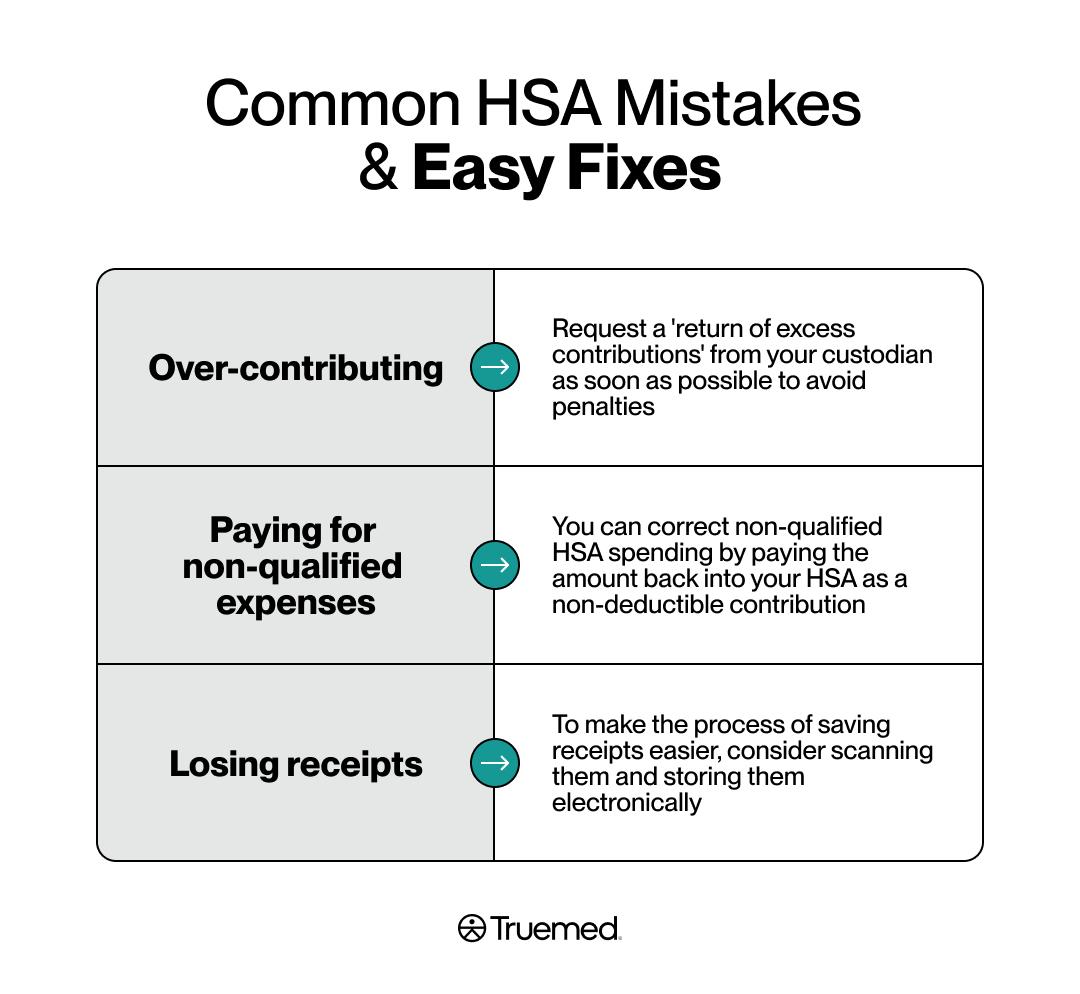
We've covered a lot of ground surrounding HSAs and how they function, so let's quickly recap some of the common mistakes that can be made when using these accounts.
- Over-contributing: Remember that the IRS limits the amount you can contribute to an HSA each year. However, if you accidentally contribute too much to an HSA, it is possible to rectify the situation. "If you contribute more than the IRS limit, request a 'return of excess contributions' from your custodian as soon as possible to avoid penalties" says PIckner.You have until tax day, April 15, to correct this situation by withdrawing the extra funds. If you fail to withdraw the money, the IRS could hit you with a 6 percent excise tax. In addition, the IRS states that the "excise tax applies to each tax year the excess contribution remains in the account."
- Paying for non-qualified expenses: Spending HSA funds on non-qualified expenses is another common pitfall you'll want to avoid. In other words, don't withdraw HSA funds and spend the money on groceries or rent. If you do so, the IRS will treat the distribution as gross income and apply a 20 percent penalty. But this error can also be corrected in order to avoid costly penalties.
"If you spend HSA dollars on a non-qualified expense, you may fix the error by paying that amount back into the HSA as a personal, non-deductible correction," explains Cummings.
- Losing receipts: Maintaining receipts related to HSA spending is also important. These can be important in the event that you are audited in the future by the IRS. To make the process of saving receipts easier, consider scanning them and storing them electronically (if they're paper receipts.)"Lost receipts make it hard to prove eligibility, so I recommend downloading and storing digital copies from insurers and retailers immediately," says Cummings.
How Truemed Helps
Truemed can make it easier for qualified customers to use HSA/FSA funds for eligible medical expenses.* There's a variety of ways to do that.
Perhaps most importantly, Truemed can help you obtain what's known as a Letter of Medical Necessity (LMN). This document substantiates that purchases you want to make are qualified expenses that will help either prevent, treat, cure, or mitigate a disease. Having an LMN allows qualified individuals to use tax-free HSA (and FSA) dollars for medical purchases.
Here's how it works: After you finish shopping, you'll be asked to complete a health survey. An independent licensed provider will then review your survey answers to determine eligibility. If approved, you receive an LMN that you can use to demonstrate that your purchases are eligible for HSA and FSA use.
*Truemed is for qualified customers. See terms at truemed.com/disclosures.
FAQ
HSAs offer many benefits, but there are also limitations to this type of account. Most importantly, there are specific restrictions on how the money in an HSA can be spent. The funds you withdraw must be used for qualified medical costs or you'll face tax penalties from the IRS. In addition, there are limits annually to how much you can contribute to an HSA, which for some people might be considered a downside.
Both HSAs and 401)k) accounts offer tax benefits when it comes to saving money. But an HSA offers far more of those benefits than a 401(k). HSAs come with a triple tax advantage that a 401(k) does not. With an HSA account, you're able to contribute money from your paycheck on a pre-tax basis. In addition, the money you accumulate in an HSA savings (including interest) is able to grow tax-free. And finally, you can withdraw money from an HSA tax-free, if it is spent on qualified medical expenses.
One of the incredibly valuable benefits of HSAs is that the money you accumulate in the account rolls over year after year. There is no spend it or lose it requirement. This feature makes HSAs a great tool for saving money that can be used in retirement for qualified medical expenses.
If you've paid for a qualified medical expense out of pocket, you can reimburse yourself from your HSA account to cover that cost. HSA providers may have specific steps that must be followed to obtain a reimbursement, but often you can go to your account's online portal and make a request for transfer of HSA funds to a linked bank account in your name. Some HSA accounts also allow for writing yourself a check from your HSA to cover the amount of the qualified medical expense.
Editorial Standards
At True Medicine, Inc., we believe better health starts with trusted information. Our mission is to empower readers with accurate and accessible content grounded in peer-reviewed research, expert insight, and clinical guidance to make smarter health decisions. Every article is written or reviewed by qualified professionals and updated regularly to reflect the latest evidence. For more details on our rigorous editorial process, see here.