
What Happens to Unused FSA Funds?
Author:Cheyenne Buckingham
Reviewed By:Michaela Robbins, DNP
Published:
December 04, 2025
Last Updated:
October 06, 2026



Key Takeaways
Your FSA funds have an expiration date: If you don’t use all of your FSA money before the end of the plan year, you risk losing the remaining balance.
Your FSA plan could soften hard deadlines: Certain FSA plans offer grace periods, carryover, and run-out periods that could potentially extend your deadline to use up funds or submit claims.
There are three different types of FSA plans: A Health FSA, Dependent Care FSA, and Limited-Purpose FSA each come with its own rules and limitations. That’s why it’s essential to review your Summary Plan Description (SPD) before incurring expenses or submitting claims for reimbursement.
An LMN may be necessary for certain items: If you want to buy a sauna, certain supplements, or a gym membership with your Health FSA, you may need to provide an LMN from an independent licensed health care provider through Truemed confirming the item is part of your treatment or prevention plan for a specific health condition.
Truemed makes it easy: Truemed simplifies the LMN process and offers a curated marketplace of evidence-backed health interventions that may be eligible for FSA spending for qualified individuals. It takes the guesswork out of the process so you can focus on your health, not navigating the fine print.
Key Takeaways
FSA 101
Use-It-or-Lose-It: The Core Rule
Grace Period vs Carryover vs Run-Out (Know the Difference)
What Actually Happens to Unused FSA Funds
Changing Jobs or Losing Coverage (Mid-Year Moves)
Health FSA vs Dependent Care FSA (Key Differences)
Limited-Purpose FSA (If You Also Have an HSA)
How to Avoid Forfeiting Your FSA Money (Action Plan)
Smart Year-End Spending Ideas (Health FSA)
Where LMN Helps
Documentation & Substantiation (Don’t Lose a Claim)
FAQ
A Flexible Spending Account (FSA) can be a money-saver, but only if you use it correctly. This employer-sponsored account lets you use pre-tax dollars from your paycheck for eligible medical expenses like copays, prescriptions, medical services, and, in some cases, certain fitness equipment when it is used to manage a specific health condition.
However, whatever you put into an FSA generally must be used by the end of the plan year. “If you don’t use the FSA funds, you lose them, which causes many people to be anxious,” says Alison M. Eddings, CPA and tax strategist at Top Dog Tax & Accounting, LLC.
In this guide, we will explain the use-it-or-lose-it rule; the difference between a grace period, a carryover, and a run-out period; what happens if you leave your plan mid-year; and smart ways to avoid forfeiture, so that you can use your funds with ease and confidence.
FSA 101
There are three types of FSAs: Health FSA, Dependent Care FSA, and a Limited-Purpose FSA (we’ll dive into each of these below). While they function a little differently, they all share one core requirement: you must enroll in them through your employer.
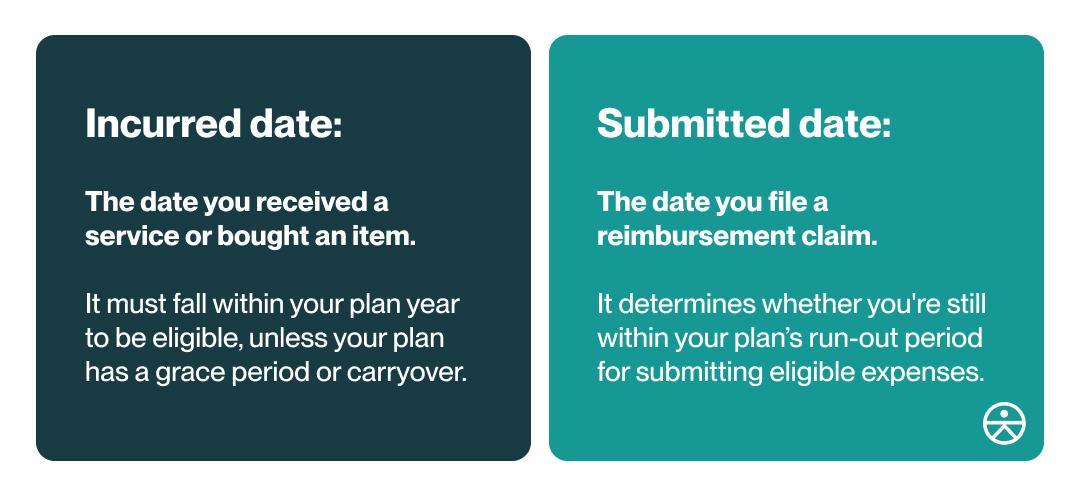
There are also two things to keep in mind when enrolling in an FSA. When you pay for something with your FSA card, whether that is the date of a medical service or the date you bought an item, this is known as the incurred date. This date must fall within your plan year to be eligible, subject to any plan-specific grace period or carryover.
When you file a claim for reimbursement, that is called the submitted date. The submitted date determines whether you are within your plan’s run-out period, which is the fixed time window when you can still submit claims for eligible expenses incurred during the plan year.
Ultimately, you should reference your Summary Plan Description (SPD) for key deadlines and reimbursement options.
Use-It-or-Lose-It: The Core Rule
An FSA is flexible on many things except one: when you need to spend the funds.
If the deadlines are not met, unused funds are forfeited back to the employer, says Chad Gammon, CFP, RICP, EA, a certified financial planner, enrolled agent, and founder of Custom Fit Financial. This results in forfeiture of your remaining FSA balance.
In some cases, employers can add features that may reduce forfeiture risk, such as a grace period, a limited carryover, and a run-out period for submitting claims.
Employers decide how forfeited funds are handled at the plan level, commonly to offset plan administrative costs. Often, this does not mean forfeited money is applied to an individual employee’s future expenses.
Grace Period vs Carryover vs Run-Out (Know the Difference)
Here’s a quick breakdown of how the grace period, carryover, and run-out period differ.
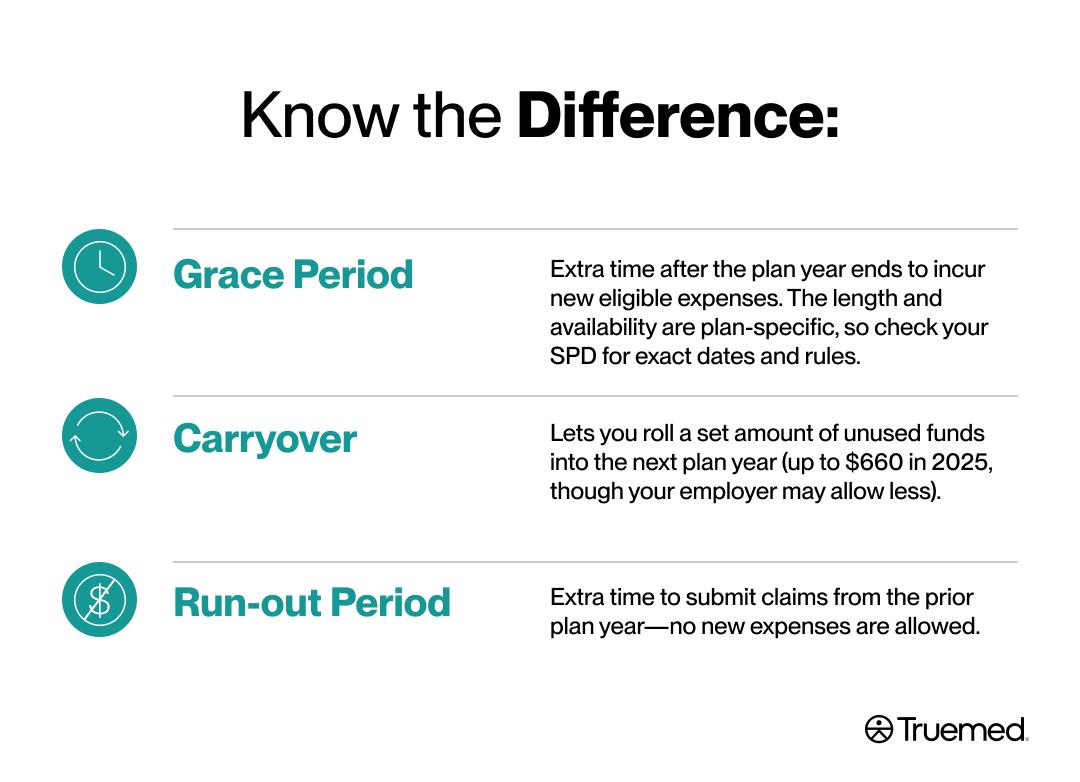
- Grace period: If your employer offers a grace period, it gives you extra time after the plan year ends to incur new eligible FSA expenses, Gammon explains. The length and availability are plan-specific, so check your SPD for exact dates and rules.
- Carryover: “Some health FSAs have a carryover feature that is set by the IRS,” Gammon explains. This means you can move a certain amount of funds from your last plan year into the next one. “The limit for 2025 is $660 maximum, but you should check your plan as your employer could have set a lower limit than the IRS,” he adds.
- Run-out period: This plan rule extends the time you have to submit claims you already incurred from the prior plan year—no new expenses are allowed.
Health FSAs may offer either a grace period or a carryover, and the availability of either feature varies by employer. A run-out period can apply to most FSA plan designs.
Dependent Care FSAs can have different rules than Health FSAs. Some plans may allow a grace period or a carryover, but you should confirm the details in your SPD.
What Actually Happens to Unused FSA Funds
It’s plain and simple, whatever funds you didn’t use from your plan year are forfeited back to your employer. Rarely do these funds come back to you, unless your plan specifies that you have a grace period or carryover.
Changing Jobs or Losing Coverage (Mid-Year Moves)
If you leave your job mid-year, your Health FSA eligibility typically ends on your coverage termination date. “You can not keep those funds in most cases,” says Gammon. Often, you can only claim expenses incurred on or before your last day. “There are a few exceptions and a common one is if you go on COBRA insurance.” (COBRA is when you temporarily continue your employer-sponsored health benefits.)
“Your employer might also have a run-out date where you could submit a claim after your termination,” Gammon adds.
To avoid losing funds, try to schedule routine care before your last day and keep all receipts for run-out submissions.
Health FSA vs Dependent Care FSA (Key Differences)
A Health FSA generally covers eligible medical, dental, and vision expenses such as prescriptions, copays, and exams. In some cases, you can also purchase certain health adjacent items such as fitness equipment and gym memberships with a Letter of Medical Necessity (LMN) written by an independent licensed provider. Depending on your employer’s plan, you may have either a grace period or a carryover, and your plan may include a run-out period for submitting claims for expenses incurred during the plan year.
A Dependent Care FSA is different: it reimburses eligible dependent care expenses needed so you can work, such as childcare or elder care. It follows separate tax rules, has specific documentation requirements, and typically requires provider receipts. (LMNs apply only to health-related FSAs, not Dependent Care FSAs.) For families with higher annual care costs, these accounts can be part of a broader tax strategy. “If you are a married couple who pay more than $7,500 a year in dependent care costs, you could potentially take both the dependent care credit on your tax return and utilize the Dependent Care Flex Spending Account,” Eddings notes.
Limited-Purpose FSA (If You Also Have an HSA)
A Limited-Purpose FSA is an option for people who want to save pre-tax dollars for just dental and vision expenses. These accounts may also include a grace period or carryover, depending on your employer’s plan design.
“If you are adopting my strategy to set aside just money for dental and vision you can do that in the limited purpose FSA and still have a Health Savings Account (HSA),” Eddings says. This is also a great route for people who want to grow their wealth with a triple tax advantage.
How to Avoid Forfeiting Your FSA Money (Action Plan)
Consider this your go-to guide to making sure you don’t lose unused FSA dollars. As Gammon notes, the first action item is to spend time planning what your expected costs will be for the following plan year. “It doesn't hurt to be a little conservative on your estimates,” he says. He also recommends checking whether you have a grace period so you can schedule some appointments in January or February if needed.
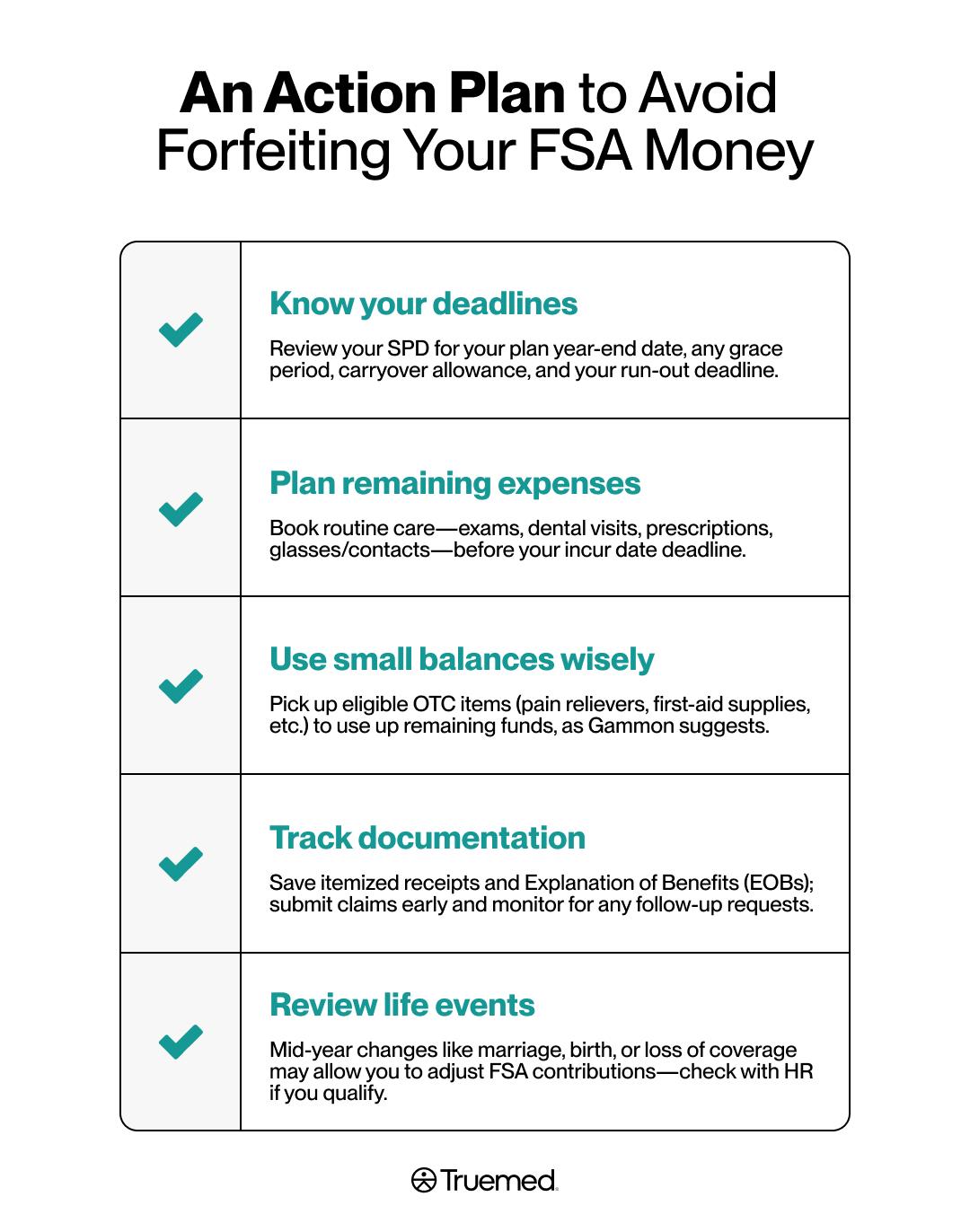
Follow this year-end checklist:
- Know your deadlines: Review your SPD for your plan year-end date, any grace period, carryover allowance, and your run-out deadline.
- Plan remaining expenses: Book routine care—exams, dental visits, prescriptions, glasses/contacts—before your incur date deadline.
- Use small balances wisely: Pick up eligible OTC items (pain relievers, first-aid supplies, etc.) to use up remaining funds, as Gammon suggests.
- Track documentation: Save itemized receipts and Explanation of Benefits (EOBs); submit claims early and monitor for any follow-up requests.
- Review life events: Mid-year changes like marriage, birth, or loss of coverage may allow you to adjust FSA contributions—check with HR if you qualify.
Smart Year-End Spending Ideas (Health FSA)
Apart from attending routine doctor and therapy visits, you can also spend your funds on many other FSA-eligible items, including menstrual care products, sunscreen, hand sanitizer and so much more. Qualified customers can also use their Health FSA to buy fitness equipment, gym memberships, and certain supplements with an LMN.
Where LMN Helps
An LMN expands FSA-eligible shopping opportunities. The key is to make sure your health care provider writes an LMN that clearly explains why you need a product or service to treat or manage a diagnosed health condition.
When you shop the Truemed marketplace for items that are FSA-eligible for qualified customers, you’ll be directed to a health intake during checkout. An independent licensed clinician will review your intake answers and based on their assessment may recommend the product for the treatment or prevention of a medically relevant condition and write you an LMN so you'll be able to use your FSA funds to make the qualified purchase.
Note: LMNs do not extend FSA deadlines or increase your contribution limits.
Documentation & Substantiation (Don’t Lose a Claim)
To help your FSA claims get processed:
- Submit itemized receipts that include the date of service, provider or vendor name, amount charged, and a clear description of the expense.
- Provide proof of service when required, especially for medical or dependent care services.
- Use your plan’s portal or app, if available, to upload documents, check claim status, and respond to resubmission requests promptly.
- Keep records organized, including any LMNs for applicable medical expenses, for the retention period your plan recommends.
- Save receipts and EOBs with your claim file in case they are needed for audit support.
FAQ
For many people, the biggest drawback is the use-it-or-lose-it rule, which means any unused funds can expire if you miss the deadlines. This makes it essential to understand your plan’s specific rules—like grace periods, carryovers, and run-out dates—so you can use all of your pre-tax dollars accordingly.
If you don’t spend your FSA money before the end of your plan year, and your plan doesn’t offer a grace period or a carryover, you will lose that money forever.
“They can in a couple of cases,” Gammon says. “If you had ineligible expenses, you must repay the amount [you charged]. Also if you can't provide documentation, they could say it is ineligible as well.” In short: Be sure to know which items are FSA-eligible and which ones aren’t before you charge your FSA card or submit a claim for reimbursement.
If you don’t use your FSA funds before your retirement date, i.e. the date you leave your job, the funds will be forfeited. There are no special exceptions for retirement: “It’s the same as if you left your job for another one,” Gammon says. “You might look at COBRA insurance if you still need insurance before Medicare.”
Once your funds have been forfeited there is no going back. Be sure to read your SPD at the beginning of the plan year to make sure you know when you need to use your funds before you lose them.
Editorial Standards
At True Medicine, Inc., we believe better health starts with trusted information. Our mission is to empower readers with accurate and accessible content grounded in peer-reviewed research, expert insight, and clinical guidance to make smarter health decisions. Every article is written or reviewed by qualified professionals and updated regularly to reflect the latest evidence. For more details on our rigorous editorial process, see here.