
The Gen Z Health Investment Stack: Sleep, Exercise, and Animal Organ-Based Supplements
Author:Sinduja Rangarajan
Published:
August 07, 2026


Key Takeaways
Gen Z is the fastest-growing cohort on Truemed: Their share of platform orders climbed from 10.4% to 12.5% between Q1 2025 and Q1 2026.
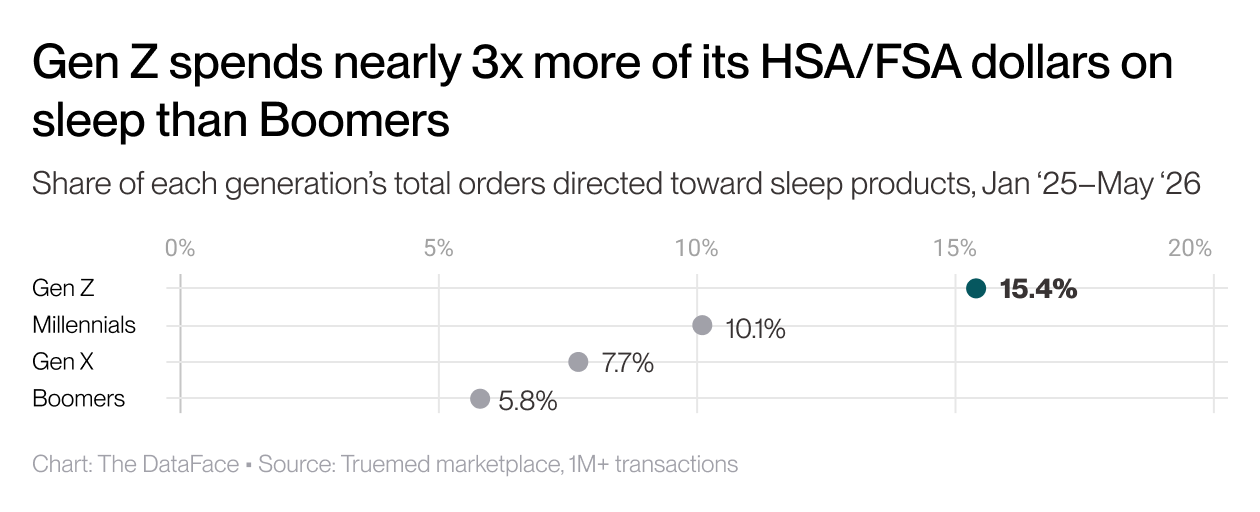
Sleep accounts for 15.4% of Gen Z's orders, nearly three times Boomers' share (5.7%): Sleep ranks #2 in Gen Z's basket, behind supplements.
The structural investment shift from pills to infrastructure: Share of supplements fall from 47.6% of Boomer orders to 24.5% of Gen Z orders. The orders the older cohorts spend on pills, Gen Z spends on exercise passes, wearables and activity trackers, and home fitness infrastructure.
Gen Z is investing in exercise as preventive care more than any older generation: Gyms and studios make up 7.8% of Gen Z's orders, nearly twice the rate of millennials (4.3%) and more than five times the rate for Boomers (1.4%).
Metabolic-and-longevity supplementation over-indexes with Gen Z: Blueprint by Bryan Johnson, marketed for cardiovascular, metabolic health and longevity, sees Gen Z buyers at more than twice the Boomer rate.
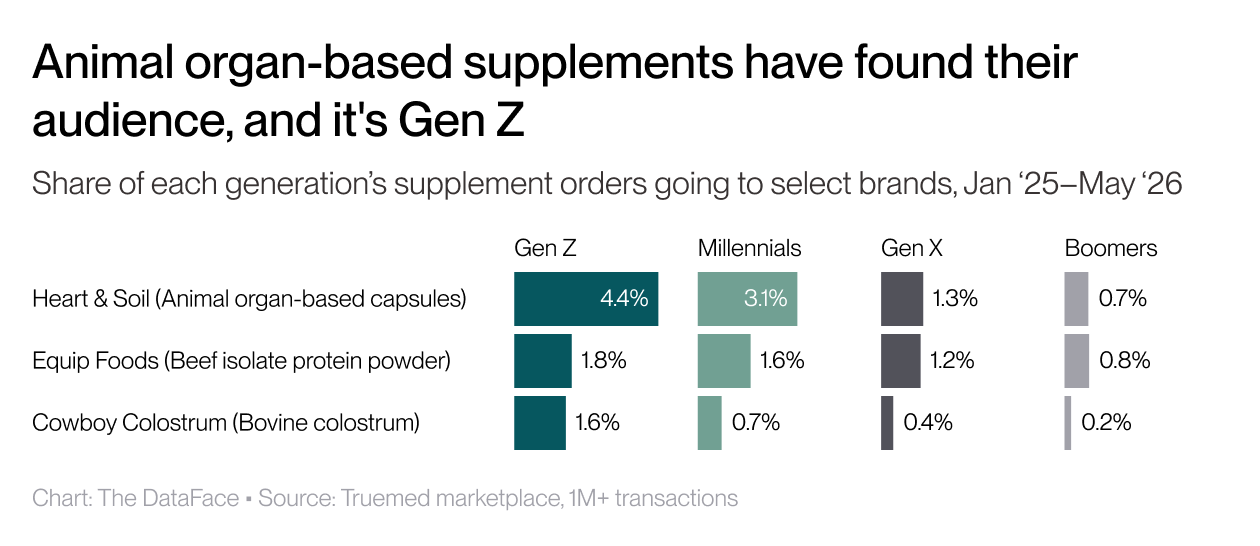
Organ-based supplements are a Gen Z brand cluster, marketed against nutrient deficiency: Heart & Soil, Cowboy Colostrum, and Equip each show up in Gen Z's top 30 supplement merchants and barely register in older cohorts.
Key Takeaways
1. Gen Z is the fastest-growing cohort on Truemed
2. Gen Z is prioritizing sleep before any other generation
3. The shift from pills to investing in health infrastructure
4. Animal organ-based nutrition supplements are a Gen Z phenomenon
5. The longevity bet, made young
The bigger picture
Methodology
Citations
FAQ
Shop Eligible Products
Ready to unlock your HSA/FSA funds for qualified medical expenses?
A new analysis of more than a million HSA and FSA transactions on Truemed's preventive health marketplace, covering January 2025 through May 2026, finds Gen Z (18-29) growing faster than any other generation on the platform and directing their orders toward a different mix of wellness categories than older cohorts — more sleep, more gyms, exercise-and fitness-based programs and metabolic-and-longevity based supplements.
Gen Z now spends more time sleeping than any other generation and #sleepmaxxing has become a defining bedtime ritual on TikTok; the sleep-technology market is on track to almost triple in size between 2019 and 2026 per McKinsey; and Fortune writes about CEOs adopting Gen Z's bedtime routines.
The same generation that gets called the loneliest and the most overwhelmed in modern survey work is the one showing up in the preventive-health aisle with the most intention.
The clinical case for Gen Z’s investments in sleep and exercise are well documented in chronic-disease literature. Sleep loss in young adulthood is associated with long-term cardiovascular, metabolic, and neurodegenerative risk. Physical activity in young adulthood reduces incidence of cardiovascular disease, type 2 diabetes, anxiety, and depression decades later.
Gen Z's health investment is following a playbook that learns from older generations' mistakes and prepares for their own.
1. Gen Z is the fastest-growing cohort on Truemed
Gen Z's order count on Truemed climbed faster than any other generation's over the past year, lifting their share of platform orders by about two points.
- Share of platform orders: Gen Z climbed from 10.4% to 12.5% between early 2025 and early 2026.
Gen Z is taking charge of preventive care earlier than any other generation on Truemed. They're treating sleep, exercise, and metabolic health as long-term investments and acting now.
2. Gen Z is prioritizing sleep before any other generation
Sleep accounts for 15.4% of Gen Z's orders on Truemed, nearly three times Boomers' share (5.7%), and ranks #2 in the Gen Z basket behind supplements.
McKinsey ranks sleep as the second-highest U.S. health priority and the area with the most unmet demand.
The CDC links chronic sleep loss to hypertension, type 2 diabetes and depression. In 2020, 35% of U.S. adults reported sleeping less than seven hours per night, the level the CDC associates with elevated risk for those conditions.
- Sleep order share by generation: Gen Z 15.4% / Millennials 10.1% / Gen X 7.7% / Boomers 5.7%
- Hatch, a sunrise alarm and bedtime-routine device, which qualifies for sleep disorders and circadian rhythm dysregulation, ranks as Gen Z's #1 merchant on Truemed.
- Sleep brands such as Eight Sleep, Purple, and Resident Home qualify for HSA and FSA spending when used to address chronic fatigue, insomnia and other conditions, and rank among Gen Z's most-purchased products.
Gen Z is growing up in a stress-saturated cultural moment that makes sleep harder to come by. They sleep poorly as compared to other generations, understand what's at stake and are spending pre-tax dollars on sleep.
Sleep is Gen Z's #2 category, and it peaks where America sleeps worst
Sleep is the second-largest slice of Gen Z's wellness orders nationally (about 15%, behind supplements), and geographically it peaks in Appalachia.
It is highest in West Virginia (23%) and Kentucky (19%), roughly 1.5x and 1.2x the national rate. That lines up with the CDC sleep map: the Southeast and Appalachia have the worst sleep in the country, and West Virginia and Kentucky rank among the most sleep-deprived for both adults and kids.
Beyond Appalachia, elevated sleep orders also show up in the Plains and Upper Midwest (Kansas, Iowa, Wisconsin) and northern New England (Maine).
The big-volume states (California, New York, Florida, Texas, Colorado) all sit at or below the national average, so despite their large order counts they do not over-index on sleep.
| State | Sleep share of Gen Z orders | vs. national (~15.3%) |
|---|---|---|
| West Virginia | 23% | 1.5x |
| Maine | 20% | 1.3x |
| Kentucky | 19% | 1.2x |
| Washington, D.C. | 18% | 1.2x |
| Iowa | 18% | 1.1x |
| Kansas | 18% | 1.1x |
| Nevada | 17% | 1.1x |
| New Mexico | 17% | 1.1x |
| North Carolina | 17% | 1.1x |
| Wisconsin | 17% | 1.1x |
| New Hampshire | 17% | 1.1x |
| Virginia | 17% | 1.1x |
| Oregon | 16% | 1.0x |
| California | 15% | 1.0x |
| New York | 15% | 1.0x |
| Florida | 15% | 1.0x |
| National | 15.3% | 1.0x |
| Texas | 15% | 1.0x |
| Colorado | 14% | 0.9x |
3. The shift from pills to investing in health infrastructure
Gen Z is putting a smaller share of their orders into supplements and a larger share into health infrastructure — gyms, sleep and home health — than any older generation.
Physical activity is an established intervention for cardiovascular disease, hypertension, type 2 diabetes, depression, and anxiety. Gen Z directs a higher share of orders to exercise- and fitness-based programs than any older cohort.
Gyms and studios make up 7.8% of Gen Z's orders, nearly twice the rate of millennials (4.3%) and more than five times the rate for Boomers (1.4%).
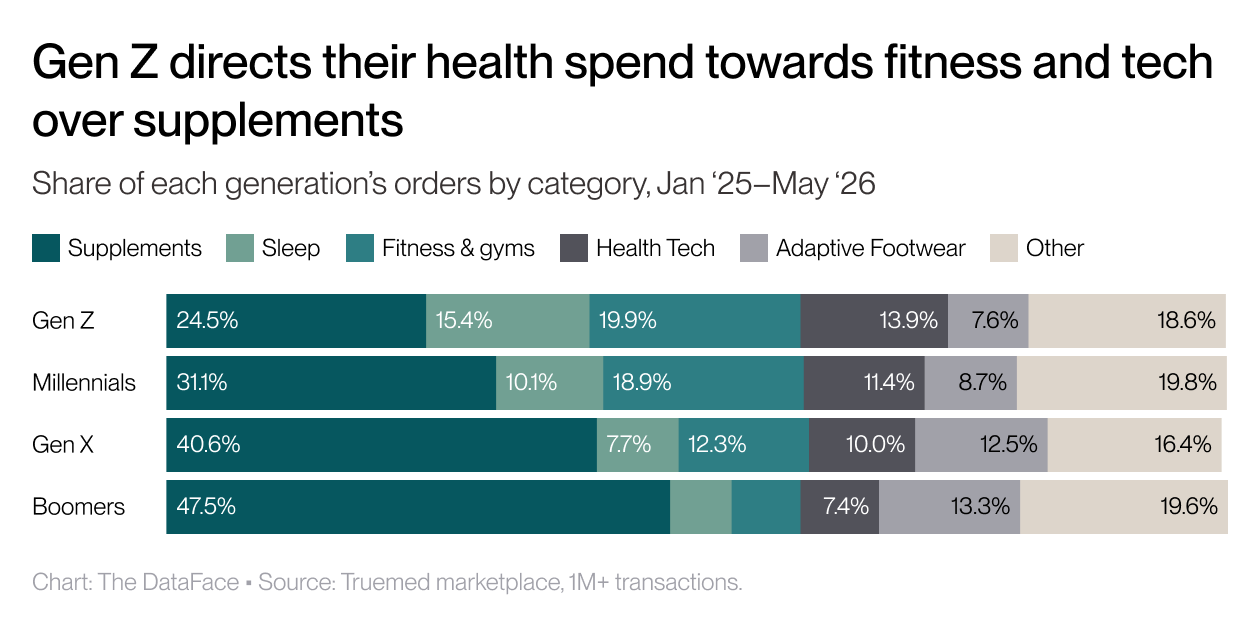
For older cohorts on Truemed, preventive care comes mostly as a daily pill. Pills don't disappear in the Gen Z basket; they take a smaller share of it, with gym memberships, fitness equipment, sleep, and home-health products absorbing the rest.
Gen Z's favorite sport is climbing, led by D.C. and Minnesota
Climbing is the clearest generational signal in fitness, and it concentrates in a specific set of young, urban metros rather than spreading evenly.
Gen Z places about 1.5 times as many of its gym orders on climbing as Millennials do, and far more than Gen X or Boomers. The pull is driven by a handful of very popular climbing brands: Central Rock Gym, Bouldering Project, Movement Gyms, Mesa Rim Climbing Centers, and Touchstone Climbing.
| Generation | Climbing share of gym orders |
|---|---|
| Gen Z | ~13% |
| Millennials | ~9% |
| Gen X | ~3% |
| Boomers | ~0% |
Geographically it clusters: climbing is biggest in Washington, D.C. and Minnesota (about 34% of Gen Z gym orders each), then Maryland, Washington State, and Colorado, against about 13% nationally.
These are young, urban, outdoors-minded places where climbing gyms double as social hubs as much as workout spots.
| Place | Climbing share of Gen Z gym orders |
|---|---|
| Washington, D.C. | 34% |
| Minnesota | 34% |
| Maryland | 29% |
| Washington | 26% |
| Colorado | 23% |
| National | 13% |
4. Animal organ-based nutrition supplements are a Gen Z phenomenon
A small group of animal-based supplement brands marketed for nutritional deficiency, gut support and immune health and shows up disproportionately in Gen Z's basket on Truemed.
Ancestral nutrition is a movement built around supplements meant to mirror what pre-industrial ancestors ate: capsules of beef liver, heart, and other organ meat; bovine colostrum, the first milk a cow produces after birth; and grass-fed beef proteins. The premise is that modern processed food strips out nutrients that ancestral diets contained.
Heart & Soil, Cowboy Colostrum, and Equip beef isolate rank inside Gen Z's top 30 supplement merchants.
5. The longevity bet, made young
Blueprint by Bryan Johnson is a daily supplement, food and biometric tracking regimen targeting mitochondrial function, inflammation control, and metabolic regulation engineered for longevity.
Gen Z orders Blueprint at more than twice the Boomer rate, and ahead of Millennials and Gen X.
- Relative purchase rate (Boomer rate = 1x): Gen Z 2.3x / Millennials 1.8x / Gen X 1.3x / Boomers 1.0x
The bigger picture
McKinsey describes sleep, fitness, longevity, and women's health among the fastest-moving dimensions of consumer health and wellness which is growing at about 10% every year. Gen Z is the cohort turning those dimensions into pre-tax preventive-care spending earlier than any prior generation. Their pattern:
- Less oral supplementation; more behavior- and environment-based intervention
- More sleep as cardiovascular-and-cognitive preventive care
- More exercise as medicine
Methodology
This analysis covers more than a million completed HSA and FSA transactions on Truemed's preventive-health marketplace between January 2025 and May 2026. All data is aggregated and anonymized at the generation and gender level. Age and gender are self-reported at the qualification step in Truemed's intake process.
- Gen Z: 18 to 29
- Millennials: 30 to 45
- Gen X: 46 to 61
- Boomers: 62 and older
- Order share = a category's or brand's transactions ÷ that cohort's total transactions during the study window
- Generation share of platform orders is a point-in-time comparison between Q1 2025 and Q1 2026
Truemed sees orders placed on the platform using HSA and FSA dollars, but not a buyer's full HSA balance or out-of-marketplace purchases.
All transactions on the platform, when required, are accompanied by a Letter of Medical Necessity (LMN) issued by an independent licensed practitioner under IRS guidance allowing pre-tax health spending on products and services that diagnose, prevent, mitigate, or treat disease.
Citations
Sleep and chronic disease
CDC, Sleep Chronic Disease Indicators
CDC – Preventing Chronic Disease, Effect of Inadequate Sleep on Frequent Mental Distress / PubMed abstract
NIH/PMC, Sleep Deprivation in Dementia Comorbidities: Cardiovascular Disease, Diabetes, Anxiety/Depression
NIH/PMC, Sleep as a Mediator Between Chronic Diseases and Depression (NHANES 2005–2018)
Exercise, mental health, and chronic disease
PubMed, Effectiveness of Wearable Activity Trackers to Increase Physical Activity
PubMed, Association Between Physical Activity and Risk of Depression: A Systematic Review and Meta-analysis
AHA Journals (Circulation), Exercise and Physical Activity in the Prevention and Treatment of Atherosclerotic Cardiovascular Disease
Gen Z sleep, stress, and lifestyle
NIH/PMC, Internal and External Factors Influencing Gen Z Wellbeing
Journal of Computer Science, Generation Z Health Trends: Data Mining of Sleep and Lifestyle
FAQ
Yes, in many cases gym memberships are eligible for HSA/FSA spending when used to treat a diagnosed condition (like obesity, hypertension, or a musculoskeletal issue). For qualified customers, a membership to a climbing gym or yoga studio may be HSA/FSA eligible when accompanied by a Letter of Medical Necessity (LMN) from a licensed clinician. Without appropriate documentation connecting the membership to a diagnosed medical condition, gyms are considered general wellness and aren't HSA/FSA eligible.
Sleep tech (like Hatch or Eight Sleep) may be eligible when used to address a diagnosed condition such as insomnia, sleep apnea, or circadian rhythm disorders, again with a Letter of Medical Necessity. A device bought purely for general comfort or convenience wouldn't qualify on its own.
Some nutritional supplements are pre-approved for HSA/FSA spending while others are only eligible when they’re accompanied by documentation that specifically connects the product to a diagnosed medical condition. Organ supplements like ARMRA, Cowboy Colostrum, and Heart & Soil have become very popular among Gen Z audiences and may be eligible for HSA/FSA spending for qualified customers.
A Letter of Medical Necessity (LMN) is a document from a licensed healthcare provider that says a specific product or service is needed to treat, prevent, or manage a health condition. And with one, your HSA/FSA dollars can go a lot further, covering things that actually support your health, like supplements, sleep tech, diagnostics, or fitness equipment. That’s where Truemed comes in. We connect you with a licensed clinician who can evaluate your needs and, if appropriate, issue an LMN for IRS-approved products and services. No doctor visits, no insurance hoops. Just a smarter way to spend on the clinically-backed interventions that matter for your health.



See what you can do with your HSA/FSA.
Join 1.5 million Americans who have routed their healthcare dollars toward root cause health via Truemed's HSA/FSA marketplace.
New product announcements
Sales and special offers
Tips for utilizing your HSA/FSA
Editorial Standards
At True Medicine, Inc., we believe better health starts with trusted information. Our mission is to empower readers with accurate and accessible content grounded in peer-reviewed research, expert insight, and clinical guidance to make smarter health decisions. Every article is written or reviewed by qualified professionals and updated regularly to reflect the latest evidence. For more details on our rigorous editorial process, see here.