
HSA Statistics, Facts, and Research for 2026
Author:Mia Taylor
Reviewed By:Michaela Robbins, DNP
Published:
March 31, 2026
Last Updated:
August 10, 2026



Key Takeaways
Millions of HSA Accounts: As of mid-2025, there were some 40 million HSA accounts with combined assets of $159 billion.
Adoption Steadily Growing: Adoption of HSA accounts has been growing. Between mid-2024 and mid-2025 the total HSA accounts increased by 6 percent year-over-year.
Record Levels of Investment: The amount of money being invested through HSA accounts has reached record levels, nearly $73 billion as of mid-2025, a 30 percent increase over one year earlier.
Most HSAs Provided by Employers: The majority of HSA accounts, 61 percent, are employer affiliated. That amounts to 24 million accounts.
Key Takeaways
HSA statistics snapshot (accounts, assets, average balance)
Average HSA account balance: what it means
Average HSA contribution: employee vs employer
HSA growth rate and HSA trends over time
How people use HSAs: spending, saving, and investing patterns
Who has HSAs: demographics
Where HSA statistics come from
How it works with HSA/FSA and Truemed
FAQ
Shop Eligible Products
Ready to unlock your HSA/FSA funds for qualified medical expenses?
A health savings account (HSA) is a special type of savings account designed to help you set aside money to pay for qualified, out-of-pocket medical expenses. These valuable tax-advantaged savings accounts are available to people who have a high-deductible health plan (HDHP), whether through an employer or through a health insurance marketplace.
In this guide, we'll take a closer look at some of the key statistics surrounding adoption and use of HSAs in the United States including the average HSA account balance, the average annual HSA contribution, and how much money HSA account holders typically withdraw. This guide answers those questions and more, based on the most recently available information. Read on to find out more.
HSA statistics snapshot (accounts, assets, average balance)
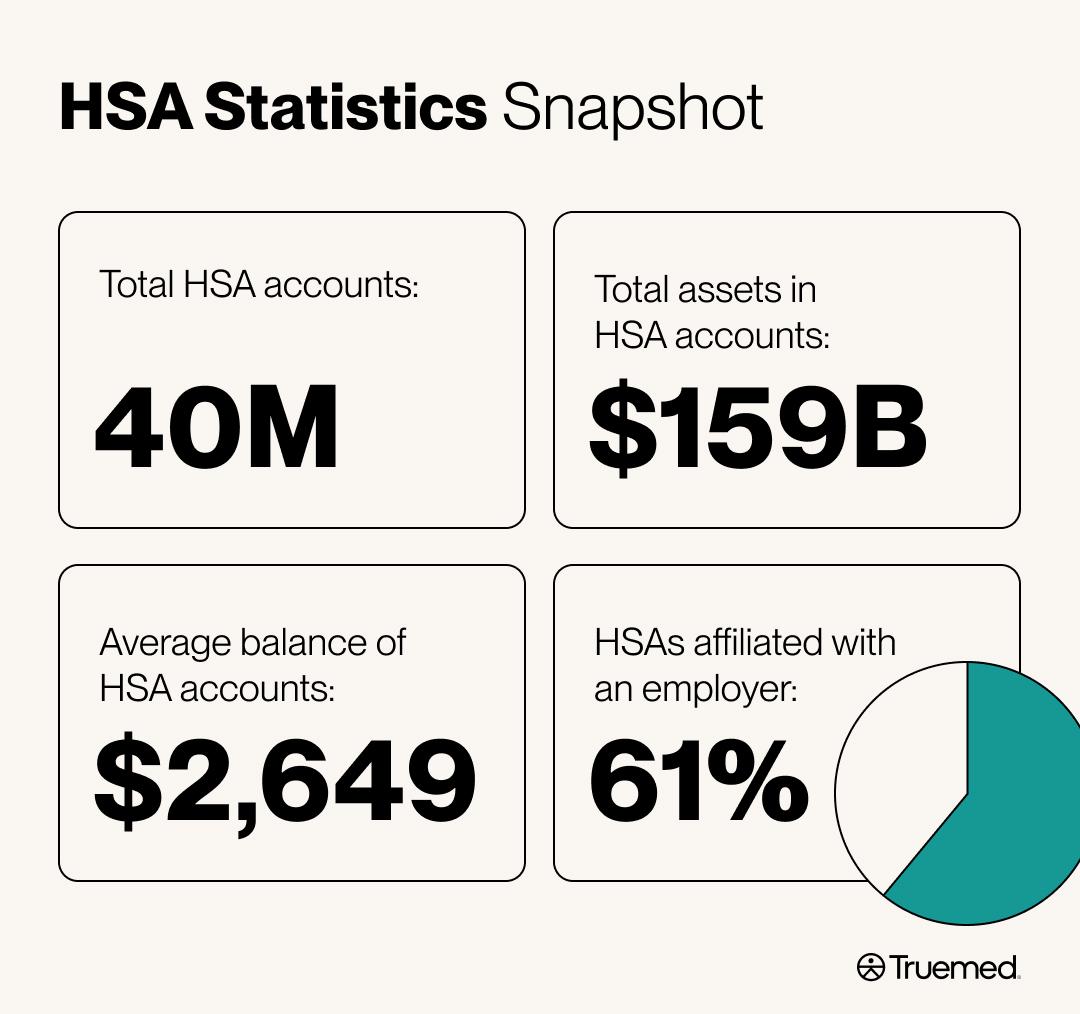
Some of the latest statistics surrounding HSAs in the United States (from mid-year 2025) show just how widespread this type of savings has become and also provides insight into how account holders utilize HSAs. All of the information below is as of mid-2025:
- Total HSA accounts: 40 million
- Total assets in HSA accounts: $159 billion
- Average balance of deposit-only HSA accounts: $2,469
- Percentage of HSAs with some portion of the assets invested: 10%
- Total HSA accounts holding investments: 4 million
- Average account balance in HSA accounts containing both cash and invested assets: $22,635
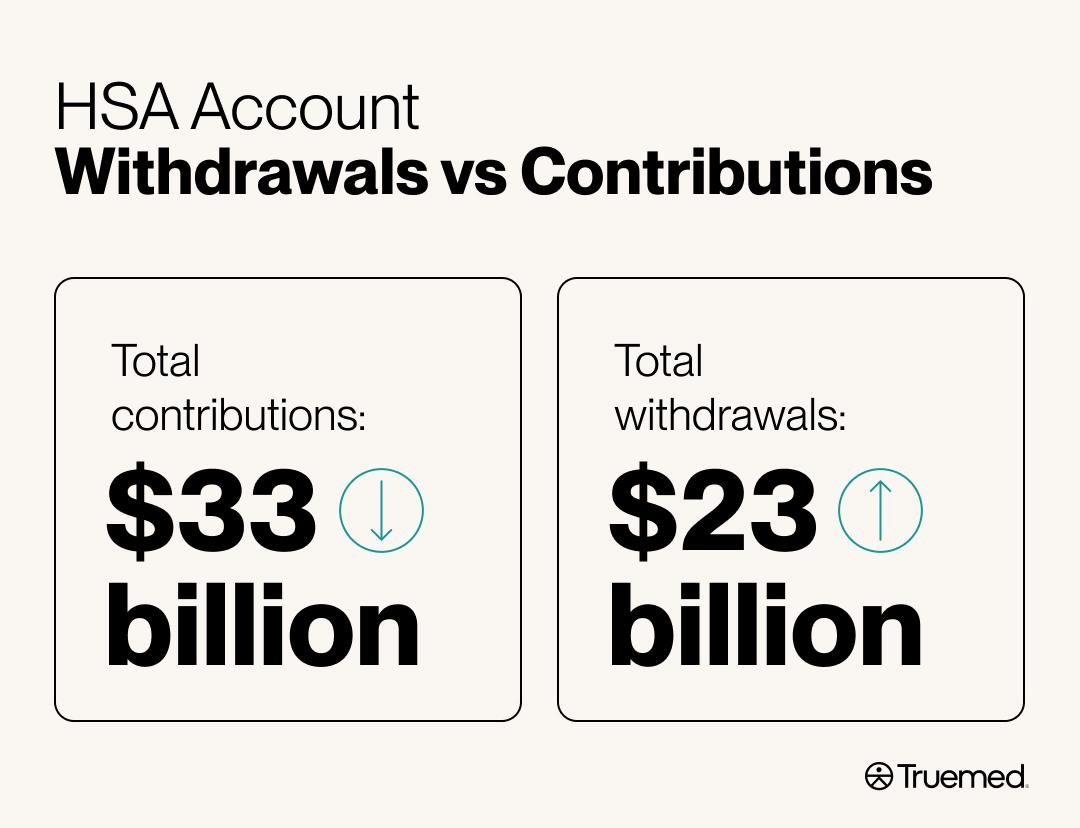
- HSA account withdrawals versus contributions. Contributions $33 billion; withdrawals $23 billion
- Total employer-sponsored or affiliated HSA accounts: 24 million or 61% of all HSA accounts
These types of statistics are valuable to understand because HSAs offer Americans one way help to manage rapidly increasing costs of healthcare expenses in the United States. A West Health-Gallup Affordability Index published in March 2026 reveals that Americans' ability to cover the costs of healthcare has declined in recent years, explaining that: "In 2026, millions are expected to face higher insurance premiums and rising out-of-pocket costs as the expiration of some Affordable Care Act subsidies and upcoming cuts to Medicaid enrollment threaten coverage."
Average HSA account balance: what it means
When reviewing statistics surrounding HSA account balances, there are some important nuances to understand. For instance, reports covering HSA statistics may reference two different types of balances: cash balances and invested balances.
That's because HSAs can hold funds in cash and some HSAs may also allow a portion of the money in an HSA to be invested in stocks, bonds or mutual funds.
The average balance in the United States for HSAs that are "deposit only" HSAs (meaning investing is not an option with these HSA accounts) is $2,469. By contrast, the average balance for HSAs that have at least some portion of the funds invested is $22,635.
While we're on the topic of HSA balances, it's also important to point out that there are various common drivers behind the total amount of savings one amasses in an HSA. Some of the drivers include age of the account (when it was opened)and employer matching contributions.
A 2025 report published by Devenir, an HSA investment solutions provider, shows that there's a clear link between the age of an HSA account and how much money is in the account. In other words, older HSA accounts often have more money in them. The report explains, for instance, that "funded accounts opened in 2004 have the highest average balance at $33,010, while those opened in the first half of 2025 average $1,723."
The report shows a gradual decline in average balances of HSA accounts the more recently the account was opened. Here's a snapshot of what that looks like over the past five years:
- 2020: average balance of $5,521
- 2021: average balance of $4,780
- 2022: average balance of $4,240
- 2023: average balance of $3,254
- 2024: average balance of $2,946
Devenir says this data underscores "the cumulative effect of long-term HSA ownership, with older accounts benefiting from extended periods of potential contributions."
Average HSA contribution: employee vs employer
Now let's look at some of the available statistics surrounding HSA contributions. A significant 61 percent (24 million) of HSAs are affiliated with an employer, meaning individuals are accessing these accounts through their workplace. And some of those employers make HSA contributions on behalf of employees. (This is in addition to the employees themselves making HSA contributions.)
The most recent data from mid-2025 shows that there's $108 billion in assets in employer-affiliated HSA accounts. The lion's share of the contributions to funded HSA accounts were made by employees. According to Devenir, employees made 60 percent of HSA contributions, while employer contributions to funded HSA accounts amounted to just 26 percent.
The average employer contribution for the first half of 2025 was $679, while the average employee contribution for the same timeframe was $1404.
There's also some seasonality to the balances in HSA accounts. Many HSA accounts are opened during the fall each year (typically as part of an employer's open enrollment seasons). However, many accounts "remain unfunded until early the following year," explains the Devenir report. And even at mid-year, some 19 percent of accounts continue to have no balance at all.
One more important note while we're on the topic of HSA contributions: There are limits established by the IRS surrounding how much can be contributed to an HSA annually. For 2026, the maximum amount that can be deposited into an HSA is $4,400 for individuals with self-only health insurance coverage and $8,750 for those with family coverage,
HSA growth rate and HSA trends over time
While the ins and outs of HSAs may be somewhat confusing to some people, there has been significant growth in the amount of money being saved in these accounts. By midyear 2025, the total assets in HSA accounts was close to $159 billion across 40 million accounts. That figure represented a 16 percent year-over-year increase in assets, while the total number of HSA accounts was up 6 percent year-over-year.
The share of HSA account holders who invest some of their savings has also grown. As of mid-2025 investment assets had reached a record $73 billion, according to Devenir. That's a 30 percent year-over-year uptick.
The growth in HSA usage is likely due to a variety of factors including more widespread employer adoption of HSA accounts, along with increased enrollment in high deductible health plans and the steadily rising price-tag of medical expenses driving consumers to find ways to reduce costs.
How people use HSAs: spending, saving, and investing patterns
Let's dive next into how much HSA account holders are spending each year (meaning: withdrawing) from their accounts. According to that same Devenir report referenced earlier, the average amount pulled from HSAs as of mid-2025 was $706. The vast majority of that amount (91 percent) was spent using a debit card associated with the HSA account. And the average debit card transaction was $123. Here's a breakdown of some of the other ways HSA account holders withdrew or spent their HSA savings last year:
- Check: 1%
- Online bill pay: 6%
- ATM: <1%
- Unknown: 2%
Not all the money deposited into HSA accounts ends up being spent by the account holder on medical needs. There are HSA accounts that allow for investing savings in stocks, bonds and mutual funds.
As of June 30, 2025, about 46 percent of all HSA assets are investments and those investments amount to a massive $72.9 billion, according to Devenir. As mentioned earlier in this guide, the average balance in HSA accounts that allow investing is $22,635 per account. That balance represents both deposits and investments combined.
The amount of HSA savings invested in stocks, bonds and mutual funds has grown significantly over time. In 2020, for instance, the total amount of invested HSA assets was $23.8 billion. Fast forward to mid-2025 and that figure has skyrocketed to $72.9 billion. What's more, the Devenir report predicted that by the end of 2025, total invested HSA assets would jump to $81.8 billion. (The actual final figures for 2025, however, are not yet available).
Looking into the future, Devenir projects that invested HSA assets will top $107 billion by 2027.
Still, with all of that said, cash deposits in HSAs represent the biggest portion of the assets in HSA accounts. Though here too, the figure has been creeping upward over time. In 2020, the cash in HSAs represented 71 percent of total account assets, while investments made up just 29 percent of the funds in HSA accounts. Jumping ahead to 2025, that split has evolved to an average of about 56 percent in cash per account and 44 percent invested.
Who has HSAs: demographics
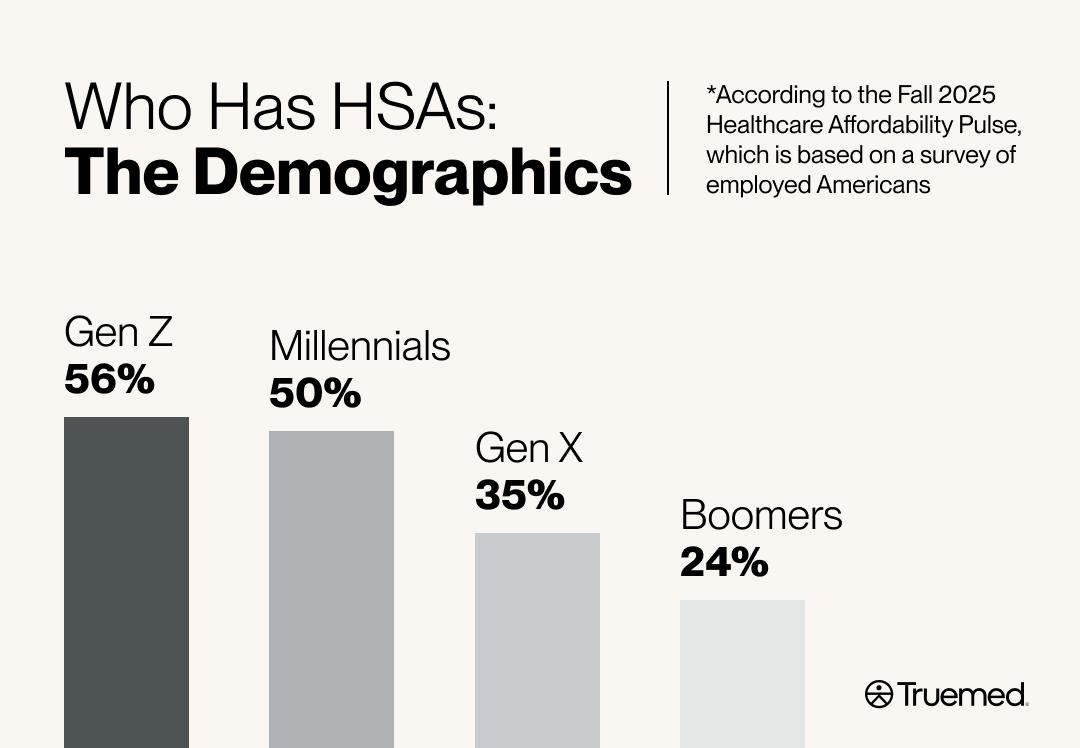
One of the more surprising developments with regard to HSAs is the rapid adoption of this type of savings among younger Americans. A Fall 2025 Healthcare Affordability Pulse survey conducted by HealthEquity, which is the country's largest health savings account custodian, found that younger Americans are in fact leading when it comes to HSA adoption. This is true despite the fact that these same young Americans simultaneously experience the most economic stress and strain.
According to the Fall 2025 Healthcare Affordability Pulse, which is based on a survey of employed Americans, 56 percent of Gen Z and 50 percent of Millennials have HSAs. This is far greater than the 35 percent of Gen X who hold HSA accounts, and the mere 24 percent of Boomers.
A separate report, published by the Employee Benefits Research Institute (EBRI) in June 2025 based on 2023 data indicates that while younger generations may be adopting HSAs more readily, it is still older account holders who have the most savings.
"On average, older accountholders contributed more to their HSAs, had higher balances, more frequently took distributions, and had a higher likelihood of investing at least some portion of their HSA in assets other than cash," says the report.
Accountholders under the age of 25, for instance, had an average HSA balance of $1,154 as of 2023. This is compared with middle-aged and mid-career accountholders ages 35–44, who had an average balance of $4,438. Even older accountholders, those ages 65 or older, had an average balance of $9,022, says the report.
Where HSA statistics come from
HSA statistics surrounding usage, balances and investments are derived from a variety of sources including the individual tax returns filed with the IRS by individuals who have HSA accounts. Government agencies use this and other information to publish data and reports surrounding HSA adoption, assets and trends. Some of the government agencies that provide statistics surrounding HSAs include the Government Accountability Office (known as the GAO), along with the Bureau of Labor Statistics (BLS).
HSA and financial industry organizations also periodically conduct and publish their own analysis of HSA statistics and trends. Examples in this category include reports published by the American Bankers Association and the investment solutions provider Devenir.
While there are many different sources of information surrounding HSAs the date that these reports are published varies widely. There may also be subtle differences in the methods used to calculate information in each report.
HSA infographic: what to include (hsa infographic + shareable stats)
How it works with HSA/FSA and Truemed
Now that we've covered many of the statistics surrounding HSAs, let's talk for a moment about how Truemed can help you maximize the value of this type of account.
You can browse the Truemed platform to find products and even services (such as gyms and fitness studios) that may be eligible for HSA spending for qualified customers. If you find an item or service that you're interested in learning more about, click on the "Shop Now" button to be taken to the brand's own website.
As part of this process, you will be prompted to complete a health intake, which a licensed medical provider will review to determine whether you're eligible for HSA spending.
If it's determined that the purchase or service is medically necessary to treat or prevent your medical condition, based on your health information, a document known as a Letter of Medical Necessity (LMN) will be issued. This LMN will be sent to the email address you provide.
Equally important to note, there is no additional cost to use Truemed when making purchases with your HSA funds, because the cost of Truemed's services is included in the item's purchase price.
FAQ
Based on recent statistics from Devenir, use of HSA accounts appears to be growing. By midyear 2025, the total number of HSA accounts was up 6 percent year-over-year. Additionally, the total assets saved in HSA accounts was close to $159 billion, a 16 percent year-over-year increase in HSA assets.
Depending on your financial needs and goals, there may be a few potential downsides of HSAs. For starters, you must be enrolled in a qualifying high-deductible health plan (HDHP) in order to be eligible to open an HSA. In addition, the cash you've stashed away in an HSA can only be used for qualified medical expenses. If you withdraw or spend HSA cash on nonmedical expenses before reaching age 65, you’ll be required to pay income tax on the amount you spent. And that's not all, you'll also be hit with a 20 percent IRS penalty.
Yes, you can buy a wide variety of qualified items online using your HSA cash, everything from over-the-counter medications to vision and hearing items, along with first-aid supplies and more. You can use HSA funds to pay for online purchases at any retailer that accepts this form of payment.



See what you can do with your HSA/FSA.
Join 1.5 million Americans who have routed their healthcare dollars toward root cause health via Truemed's HSA/FSA marketplace.
New product announcements
Sales and special offers
Tips for utilizing your HSA/FSA
Editorial Standards
At True Medicine, Inc., we believe better health starts with trusted information. Our mission is to empower readers with accurate and accessible content grounded in peer-reviewed research, expert insight, and clinical guidance to make smarter health decisions. Every article is written or reviewed by qualified professionals and updated regularly to reflect the latest evidence. For more details on our rigorous editorial process, see here.