
6 HSA Myths We Need to Retire (With Data)
Author:Mia Taylor
Reviewed By:Michaela Robbins, DNP
Published:
April 29, 2026
Last Updated:
October 06, 2026



Key Takeaways
HSA confusion: There continues to be a great deal of misinformation surrounding how HSAs work, about whether the money in an HSA is forfeited if it's not used each year and whether you lose access to an HSA if you leave a job.
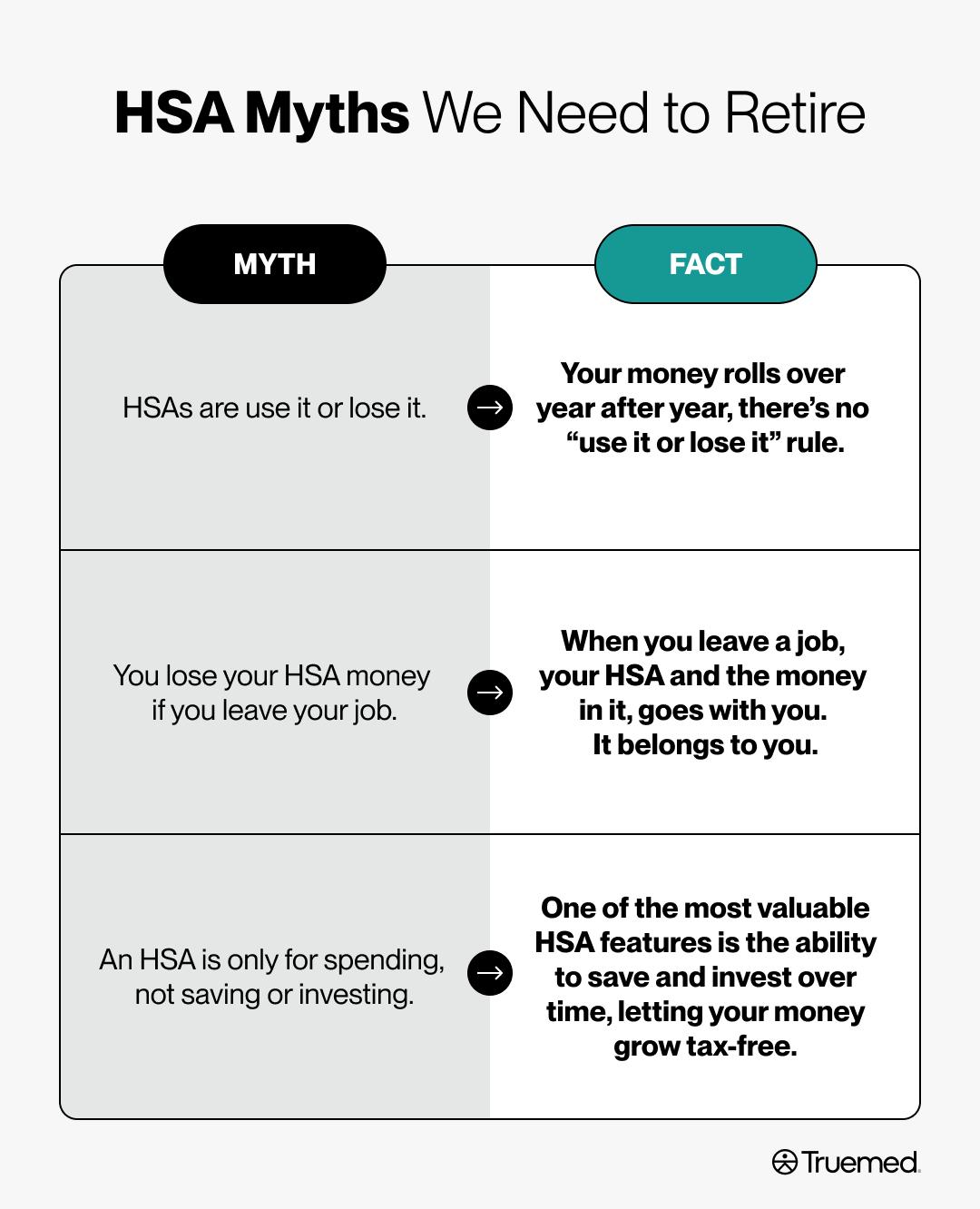
Money rolls over every year: With an HSA, the money you've saved rolls over year after year. There is no “use it or lose it” rule, despite common misperceptions on this front.
HSAs are portable: When you leave a job, your HSA and the money in it, goes with you. It is not tied to a specific employer or job. An HSA belongs to you.
Long-term growth: One of the most valuable features associated with many HSAs is the ability to save money over the long-term and invest your HSA savings, allowing it to grow tax-free.
Key Takeaways
The most common categories of HSA myths
Myth: HSAs are use it or lose it
Myth: You lose your HSA money if you leave your job
Myth: An HSA is only for spending, not saving or investing
Myth: HSAs are only useful for high-income people or young, healthy individuals
Myth: You cannot use an HSA in retirement or once Medicare enters the picture
Myth: You can only open or fund an HSA one way
How It Works with HSA and Truemed
FAQ
Though they've existed for more than two decades—created via a bill President George W. Bush signed into law in 2003—confusion persists surrounding health savings accounts (HSAs). What are they? How do they actually work? And do they differ from Flexible Spending Accounts (FSAs)?
There's a great deal of misinformation surrounding the answers to these and other HSA-related questions. And all of that inaccurate (or only partially accurate) information can make it confusing when you're trying to make the most of an HSA, including when you're considering using the funds you've accumulated in an HSA to make qualified purchases for medical needs.
This guide will provide a clean reset on HSAs, covering some of the most common HSA myths and why they persist, so that you can confidently navigate the ins and outs of these valuable savings accounts.
The most common categories of HSA myths
Thanks to the internet and social media, we're constantly exposed to all types of information. And sometimes, as we're wading through all of the information coming our way, it can be tricky separating fact from fiction. That includes with regard to HSAs, how they work and their rules.
Have you found yourself flummoxed by all of the conflicting information surrounding HSAs? Then you've come to the right place. The goal of this article is to retire some of the outdated misinformation or assumptions related to HSAs ranging from how they work to whether they expire, and if they're portable. These are just some of the most common categories of myths surrounding HSAs.
But before we get into those important topics, let's first cover a few of the key basics surrounding HSA accounts, how they work and why they can be such a valuable part of your overall financial planning strategy.
Most importantly, a health savings account (HSA) is a tax-advantaged savings account that allows you to set aside money for qualified medical expenses. In fact, these accounts are often described as having a 'triple tax advantage.'
Advantage number one is that HSAs can be funded on a pre-tax basis, meaning you can deposit money you've earned but not yet paid taxes on. In addition, the money you accumulate in your HSA savings is allowed to grow and accumulate interest tax-free. (That's advantage number two, for those counting.) And finally, advantage number three is that account holders can withdraw money from an HSA tax-free, so long as it's used to pay for qualified medical expenses.
In order to be eligible to open an HSA, you must have a high-deductible health plan. And you cannot be claimed as a dependent on another individual's tax return, per IRS rules.
Now, let's discuss some of the most common myths surrounding HSAs.
Myth: HSAs are use it or lose it
Perhaps the most widespread myth surrounding HSAs is that if you don't use the funds in your account each year—or by some pre-established annual deadline—you will lose the money you've saved. The reality is entirely the opposite.
"This is where people often confuse HSAs with FSAs. With an HSA, your money rolls over year after year, there’s no “use it or lose it” rule," says Ethan Pickner, an Arizona health insurance broker with AZ Health Insurance. "If you don’t spend it, the money simply stays in your account and continues to grow."
The fact that your HSA savings remains in the account year after year creates a great deal of flexibility and value. In fact, some account holders make the most of this benefit by opting to pay out of pocket today for medical expenses in order to allow their HSA balance to build over time, leaving it available for larger, future expenses. That includes saving HSA funds to pay for healthcare costs later in life, even during retirement.
The ability to continue saving for decades is one of the reasons HSAs "are so powerful for long-term planning," says Pickner.
Myth: You lose your HSA money if you leave your job
Another common inaccuracy related to HSAs is that once you leave an employer, you lose access to your HSA account and the funds in it.
"This one is completely false, and it trips people up all the time," says Steve Sexton, founder of Sexton Advisory Group, a financial planning firm specializing in wealth management, including tax planning and retirement planning. "An HSA is not an employer benefit in the way that, say, a pension or a 401(k) match is. It is your account. You own it. Period."
Let's state that again, shall we? When you leave a job, your HSA and the money in it, goes with you. It belongs to you.
But while we're on this topic, let's address an important nuance. When you leave an employer, you can leave your HSA with the current plan administrator or you have the option to roll the money in your account to another HSA plan administrator. This is an especially important and valuable option if your old employer's plan had limited investment choices for your HSA savings, for example, or if the administrator charged costly maintenance fees, says Sexton.
You can also consolidate or roll your existing HSA balance into a new HSA if your next employer offers this type of account as well.
"You can keep [the HSA as is], move it, or consolidate it with a new HSA if your next employer offers one," says Sexton, "But the balance doesn't disappear. The myth, though, keeps people from contributing aggressively because they're afraid of losing it. Don't let that stop you. Fund your HSA like you own it, because you do."
Myth: An HSA is only for spending, not saving or investing
Yes, HSAs were created to allow you to save money that can be spent on qualified medical expenses. But that's not the only valuable aspect of an HSA. In fact, financial advisors say that one of the most strategically important HSA features is the ability to save money in these accounts over the long-term and invest some of your savings, allowing it to grow tax-free.
"This is probably the biggest missed opportunity I see. People treat their HSA like a checking account. Money goes in, money goes out for copays. And look, that's one way to use it. But it's leaving a huge advantage on the table," says Sexton.
Many HSA providers allow you to invest your HSA savings once you hit a certain balance or threshold, often somewhere around $1,000. At that point, you can begin putting some of your HSA cash into mutual funds and index funds where it's allowed to grow tax-free.
"[Your HSA savings] is tax-free going in, tax-free growing, tax-free coming out for qualified expenses," continues Sexton. "That's the triple tax advantage, and it is genuinely hard to find this advantage anywhere else in the tax code."
Another bit of advice on this front: If you are relatively healthy and you can afford to pay medical expenses out of pocket in the short term, it can be a wise move to simply let your HSA balance grow untouched for years, reaping all the benefits of tax-free growth. "Think of it less like a medical debit card and more like a stealth retirement account for healthcare costs," says Sexton.
Myth: HSAs are only useful for high-income people or young, healthy individuals
When it comes to discussions about HSAs, there's often a great deal of chatter about who these types of accounts are best for. One common line of thinking holds that HSAs are most suited for high-income households or those who are young and healthy.
The rationale behind this view is that in order to be eligible for an HSA, you need to have a high deductible health plan (HDHP). And the deductible for a self-only HDHP must be at least $1,700 in 2026 to qualify for an HSA, per the IRS. For family coverage, meanwhile, the minimum HDHP deductible must be at least $3,400. For those who have significant medical expenses each year, these steep deductibles can be challenging.
HDHPs also typically have higher monthly premiums than other types of coverage, which can also make this type of insurance less appealing for some, particularly if your cash flow is tight.
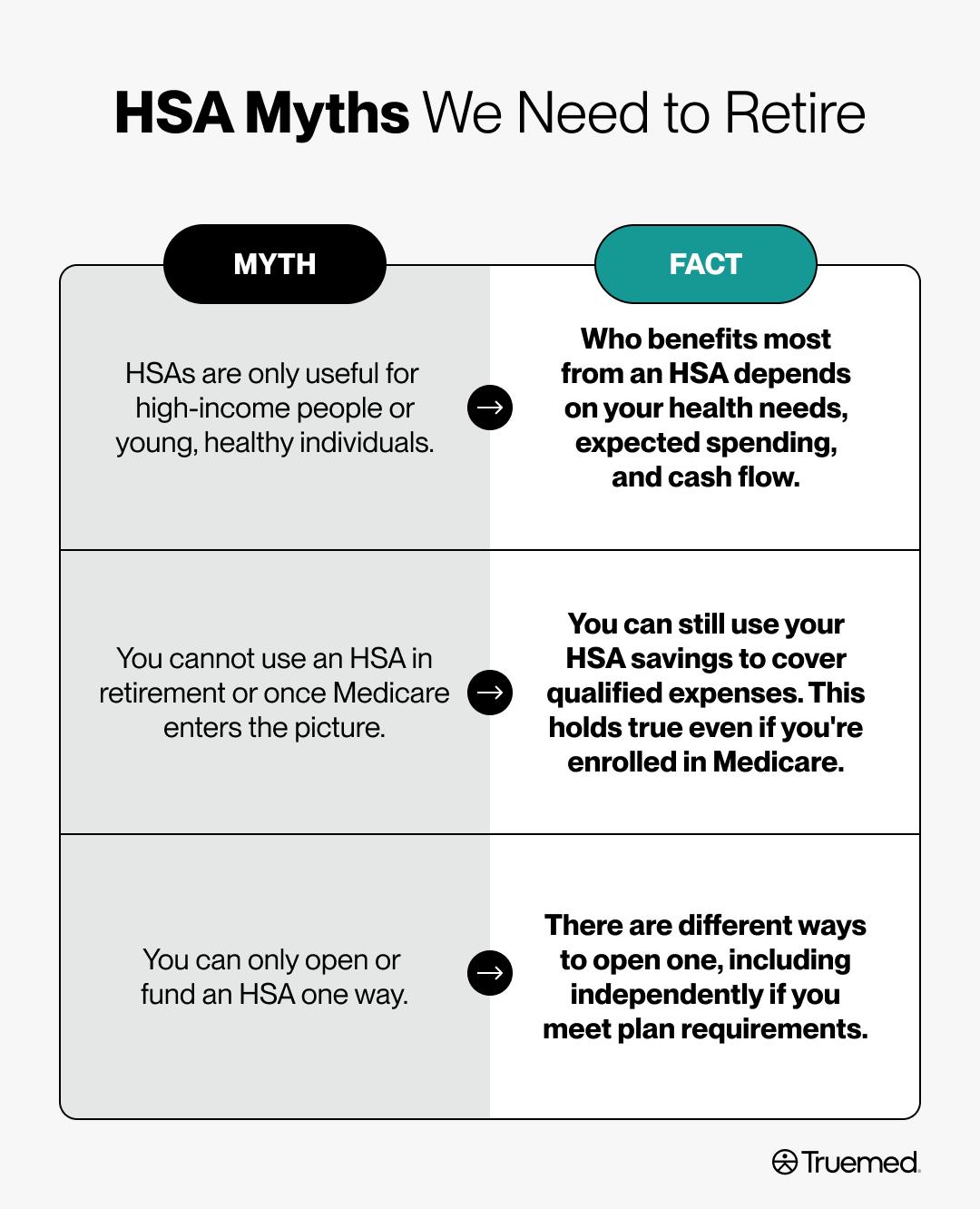
Still, experts say it's inaccurate to suggest that only certain types of people should use an HSA. It all depends on your health needs, expected spending, and cashflow comfort.
"HSAs can benefit a wide range of people, not just one specific group," says Pickner. For some people, the appeal is "the tax advantages and long-term savings potential," that come with HSAs. Or in some cases, employers may make contributions to their employees’ HSAs, "which adds immediate value regardless of income level," Pickner adds.
"Ultimately, it comes down to your situation," says Pickner. "But HSAs can be a great fit at different life stages, not just for young or high income individuals."
Myth: You cannot use an HSA in retirement or once Medicare enters the picture
As we've touched upon a couple of times already, your HSA savings can be carried right into retirement. This is a very valuable feature of HSAs—unused funds can be tapped into at a later date.
While you can no longer continue contributing to your HSA once you've left the workforce behind, you can still use your HSA savings to cover qualified expenses. This holds true even if you're enrolled in Medicare.
"You can spend HSA dollars on qualified medical expenses tax-free, regardless of age," says Brian Miller, licensed insurance agent and the COO and co-founder of OneHealth.
Sexton offers a similar perspective: "There's an important distinction to draw here. Once you enroll in Medicare, you can no longer contribute new money to an HSA. That part is true. But what you already have in the account doesn't go away, and the rules around spending it don't suddenly become more restrictive," offers Sexton.
In fact, both Miller and Sexton stress that your HSA savings often becomes even more valuable as you age because that's when you're more likely to have higher healthcare costs, compared to when you initially funded the account.
"Medicare premiums, dental, vision, hearing, long-term care insurance premiums up to certain limits. These are costs that hit hard in later life and aren't always covered by Medicare. Having a funded HSA going into those years is a genuine financial cushion," explains Sexton.
Another often overlooked benefit associated with HSAs as you age, if you're over age 65 you're allowed to withdraw HSA money for non-medical expenses without incurring a penalty, adds Miller. "If you choose to do this you would simply pay regular income tax, as you would with a traditional IRA disbursement," he explains.
Myth: You can only open or fund an HSA one way
Let's cover one last myth before wrapping up this important discussion about HSAs: the idea that you can only open an HSA through an employer. Again, this is simply not true. Individuals, including those who are self-employed, may be able to open an HSA independently if you meet plan requirements such as having a HDHP.
"Many people assume HSAs only come through an employer, but that’s not the case," notes Pickner. "If you’re enrolled in a qualified high deductible health plan, you can open and fund an HSA on your own, independent of any employer. Contributions can be made through payroll deductions or directly into the account, giving you flexibility in how you fund it.
How It Works with HSA and Truemed
As you're considering how best to use and maximize the benefits of an HSA, at any age, it's important to note that Truemed helps qualified customers explore whether certain health products may be eligible for HSA coverage.
You can do this by using the Truemed marketplace to browse items or services that you're interested in and that may be eligible for HSA spending for qualified customers. If you find an item or service you'd like to learn more about, simply click on the "Shop Now" button to be taken to the brand's own website.
As part of this process, you will be directed to complete a health intake, which a licensed medical provider will review to determine whether you're eligible for HSA spending.
If it's determined that the purchase or service you're considering is medically necessary to treat or prevent a medical condition, based on your health information, a document known as a Letter of Medical Necessity (LMN) will be issued. The LMN will be sent to the email address you provide to be saved for your records.
One more important note: There is no additional cost to use Truemed when making purchases with your HSA funds. The cost of Truemed's services is included in the item's purchase price.
FAQ
This is one of the most common misperceptions about HSAs. The money accumulated in an HSA is not forfeited at the end of the plan year. Quite the opposite. The cash you accumulate in an HSA can be rolled over year after year after year for as long as you want. In fact, that's one of the many valuable benefits of HSAs, that you can use them to set aside money that can even be used for qualified medical expenses during retirement, if you so choose. Bottom line? There is no "use it or lose it" regulation related to HSAs.
Yes, you can absolutely keep your HSA when you leave a job. This is another important benefit of HSAs. If you leave an employer for any reason, the account and all of the money you've put into it, goes with you. And you can continue to tap into your HSA to pay for qualified medical expenses.
Yes. In addition to paying for things like doctors visits and prescriptions, your HSA can be used to pay for hundreds of other health-supportive expenses. That includes things like therapy, supplements, sleep technology and more. The key to using your HSA for these types of expenses is knowing what qualifies and when you might need to obtain a letter of medical necessity (LMN) to tap into your HSA funds for such expenses. A LMN is a document provided by a healthcare provider that explains why a product or service (that isn't typically seen as a medical expense) is needed for a particular treatment or health condition.



Editorial Standards
At True Medicine, Inc., we believe better health starts with trusted information. Our mission is to empower readers with accurate and accessible content grounded in peer-reviewed research, expert insight, and clinical guidance to make smarter health decisions. Every article is written or reviewed by qualified professionals and updated regularly to reflect the latest evidence. For more details on our rigorous editorial process, see here.