
FSA Benefits: Is an FSA Worth It?
Author:Jennifer Chesak
Reviewed By:Alan Knapp
Published:
May 15, 2026
Last Updated:
September 09, 2026



Key Takeaways
FSA: is an employer-sponsored benefit that helps you pay for qualified medical expenses with pre-tax dollars.
An FSA is worth it: if you have relatively predictable medical expenses.
Truemed: specializes in helping you maximize your FSA, HSA, and other health-related benefits.
Medical expenses are arguably one of the least fun things we have to spend money on. But they are often a necessity for your health and that of your family members. Healthcare costs can get expensive when you factor in insurance copays, deductibles, prescription medications, over-the-counter supplies, dental and vision care visits, and more.
One way to help ease the pain of paying for medical expenses is to use pre-tax dollars from your paycheck. You can do this with an FSA if your employer offers this option. But is an FSA worth it for you?
Key benefits of an FSA
An FSA can help save money, but there are also a few other key conveniences:
- Tax savings on eligible healthcare spending and taxable income
- Lower cost burden for routine healthcare-related expenses
- Easier budgeting for expected medical costs
- A wide range of potentially eligible expenses
- Automatic deductions from payroll
- Possible options for extended coverage for dependents
- Convenient payment and reimbursement options
- Potential immediate access to the full annual election early in the year
An FSA can cover copayments, deductibles, coinsurance, and qualified prescription costs. Many medical supplies and devices may also be FSA-eligible. FSAs can also benefit families hoping to plan ahead for predictable health spending, recurring eligible purchases, and preventive and follow-up care expenses.
FSA Benefits and Tradeoffs at a Glance
| Benefits or rule | What it means | Why it matters | What to watch for |
|---|---|---|---|
| Pre-tax contributions | Money comes out before taxes | Lowers taxable income | Must be used for eligible expenses |
| Payroll deductions | Contributions happen automatically | Easier healthcare budgeting | Annual election still needs planning |
| Broad eligible expenses | Many medical costs may qualify | Useful for routine and surprise care | Not every purchase is eligible |
| Pre-funded access | Full annual election may be available early | Helps with large early-year expenses | Plan details still apply |
| Use-it-or-lose-it rules | Unused funds may expire | Encourages planning | Carryover is not guaranteed |
| Documentation requirements | Receipts or substantiation may be needed | Supports reimbursement and compliance | Missing records can create delays |
Is an FSA Worth it for Your Healthcare Spending?
If you’re wondering what an FSA is and how it works, we explore that in depth below. But first, we share the hot takes from a variety of legal, financial, and tax experts on whether an FSA is worth it. Here’s what they had to say.
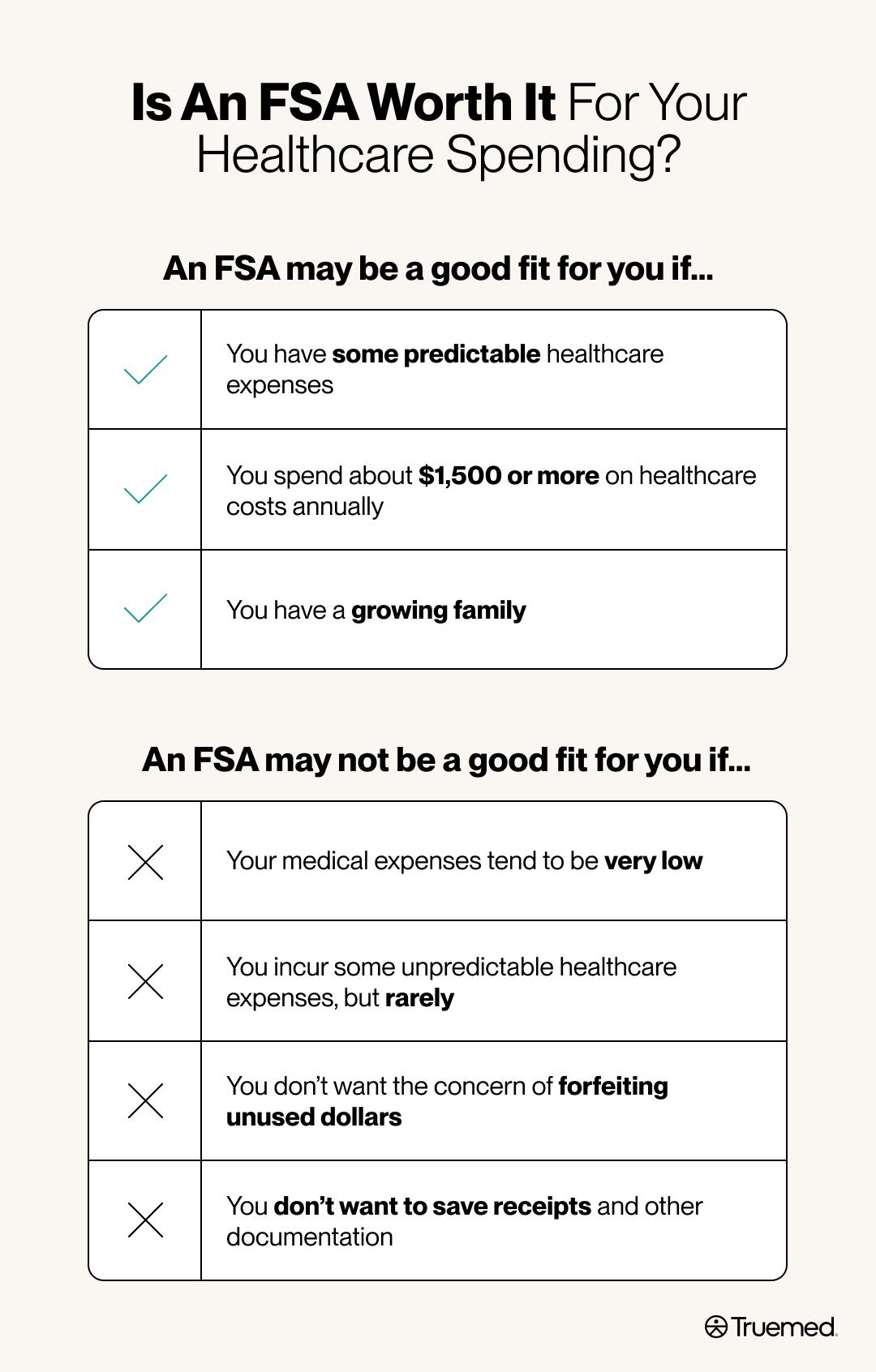
Do you have some predictable healthcare expenses?
“If you are an individual with predictable, known expenses, such as prescriptions, therapy, and ongoing treatments, and you will consistently bear the burden of those expenses throughout the year, you’ll benefit from an FSA.” —Joe Braier, president and CEO of Lake Country Advisors
Do you spend about $1,500 or more on healthcare costs annually?
“FSAs tend to work really well for W-2 employees who wear glasses, have regular prescriptions, or go to the dentist twice a year. Those three things alone usually justify it. The decision doesn’t have to be complicated. If you can predict $1,500 in healthcare spending, an FSA saves you real money. —Russell Moran, owner of Russell Moran Enterprises
Do you have a growing family?
“The best FSA candidates are those with young children who need regular visits to the pediatrician, those with chronic health conditions who have ongoing prescription costs, those who have planned dental or vision expenses for the year, and working parents who have dependent-care expenses. These are people who are going to spend that money regardless. The FSA just lets them spend pre-tax dollars instead of post-tax ones.” —Yad Senapathy, MS, PMP, Founder and CEO of the Project Management Training Institute (PMTI)
Notes on tax savings
“Every dollar you put into an FSA comes out of your paycheck before taxes are calculated, which means you never pay federal income tax, state income tax, or payroll tax on that money.” —Brennan Kolar, founder of Atlas CPA Index
“The tax savings on an FSA are actually pretty big. Most articles don’t explain it well because they forget to include FICA. When you put $3,400 into a health FSA in 2026, you’re not just saving on income tax. You're also avoiding the 7.65% FICA charge for Social Security and Medicare.” —George Dimov, founder and CEO of DIMOV Tax.
When an FSA May Not Be Worth It
In many cases, as the experts quoted above describe, an FSA will be worth it. However, some situations might not make an FSA worth it.
- Your medical expenses tend to be very low
- You incur some unpredictable healthcare expenses, but rarely
- You don’t want the concern of forfeiting unused dollars
- You don’t want to save receipts and other documentation
Common mistakes that reduce the benefits of FSAs
Maximize your FSA by avoiding a few common pitfalls:
- Contributing too much. This could mean your eligible out-of-pocket expenses are lower than the amount put into the FSA–if you don’t use all the money, you lose it
- Misunderstanding timelines. Some FSA plans allow the full year contribution to be available at the beginning of the plan year, while others accumulate through payroll deductions. Understand your plan to align spending with contributions for the year.
- Confusing rules. IRS, plan administrator, and IRS rules can be confusing; when in doubt, know that the IRS sets the funding limits, the plan sets the eligible expenses, and the employer determines which of its employees are eligible to sign up to have an FSA.
- Missing deadlines, including for claims, card use, and election periods
- Over-assuming FSA eligibility. Not every health-related purchase qualifies as a medical expense. Consult your plan to better understand which purchases are eligible.
- Forgetting to save receipts or requested documentation.
- Not checking balances. Periodically checking carryover balances, grace periods, claims decisions, or requests for supplemental documents can help ensure you are not left with a balance to forfeit at the end of the calendar year.
How It Works with Truemed
You’ve got one more thing to consider regarding whether an FSA might be worth it for you. Just because an item isn't automatically FSA-eligible doesn't mean it's off the table. Many health products and services could qualify when they're medically necessary and supported by proper documentation (like an LMN).
For example, you might be able to purchase a red-light therapy device with your FSA dollars. Such a device might be an eligible expense if you’re using it to address a specific medical condition. If approved by an independent licensed clinician, such conditions might include alopecia or rheumatoid arthritis.
You might need a letter of medical necessity (LMN). An LMN is a formal document from a licensed healthcare provider that explains why a certain product, treatment, or service is necessary to treat, mitigate, or prevent a medical condition.
Certain health products and services may be eligible for qualified customers with an LMN issued by an independent practitioner when the item is used to address a specific medical condition.
Truemed* specializes in helping you maximize your FSA and other health-related benefits (such as an HSA):
- First, you can check whether a product or service is normally considered a qualifying medical expense or whether you might need an LMN.
- Complete a health intake survey that will be reviewed by an independent licensed clinician.
- Buy the item; either pay directly with your HSA/FSA card at checkout, or pay with a regular credit/debit card and seek HSA/FSA reimbursement afterward.
- The independent licensed practitioner will review your medical history, and if you qualify, will issue an LMN. Truemed itself does not make eligibility determinations.
- Truemed also offers support in the event you get a denial of reimbursement and need to provide substantiation documentation.
*Truemed is for qualified customers. HSA/FSA tax savings vary. Learn more at truemed.com/disclosures
FAQ
If you rarely have healthcare needs, an FSA might not be worth it. This is because if you don’t use your FSA dollars by the end of the year, you forfeit the remaining balance, unless your FSA offers a grace period or carryover.
One key downside of an FSA is the use-it-or-lose-it rule. This means that if you don’t spend your FSA dollars by your plan’s end, which is usually the end of the year, you forfeit any remaining money unless you have a grace period or carryover option. However, with careful planning, the use of LMNs, and more, you can strategize to ensure you spend your FSA dollars by the deadline.
A health savings account (HSA) is different from an FSA in several ways. While an FSA stays with your employer if you leave your job, an HSA is an account that you own and can take with you. Additionally, you can only have an HSA if you have a high-deductible health plan. With an HSA, you do not need to spend your dollars within a certain timeframe, as you do with an FSA. Additionally, you can invest your HSA dollars to boost your balance over time and save for future healthcare expenses. You cannot do this with an FSA.
Editorial Standards
At True Medicine, Inc., we believe better health starts with trusted information. Our mission is to empower readers with accurate and accessible content grounded in peer-reviewed research, expert insight, and clinical guidance to make smarter health decisions. Every article is written or reviewed by qualified professionals and updated regularly to reflect the latest evidence. For more details on our rigorous editorial process, see here.