
Stripe HSA/FSA Processing: How Ecommerce Brands Can Accept HSA/FSA Payments
Author:Anna Meyer
Published:
May 29, 2026
Last Updated:
October 06, 2026



Key Takeaways
Stripe can process HSA/FSA payments: However, it doesn't determine eligibility itself — it relies on external systems (MCC, 90% rule, IIAS/SIGIS, or a dedicated pro
Four acceptance methods exist:: Healthcare MCC, IIAS + SIGIS infrastructure, reimbursement flows, and dedicated processors like Truemed.
Reimbursement models are easier to launch: Customers pay normally and get documentation to submit to their administrator — good for supplement, sleep, fitness, and wellness brands.
Truemed fills Stripe's compliance gaps: It handles dual-use/mixed-eligibility validation and LMN collection, transferring HSA/FSA funds to your existing Stripe account.
Talk to Sales
Ready to unlock HSA/FSA payments for your business?
Can Stripe Accept HSA/FSA Payments?
The straightforward answer is yes. Stripe can process HSA/FSA cards, but approval depends on how your business is structured and how eligibility is handled. Meaning, your ability to use Stripe depends on which HSA/FSA processing model you choose.
Before choosing your payment processing model, you’ll need to understand how Stripe validates product eligibility and whether any of these options suit your business.
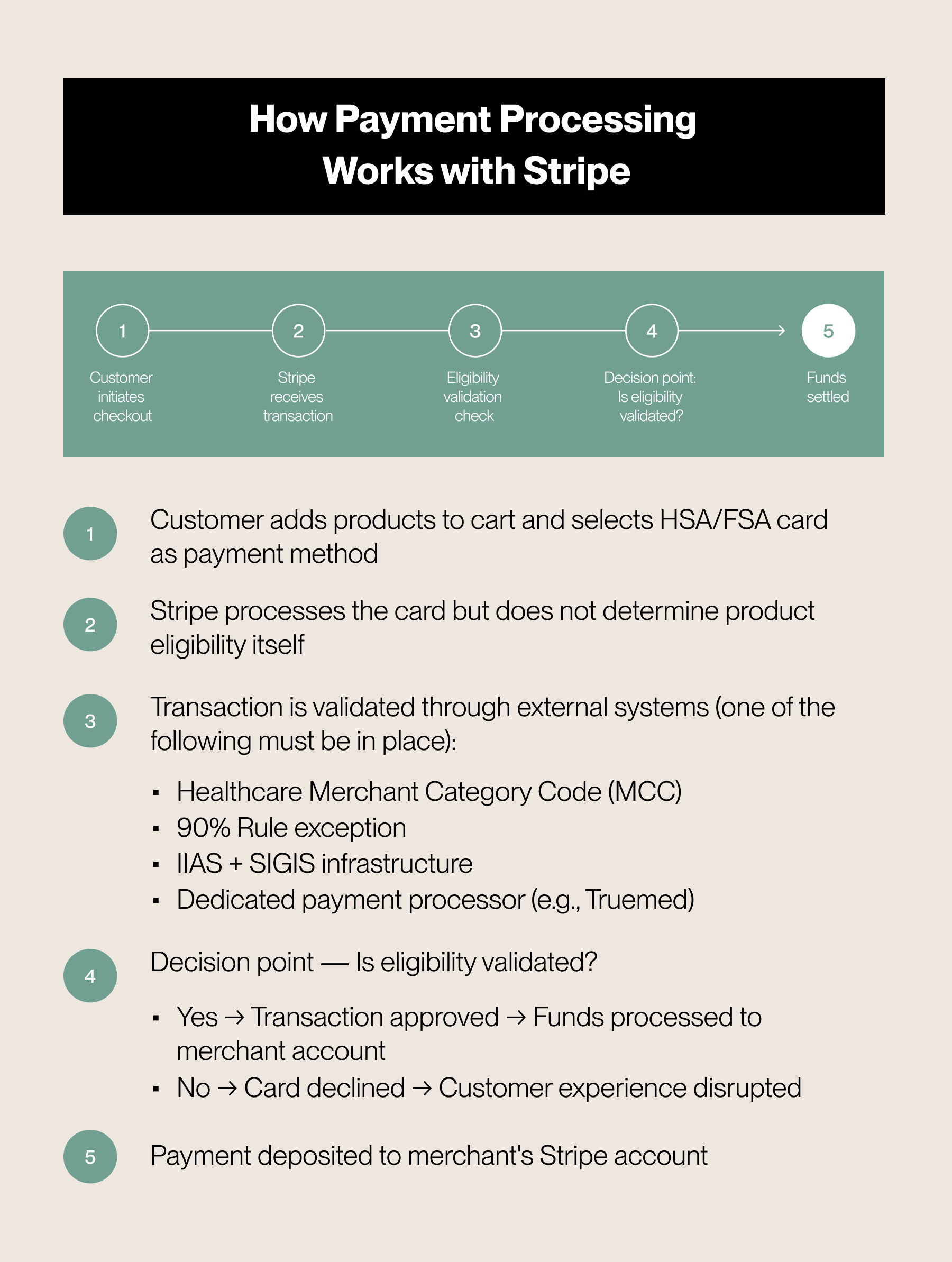
How Stripe Determines HSA/FSA Eligibility
Stripe itself doesn’t decide whether products qualify for HSA/FSA spending because Stripe healthcare payments rely on external eligibility and compliance systems. Eligibility is determined through a combination of merchant classification, payment infrastructure, and IRS guidance.
Some of the main components you’ll need to have to process HSA/FSA cards through Stripe include a healthcare Merchant Category Code, 90% rule exception, or an Inventory Information Approval System(IIAS) with a Special Interest Group for IIAS (SIGIS) registration.
Keep in mind these options apply to businesses who sell products that are clearly qualified medical expenses. If you sell dual-use products or a mix of eligible and non-eligible products, then you’ll need to use a complementary system that handles the validation portion of the transaction. But more on that later.
Merchant Category Codes (MCCs)
MCCs are a code system that classify businesses by industry type and are assigned by card issuers and banks. The catch is only certain healthcare-related MCCs are more likely to support direct HSA/FSA card acceptance and these MCCs are reserved for medical providers like doctors, optometrists, pharmacies, etc.
Examples include:
- 8099 for medical services
- 5912 for pharmacies
- 5047 for medical equipment
If your business falls outside traditional healthcare categories, unfortunately direct approval becomes more complicated.
The 90% Rule
The 90% rule is an exception allowed by the IRS where a business may qualify if at least 90% of your inventory consists of eligible medical expenses.
On paper, this sounds simple. Operationally, it can become difficult to maintain, especially for ecommerce brands with mixed catalogs or fast-changing inventory.
IIAS Certification
An Inventory Information Approval System (IIAS) is a system specifically created for product based businesses to help you validate eligible items during checkout.
IIAS infrastructure can work well for highly regulated healthcare retailers but it becomes more difficult for broader health-related ecommerce brands. This is because it requires SKU-level eligibility mapping, ongoing inventory maintenance, and compliance oversight.
An IIAS set up is also geared toward products that are clearly a qualified medical expense. Dual-use products that require a Letter of Medical Necessity to prove eligibility don’t work with an IIAS since there is no LMN flow included in the system.
SIGIS Registration
The Special Interest Group for IIAS (SIGIS) is an independent body that oversees parts of the healthcare card ecosystem and provides the industry standards for healthcare payments through HSAs and FSAs.
SIGIS participation is only necessary when you’re using an IIAS to verify product eligibility.
These are the main ways that Stripe validates product eligibility for HSA/FSA purchases. But what payment option is best for your business?
The 4 Ways Ecommerce Brands Handle Stripe HSA/FSA Payments
Once you’ve figured out what eligibility validation option is best for your business, the next step is deciding how to accept HSA FSA payments with Stripe.
Direct Acceptance Through Healthcare MCCs
This method requires no special set ups or systems as your healthcare MCC is assigned by card issuers which allows Stripe to automatically process payments made with HSA/FSA cards.
The advantage is a cleaner checkout experience with direct card acceptance and no additional systems to implement.
The drawback of this method is it’s limited to healthcare providers like doctors, optometrists, pharmacies, clinics, etc. So ecommerce brands who sell mostly dual-use products likely won’t be able to use this method.
IIAS + SIGIS Infrastructure
This option enables direct HSA/FSA card processing through eligibility infrastructure.
To set this infrastructure up, you’ll need an IIAS integration with a SIGIS registration to facilitate eligibility validation and ensure that you have the necessary compliance documentation available.
If you don’t have a healthcare MCC or 90% rule exception, then Stripe will typically require this option if you’re selling items that are considered qualified medical expenses.
The biggest concern here is usually speed to value. Your team could spend months building infrastructure before seeing measurable revenue impact.
Reimbursement Flows
Reimbursement models have become increasingly popular among brands because they reduce implementation complexity.
Instead of relying on direct card approval at checkout, customers purchase normally and receive documentation that may allow reimbursement through their HSA/FSA administrator.
This model is often easier for:
- supplement brands
- sleep companies
- fitness platforms
- recovery products
- functional health brands
It also reduces some of the operational burden associated with IIAS infrastructure.
Dedicated Processors for Stripe Healthcare Payments
Some ecommerce brands use dedicated HSA/FSA payment processors to simplify the process.
The advantage of a dedicated payment processor like Truemed* is that it fills in the compliance gaps that Stripe doesn’t cover, specifically for dual-use and mixed eligibility products. This solution removes the stress of IRS compliance with regards to product validation while also facilitating LMN collection (something Stripe doesn’t offer either).
The beauty of partnering with Truemed is that you can still use Stripe to collect payments for ineligible products and from non-HSA/FSA customers, while also collecting HSA/FSA payments through Truemed. Truemed collects the payment from your HSA/FSA customers and then transfers those funds to your Stripe account, leaving your main payment system intact.
This is the ideal solution if you want to use Stripe and accept HSA/FSA cards but don’t qualify for a health MCC, 90% rule, or an IIAS set up.
* Truemed is for qualified customers. See terms at truemed.com/disclosures.
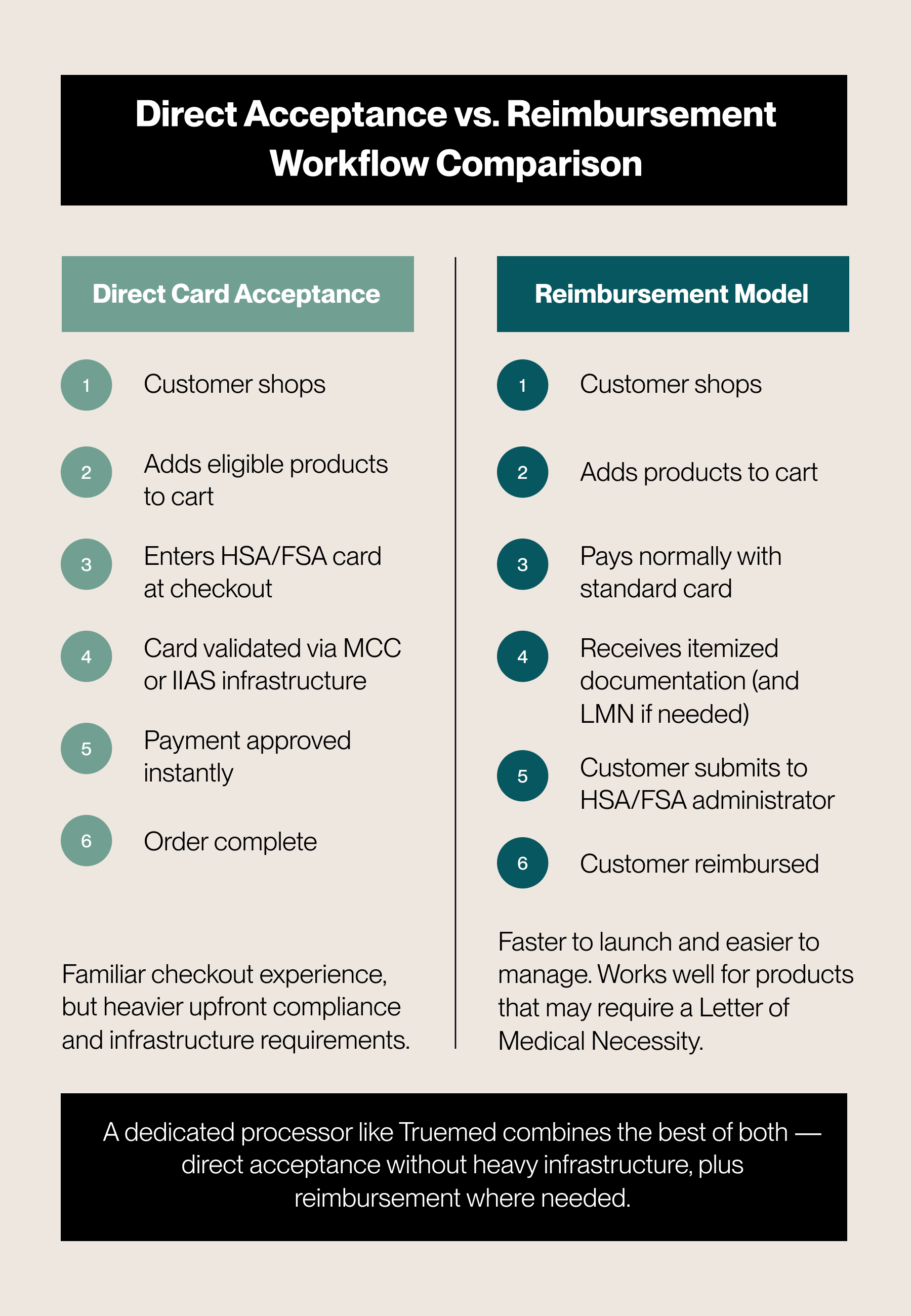
Direct Card Acceptance vs Reimbursement Models
For ecommerce brands, this is usually the most important strategic decision.
Direct card acceptance creates a familiar checkout experience, but it often comes with heavier upfront compliance requirements, infrastructure complexity, stricter eligibility controls, and operational overhead.
Reimbursement models on the other hand are typically faster to launch and easier to manage operationally.
They also work particularly well for brands selling products that may require LMNs.
Of course the ideal option has a combination of the best parts of both. A dedicated payment processor that allows direct card acceptance, without the major infrastructure requirements, that also facilitates reimbursement where necessary, is the creme de la creme as far as HSA/FSA payments are concerned.
Common Stripe HSA/FSA Processing Problems
Declined HSA/FSA Cards
Declines can happen for several reasons but these are some of the most common reasons:
- incorrect MCC assignments
- ineligible products
- insufficient documentation
- issuer restrictions
- lack of eligibility validation
Customers often blame the merchant when cards fail, which makes approval reliability especially important for customer experience and your brand reputation. One star reviews are hard to shake so it’s best to reduce declines as much as possible.
Dual-Purpose Product Issues
Products with both general wellness and medical uses can create eligibility complications. When selling dual-use products you’ll need to ensure that you have a LMN collection built into your checkout flow especially if you’re selling products like supplements, sleep products, recovery tools, and wearable devices.
Eligibility Documentation Challenges
Stripe currently doesn’t have native systems in place to confirm product eligibility for businesses who don’t have a health MCC, IIAS, or a 90% rule exception. This means brands who sell dual-use items or a mix of eligible and non-eligible items are more likely to experience processing issues.
How HSA/FSA Payments Impact Revenue
Ecommerce brands continue to explore HSA/FSA payments for a simple reason; revenue impact.
When customers use pre-tax healthcare dollars their spending power increases, their price sensitivity drops and they’re much less hesitant to make large purchases.
This change in shopping behaviour can translate into an average of 22% higher AOV, stronger conversion rates, improved CAC efficiency, and most importantly, new customer acquisition channels. Especially if you partner with a payment processor that has a built-in marketplace. Take Echelon Fitness for example, after partnering with Truemed they had a projected increase of 66% in sales, with nearly 30% of those sales coming from Truemed’s marketplace.
Best Practices for HSA/FSA Checkout Experiences
The best checkout experiences reduce uncertainty early and typically incorporate a mix of these elements:
- Clearly tagged eligible products
- HSA/FSA eligibility explanations before checkout
- Simplified reimbursement flows
- Automatic split carts when needed
- Itemized receipts
- LMNs when appropriate
- FAQ sections that answer common approval questions upfront
Most brands don’t realize that customer education matters more than they expect and confusion during checkout can kill conversion even when eligibility exists. These are some elements you can work into your checkout flow to improve your customer experience and ultimately your bottom line.
Final Thoughts
For ecommerce brands, HSA/FSA payments are quickly shifting from a niche healthcare feature into a meaningful revenue opportunity.The good news is that ecommerce businesses no longer need to rebuild their payment stack from scratch to accept HSA FSA payments with Stripe. With the right infrastructure and payment partners in place, brands can create a smoother HSA/FSA checkout experience while keeping their existing Stripe ecosystem intact.
FAQ
Stripe HSA/FSA processing refers to accepting HSA or FSA payments through Stripe using healthcare-related merchant infrastructure, reimbursement workflows, or dedicated HSA/FSA payment partners.
The 90% rule generally refers to businesses where at least 90% of inventory qualifies as eligible medical expenses under HSA/FSA guidelines.
Some direct card acceptance models may require SIGIS participation depending on the merchant setup and payment flow. An alternative flow to consider for dual-purpose items is using Truemed which streamlines the compliance gaps that often come with trying to set up HSA/FSA payments.
Not always, some businesses use reimbursement-based models that avoid direct IIAS integration.
Cards can be declined for various reasons but the most common causes include ineligible products, incorrect merchant classification, missing documentation, or issuer restrictions.



Editorial Standards
At True Medicine, Inc., we believe better health starts with trusted information. Our mission is to empower readers with accurate and accessible content grounded in peer-reviewed research, expert insight, and clinical guidance to make smarter health decisions. Every article is written or reviewed by qualified professionals and updated regularly to reflect the latest evidence. For more details on our rigorous editorial process, see here.