
Are Pillows HSA/FSA Eligible? A Guide to Getting Your Pillow Covered
Author:Kennedy Coleman
Published:
September 22, 2026
Truemed writers and editors independently evaluate all our product recommendations. If you make a purchase through any affiliate links we provide, we may receive compensation. Learn more.


Key Takeaways
Pillows are dual-purpose products, so eligibility isn't automatic: They don't qualify for HSA/FSA spending the way bandages and thermometers do. Coverage depends on documentation, not the product itself.
A Letter of Medical Necessity is what makes a pillow eligible for qualified customers: Without one from a licensed provider that connects the specific pillow purchase to a documented health or medical condition, most plan administrators will deny the claim.
Different pillow types qualify on different clinical grounds: Cervical, wedge, pregnancy, and cooling pillows each solve a distinct problem, from neck alignment to reflux to temperature regulation.
With Truemed, the LMN comes from a virtual intake survey, not a doctor visit, for qualified customers: A licensed provider reviews your answers at checkout, so there's no separate appointment to schedule.
Shop Eligible Products
Ready to unlock your HSA/FSA funds for qualified medical expenses?
You spend roughly a third of your life on a pillow (we hope), and if you have neck pain, reflux, or a pregnancy that has taken back sleeping off the table, you already know how much the wrong pillow costs you. What most people do not know, however, is that the right one may be eligible to purchase with your pre-tax HSA or FSA funds, if qualified.
That said, pillows sit in an eligibility area that trips up a lot of shoppers. They are not automatically eligible the way a prescription or bandaids would be, but they are not completely excluded either. In this guide, we cover what actually determines whether your pillow purchase qualifies, and how the four most commonly covered pillow types make their case.
Are Pillows FSA/HSA Eligible?
Yes, they can be, but it depends on an individual’s health history and needs, not just the product. This is because a pillow is what the IRS considers a dual-purpose product, meaning they have an obvious everyday use alongside a potential medical one, which puts them in the same bucket as gym memberships, sunglasses, and even mattresses. For this reason, dual-purpose products are eligible only when a licensed provider documents the medical need.
That documentation is a Letter of Medical Necessity or an LMN. Section 213(d) of the tax code defines qualifying medical expenses as costs tied to the diagnosis, cure, mitigation, treatment, or prevention of disease; an LMN is how your plan administrator confirms your pillow meets that definition. Without one, most administrators will deny the claim.
So, the honest answer is yes, pillows can be FSA/HSA eligible, but only with the right paperwork connecting the product to the treatment of a documented health condition. And the paperwork is more than the phrase suggests, so there's no need to worry about adding an hour to your purchase.
What a Letter of Medical Necessity Covers
An LMN is a short clinical document that connects three things: your diagnosed condition, the product being recommended, and the reason the product helps manage that condition. Strong letters name the diagnosis specifically and avoid vague wellness language; "this will improve my sleep quality" is exactly the kind of phrasing administrators reject.
LMNs are product and merchant specific, and they are generally valid for up to a year unless your provider sets a shorter window. That means one letter can cover more than one qualifying purchase, typically of the same product or service, during the period it is active.
If you want to see the structure before you start, our breakdown of a Letter of Medical Necessity walks through each required field and what a well-written one looks like.
Which Pillows Qualify for HSA and FSA Benefits
Not every pillow has a path to eligibility, and this is for good reason. The ones that do solve a structural or physiological problem rather than a purely comfort-driven one.
Below, we have a chart that shows how four categories of pillow compare when you are working out which one fits your situation.
| Pillow Type | What It Does | Conditions Commonly Cited | What to Mention in Your Intake |
|---|---|---|---|
| Cervical | Holds the head and neck in line with the spine overnight. | Chronic neck pain, cervical radiculopathy, tension headaches, whiplash recovery. | Your sleep position and where the pain shows up in the morning. |
| Wedge | Elevates the upper body or the legs at a fixed angle. | GERD and acid reflux, sleep apnea, post-surgical recovery, edema, sinus congestion. | The elevation your provider recommends, if one has been specified. |
| Pregnancy / Body | Supports the hips, knees, back, and belly for side sleeping. | Pelvic girdle pain, SI joint pain, sciatica, pregnancy-related insomnia. | Your trimester, or the joint pain driving the side-sleeping recommendation. |
| Cooling | Moves heat and moisture away from the sleep surface. | Night sweats, menopause-related sleep disruption, hyperhidrosis, medication side effects. | How often temperature wakes you and what you have already tried. |
These categories overlap more than the table suggests, and we'll dive a little deeper into that later. For example, a cervical pillow with a breathable cover can be relevant on both structural and thermal grounds, and there is no penalty for a situation that touches more than one row. Learn more about each type below.
Cervical Pillows
A cervical pillow is built to keep your head and neck in a neutral line with your spine instead of bending it for seven hours. Loft and firmness carry the whole design. For example, a side sleeper needs enough height to fill the gap between shoulder and ear, while a stomach sleeper needs almost none.
This category of therapeutic pillows is commonly approved for HSA/FSA spending for customers with qualifying back, neck, and shoulder conditions. If you have been searching for a pillow for neck and shoulder pain, then you are already describing something a provider can document. Other documented conditions, like chronic neck pain, cervical radiculopathy, tension headaches, and post-injury recovery, may also qualify someone to receive a Letter of Medical Necessity for a therapeutic pillow.
Wedge Pillows
Wedge pillows, and knee pillows as well, are another pillow type that more often falls into the clinical camp than the general comfort one. That’s because the product’s main job is to hold your upper body or your legs at a fixed angle for hours at a time to prevent pain or to manage a documented condition.
For example, providers recommend elevation for acid reflux and GERD, for sleep apnea, for post-surgical recovery, for swelling and circulation in the legs, and even for sinus drainage. If you’re managing one of these conditions or another where a specific elevation is a key part of your condition management, be sure to mention that specifically in the LMN process. Specificity is key when looking to purchase health tools, like wedge pillows, with HSA/FSA funds.
Pregnancy and Body Pillows
Pregnancy shifts your center of gravity, loosens your ligaments, and rules out back sleeping by the second trimester for most people. A full-length body pillow fills the space between the knees while supporting the belly and lower back, which keeps the hips stacked instead of rotating forward all night.
Qualified customers who spend HSA funds on pregnancy pillows often have documented health histories of conditions like pelvic girdle pain, SI joint pain, sciatica, or pregnancy-related insomnia. Body pillow FSA eligible claims follow the same logic outside of pregnancy; side sleepers managing hip or lower back pain use them for the same alignment reasons. If you’re going through the qualification process, it can be helpful to note your trimester or the specific joint involved to give the reviewing clinician useful context.
Cooling Pillows
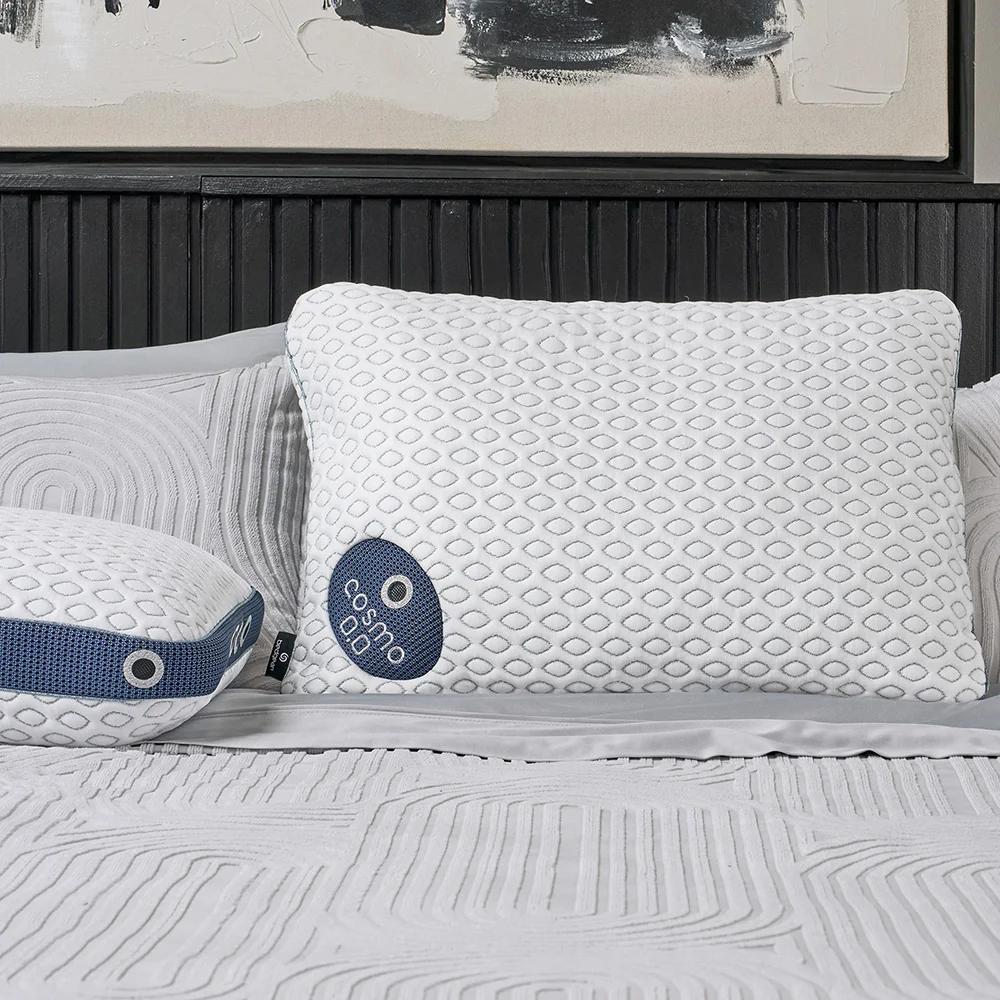
Temperature is the variable many people overlook but it’s also often the one that wakes them at 3 a.m. Cooling pillows use breathable covers, moisture-wicking fabrics, and ventilated or open-cell fills to move heat and moisture away from the surface rather than trapping it against your head.
Cooling pillows may also be HSA/FSA eligible for qualified customers when they’re linked to the treatment or a documented medical or health condition. Night sweats tied to menopause, hyperhidrosis, and temperature disruption from medication are all potential qualifying conditions.
How to Buy an FSA Eligible Pillow with Truemed
The traditional path for buying a dual-purpose product (something with both a general wellness and a medical purpose) used to mean booking an in-person appointment with a medical professional, requesting a letter, buying the product, and manually filing for reimbursement after.
Truemed* folds most of that into one seamless process directly in the checkout flow of thousands of health brands. Here’s how it works:
- Shop with a Truemed partner brand and add the pillow you want to your cart.
- Select the Truemed payment option at checkout.
- Complete the health intake survey. The survey will ask some questions about your health and medical history and is completely private. Your answers are then sent to an independent licensed clinician who will review your answers.
- Pay with your HSA or FSA card, or pay with a regular card and follow the reimbursement guide included with your LMN.
- If qualified, the licensed clinician issues the Letter of Medical Necessity (LMN) that certifies the purchase qualifies for pre-tax HSA/FSA spending.
Qualified customers save an average of about 30% by paying with pre-tax dollars. Keep your itemized receipt and your LMN together in case your administrator asks for substantiation later.
*Truemed is for qualified customers. HSA/FSA tax savings vary. Learn more at truemed.com/disclosures.
What Will Not Qualify
A few things get denied consistently, and knowing them in advance saves you a rejected claim.
- General wellness goals. Wanting to sleep better is not a diagnosable condition and will not qualify for a Letter of Medical Necessity.
- Decorative pillows, shams, and throw pillows, however they are described.
- Letters that name a product without naming a condition, or that rely on vague improvement language.
- Purchases made well before the LMN was issued, depending on your administrator.
Administrators are looking for a documented clinical link, and letters that supply one tend to clear without friction.
Picking the Right HSA/FSA Pillow Once You Qualify
Eligibility and fit are two separate problems. A wedge at the wrong angle or a cervical pillow with too little loft will not help you, at all, no matter how smoothly the documentation went. In fact, it can even make things worse for you.
Fit comes down to three inputs: your sleep position, your frame, and how warm you sleep. Side sleepers need the most loft, back sleepers need a middle range, and stomach sleepers need the least. Shoppers looking for the best pillows for back pain side sleeper usually land on a higher-loft option that keeps the spine level from hip to skull instead of letting the top shoulder collapse inward.
Truemed partners with top tier pillow and sleep brands that make finding the right pillow for your health needs easy. BEDGEAR's performance pillow collection is organized by sleep position, loft, and temperature, with breathable constructions built for hot sleepers and conforming options for neck and shoulder support. This makes it easy to get the right fit.
HSA Eligible Pillows are Worth the Paperwork
So, are pillows HSA/FSA eligible? At the end of the night, the reason HSA eligible pillows get overlooked is that almost nobody thinks to ask about them. People often assume that bedding can never be HSA eligible but that’s simply not the case. When a specialty pillow, mattress, sheet set, or other sleep product prevents, treats, cures, or mitigates a documented health or medical condition, it may be eligible for qualified customers.
Therefore, if you have FSA funds facing a use-it-or-lose-it deadline, this is a practical place to put them, especially if you want a better night's sleep. Make sure you check whether your pillow of choice comes from a Truemed partner brand, complete the health intake survey, and find out whether or not you qualify to spend your pre-tax healthcare dollars on your desired sleep purchase.
FAQ
Usually not. Pillows are dual-purpose products, so most administrators require an LMN from a licensed clinician before approving the expense.
It can be. Wedge pillows are commonly documented for reflux, sleep apnea, post-surgical recovery, and circulation, and the fixed elevation angle gives the letter a concrete clinical detail.
Yes, with an LMN, you may be able to. Pelvic girdle pain, SI joint pain, sciatica, and pregnancy-related insomnia are all conditions a provider can document.
They can be when temperature disruption is tied to a diagnosed condition such as menopause-related night sweats or hyperhidrosis. Comfort preference alone is not enough.
LMNs are generally valid for up to a year, though a provider may specify a shorter period. They are also product and merchant specific.




See what you can do with your HSA/FSA.
Join 1.5 million Americans who have routed their healthcare dollars toward root cause health via Truemed's HSA/FSA marketplace.
New product announcements
Sales and special offers
Tips for utilizing your HSA/FSA
Editorial Standards
At True Medicine, Inc., we believe better health starts with trusted information. Our mission is to empower readers with accurate and accessible content grounded in peer-reviewed research, expert insight, and clinical guidance to make smarter health decisions. Every article is written or reviewed by qualified professionals and updated regularly to reflect the latest evidence. For more details on our rigorous editorial process, see here.