
5 Best Affordable Mattresses of 2026 to Improve Your Sleep
Author:Jennifer Chesak
Reviewed By:Katherine Janosz, MD
Published:
January 09, 2026
Last Updated:
October 06, 2026
Truemed writers and editors independently evaluate all our product recommendations. If you make a purchase through any affiliate links we provide, we may receive compensation. Learn more.



Key Takeaways
You don't have to spend thousands on a mattress: Affordable options can provide the comfort, support, and features you need without breaking your budget.
Think about your preferences: When mattress shopping, think about basic needs first, such as type, material, and firmness choices, then focus on which options fit your budget.
Choose based on your needs: Whether you sleep on your side, back, tend to overheat, or need a mattress for a guest room, you can find affordable options designed to fit your specific needs.
Shop Eligible Products
Ready to unlock your HSA/FSA funds for qualified medical expenses?
You’ve been tossing and turning and waking up stiff and achy from a sagging, worn-out mattress. You know you need a new one, but when you start shopping, you recoil at the sky-high price tags. Fortunately, you don’t have to spend thousands of dollars to find a mattress that fits your needs and your budget.
Although price can be an indicator of extra bells and whistles in a mattress, a higher price doesn’t necessarily mean higher quality. Plenty of affordable mattress options can provide the comfort and support you need without breaking the bank.
In this article, we’ll explore the best inexpensive mattresses, what to look for when shopping on a budget, and how to get the most value from your purchase.
What ‘Affordable’ Really Means: Price Ranges and Tradeoffs
People often correlate price with higher quality before buying something, according to research. However, once they own and try a product, the relationship between price and perceived quality goes away.
This implies that price can sometimes create a false narrative about a product. Your experience of what you buy is all that matters for determining quality — at least to you. Price is, therefore, sometimes just a marketing tactic.
In fact, “value for price paid is a key driver in satisfaction,” reports J.D. Power, an independent researcher of consumer insights. A recent J.D. Power report also puts price into perspective. You might perceive that people are generally dropping thousands of dollars on a mattress, giving you some FOMO (fear of missing out). Some people are forking over oodles of cash, of course. But the average price point is about $1,000 for online purchases and $1,200 for in-store mattress buying.
So, if price doesn’t dictate quality, what should you look for when you're shopping on a budget? Pay attention to the mattress's construction, materials, support, comfort, and durability — not just its price tag. Features such as a warranty and trial period can also help you get more value from your purchase.
Factors affecting mattress quality independent of price.
| Factor | How it affects mattress quality |
|---|---|
| Firmness | Firmness influences sleep quality; medium-firm mattresses optimize spinal alignment and reduce back pain. |
| Material type | Material determines pressure distribution, support, durability, and comfort; latex reduces peak body pressure compared to standard foam. |
| Layer structure/zoning | Multi-layer or zoned mattresses provide better pressure relief, spinal alignment, and comfort by distributing body weight appropriately. |
| Foam density/material resilience | Higher-density foams are more durable, maintain support longer, and resist sagging; this affects long-term comfort. |
| Durability/mechanical stability | Mattresses lose firmness over time with repeated use; mechanical resilience predicts lifespan and sustained support. |
| Pressure relief/interface pressure | Lower peak pressures reduce discomfort, prevent pain, and are particularly important for side sleepers. |
| Spinal alignment/biomechanics | Mattress design affects spinal curvature, soft tissue loading, and overall support during sleep. |
| Individual comfort/personal fit | Individual differences (body weight, sleep position) influence optimal firmness, material type, and layer preference. |
| Temperature regulation/ breathability | Material and construction affect heat dissipation; latex and hybrid mattresses generally sleep cooler than high-density foam. |
Which Mattress Types Tend to Give You the Most for Your Money?
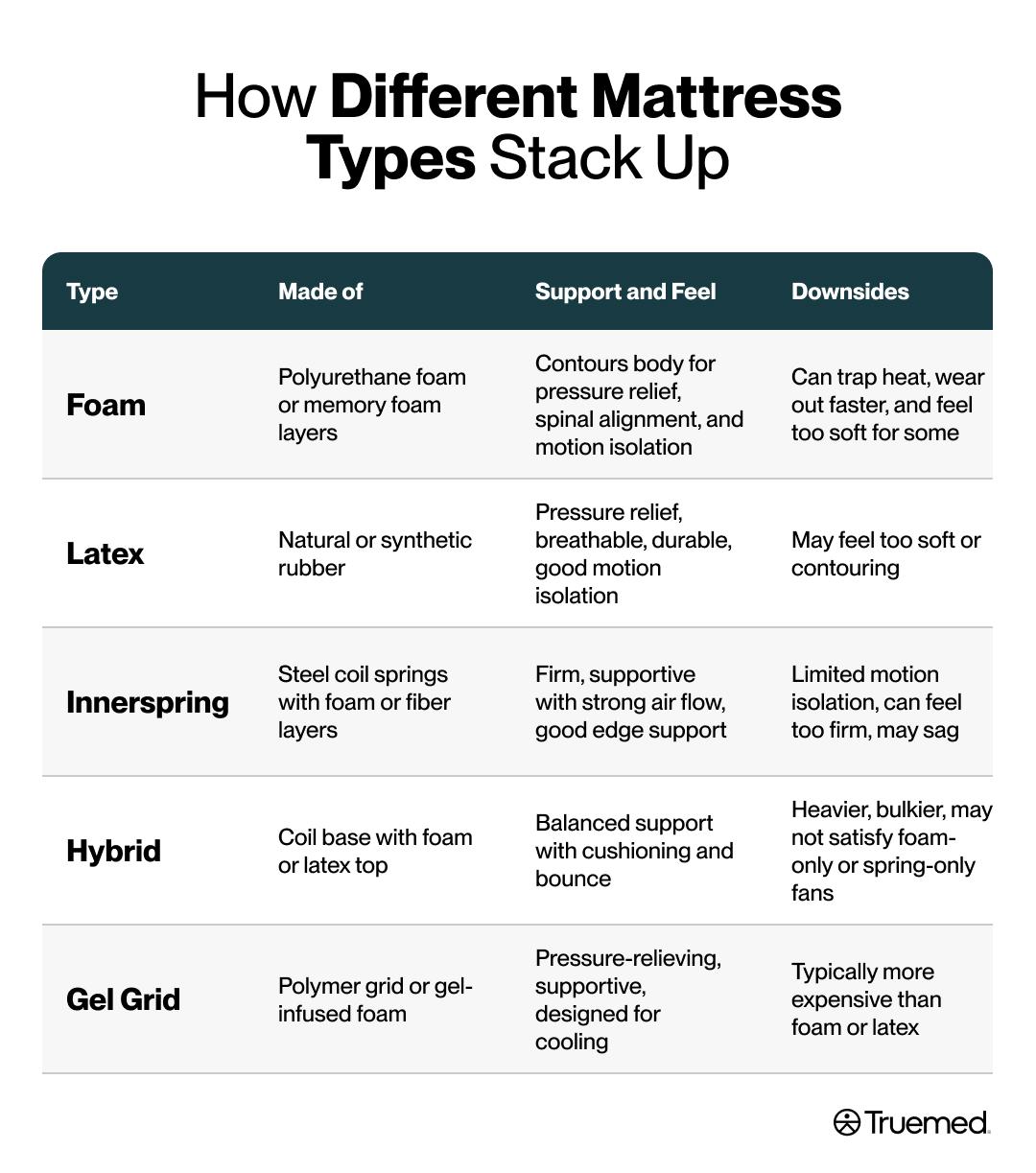
When you're shopping for an affordable mattress, the type you choose can affect both the upfront price and what you get for your money. Some mattress types tend to be more budget-friendly, while others can cost more because of their materials or construction.
For a broader look at how different mattresses compare, see our guide to the best mattresses overall.
Foam
These mattresses, made of polyurethane or memory foam layers, are some of the most affordable. They contour to your body to provide pressure relief for joints and help keep your spine in alignment. They also offer motion isolation to reduce the risk of waking a bed partner when you switch positions.
For a tight budget, foam can be a good way to get pressure relief and comfort without paying for a more complex mattress construction.
A few downsides include that they can retain heat, they may wear out faster than other mattress types, and they may not offer enough support if you prefer a firm mattress.
Latex
Latex options are made from natural or synthetic rubber. They are a bit more durable and breathable than memory foam mattresses while still providing pressure relief and motion isolation. They are also a great option if you prefer natural materials in your bedding.
However, latex may not be the best choice if your priority is finding the lowest-priced mattress. It may also not provide enough support for people who prefer a firmer feel or dislike the feeling of sinking in.
Innerspring
Innerspring mattresses feature traditional coil springs for support and a foam, fiber, or other type of padding comfort layer. You can find budget-friendly options, making innerspring a mattress type worth considering when you're trying to keep costs down.
Innerspring mattresses tend to offer firmer support compared with foam or latex mattresses, while their coils help increase airflow for breathability. They also have good edge support, so you don't accidentally slip off mid-sleep.
The tradeoff is that they may be too firm for people who prefer a sinking-in feeling, don't isolate motion as well as foam or latex, and may sag over time, depending on mattress quality.
Hybrid
Hybrid mattresses combine coil support with additional layers of foam or latex on top. You can find both affordable and more expensive options.
A hybrid can give you some of the benefits of foam or latex along with springy coil support, but you'll generally want to compare the construction and price carefully. If you're shopping on a tight budget, you may not need to pay more for features you don't want or need.
One con is that hybrids can be bulkier or heavier, and because of their hybrid nature, they may not be pleasing to folks who want a more foam or latex experience or that traditional innerspring bounce.
Gel grid
Gel grid mattresses, such as Purple, use polymer or gel-infused foam. Like latex or foam mattresses, gel versions offer pressure-relief and help keep your spine in alignment. They usually have breathability and cooling features.
However, they tend to be more expensive than foam or latex options. If keeping the price as low as possible is your primary goal, a foam or other budget-friendly option may make more sense.
The 5 Best Affordable Mattresses by Category
We’ve compiled a list of some favorite affordable mattresses, based on various needs. Keep in mind that prices may vary and fluctuate, based on sale periods or manufacturer adjustments.
Best affordable mattress for side sleepers: DreamCloud Classic Memory Foam Mattress
Side sleepers need a cushy-but-supportive option that offers pressure relief for joints while contouring to the body to keep your spine in better alignment.
Consider the DreamCloud Classic Memory Foam Mattress, available in all sizes. Even the queen and some king options slide in at a base price of under $1,000. As a bonus, sometimes the manufacturer even includes sleep accessories with your purchase.
Best inexpensive mattress for back sleepers: Brooklyn Bedding Signature Hybrid
Back sleepers typically need a mattress that’s on the firmer side.
One option that might fit your budget is the Brooklyn Bedding Signature Hybrid. It delivers the traditional support of an innerspring mattress with a high-density foam layer for pressure relief and motion isolation. And it comes in three firmness options: soft, medium, firm. You’ll get the comfort you desire without placing too much stress on your bank account.
Best cheap bed for guest rooms or short-term use: Nectar Classic Memory Foam Mattress
When you’re outfitting a guest space in your home, you want your loved ones to be comfy and sleep well, but you don’t want to fork over oodles of cash. The mattress will undergo temporary rather than continuous use, helping it to last longer. A memory foam option is great for this purpose.
Consider the Nectar Classic Memory Foam Mattress. Your guests will hopefully appreciate the just-right medium-firm feel that also helps keep them cool. And you’ll keep your cool with the budget-friendly price.
Best affordable mattress for hot sleepers: Glacier Original Hybrid
If you’re looking for a mattress that helps prevent overheating during the night, then the Glacier Original Hybrid might be for you.
As the Glacier name implies, this mattress features cooling technology with its breathable quilted cover over graphite-infused memory foam that draws heat away. But the cooling functionality doesn’t drive up the price. The manufacturer often offers sales prices at 50% off the original.
Best mattress deal for a tight budget: Boring AF (All-Foam) Mattress
You don’t need bells and whistles for a quality mattress, so if you’re on a tight budget, think about getting back to basics.
Consider the Boring AF (All-Foam) Mattress, which keeps the price point well under $1,000. Buy during a sale, and the mattress is practically a steal. Yet it provides key features, including a supportive base layer, a responsive contouring layer, and a pressure-relieving layer for sensitive joints.
Where To Find Cheap Mattress Deals That Are Still Worth It
You can buy your mattress online or in-person if your manufacturer of choice has a brick-and-mortar store.
Some research suggests that people save about $250 by shopping for a mattress online. This may be because online-only manufactures might have some reduced overhead costs and are more able to pass savings on to the consumer.
What to Look for When Shopping for a Cheap Mattress
Regardless of where or how you shop, here’s a checklist that helps you strategize regarding savings and satisfaction with your purchase:
- Is the mattress on sale? Manufacturers often slash prices on major holiday weekends.
- Does the mattress come with any add-ons, such as mattress pads or pillows? This can help you get the most bang for your buck.
- Does the mattress come with a warranty?
- Does the mattress come with a trial period, such as 120 to 365 days, allowing you to try it out worry-free?
- What is the return policy? Will you incur a processing fee?
- Does the manufacturer offer old mattress removal when they deliver your new one? This can save you from some hassle.
How it Works with your HSA or FSA and Truemed*
You might be able to purchase some mattresses and other sleep-related products with dollars from your health savings account (HSA) or flexible spending account (FSA). Mattresses and sleep products might be eligible expenses if you’re using the product to address a specific medical condition.
Truemed specializes in helping you maximize your FSA, HSA, and other health-related benefits:
- First, you can check whether a product or service is normally considered a qualifying medical expense or whether you might need an LMN.
- If an LMN is appropriate, an independent licensed practitioner (via Truemed’s clinical partner) will review your medical history, and if you qualify, they’ll issue the LMN. Truemed itself does not make eligibility determinations.
- You can then pay for qualifying products and services with your HSA’s or FSA’s debit card or get reimbursed for expenses after submitting your LMN and receipts.
- Truemed also offers support in the event you get a denial of reimbursement and need to provide substantiation documentation.
*Truemed is for qualified customers. HSA/FSA tax savings vary. Learn more at truemed.com/disclosures
FAQ
The word “cheap” can have a negative connotation. But it does not automatically mean that something is low-quality. You can find a cheap mattress that’s also durable, comfortable, and meets your individual needs based on your sleeping position and desired firmness level. So, yes, a cheap mattress can be “worth it.”
The price you pay for a mattress will depend on many factors. However, you can find some budget-friendly quality options that are well under $1,000 and even at around $500.



See what you can do with your HSA/FSA.
Join 1.5 million Americans who have routed their healthcare dollars toward root cause health via Truemed's HSA/FSA marketplace.
New product announcements
Sales and special offers
Tips for utilizing your HSA/FSA
Editorial Standards
At True Medicine, Inc., we believe better health starts with trusted information. Our mission is to empower readers with accurate and accessible content grounded in peer-reviewed research, expert insight, and clinical guidance to make smarter health decisions. Every article is written or reviewed by qualified professionals and updated regularly to reflect the latest evidence. For more details on our rigorous editorial process, see here.