
How Does FSA Payment Work? Understanding HSA and FSA Payments for Ecommerce
Author:Anna Meyer
Published:
June 29, 2026
Last Updated:
July 23, 2026



Key Takeaways
HSAs vs. FSAs: Both are tax-advantaged accounts for paying eligible healthcare expenses with pre-tax dollars, but they differ in ownership, rollover, and tax treatment.
How FSA payment works: Customers fund accounts via pre-tax payroll deductions, confirm a product is an eligible medical expense, then either pay with an HSA/FSA card or pay out-of-pocket and request reimbursement.
Dual-use products: Products usable for both general health and medical treatment require a Letter of Medical Necessity (LMN) to validate eligibility.
Eligibility validation: Behind the scenes, systems like Merchant Category Codes (MCCs), Inventory Information Approval Systems (IIAS), and specialized processors verify eligibility in real time.
Market opportunity is large: Nearly half of Americans have an HSA or FSA, representing over $170 billion in available healthcare assets.
Customer acquisition: The right processor, like Truemed, can connect stores to shoppers actively searching for eligible products, adding an acquisition channel beyond just a payment method.
Talk to Sales
Ready to unlock HSA/FSA payments for your business?
What Are HSAs and FSAs?
Health Savings Accounts (HSAs) and Flexible Spending Accounts (FSAs) are tax-advantaged accounts that allow consumers to pay for eligible healthcare expenses with pre-tax dollars.
Both accounts help reduce out-of-pocket healthcare costs, although they have different fund rules and tax advantages. FSAs and HSAs are rising in popularity as customers can use these funds for a wide range of qualified medical expenses. According to the IRS, qualified medical expenses are products or services that are used to treat, prevent, or mitigate a health condition. These expenses cover anything from medical devices and supplements to sleep and recovery products that meet IRS eligibility requirements.
If you’re selling health products, accepting HSA/FSA payments can make purchases more affordable for your consumers without lowering your product prices.
Key Differences Between HSA and FSA Accounts
Although HSAs and FSAs serve a similar purpose, there are several important differences.
Ownership of Funds
HSAs belong to the individual, so the account stays with them even if they change employers, making HSAs a sort of a health investment vehicle.
FSAs are typically employer-sponsored and usually remain tied to that employer. Meaning, once an employee resigns, they lose access to their FSA.
Contribution Methods
Both accounts are commonly funded through pre-tax payroll deductions. HSAs are slightly different though as they may also allow additional personal contributions although they are subject to annual contribution limits.
Eligibility Requirements
HSAs require enrollment in a qualifying high-deductible health plan (HDHP) whereas FSAs are generally available through employers that choose to offer them as part of their benefits package.
Fund Rollover Rules
Unused HSA funds roll over year after year. FSA funds however often follow a "use it or lose it" rule with available spending expiring on the final day of your plan year which is usually the 31st of December. Although, some employers offer limited carryover amounts or grace periods.
Tax Benefits
Both HSAs and FSAs reduce your taxable income however HSAs have what’s called the triple tax advantage. When used properly, your contributions are not taxed, any interest earned on your HSA is also tax free, and all withdrawals are tax free if they’re used for qualified medical expenses.
How Does FSA Payment Work?
If you've ever wondered how do FSA payments work, the answer starts before a customer reaches your website.
Once consumers have signed up for an HSA or FSA, they typically contribute money into their account through payroll deductions before taxes are calculated. For HSA owners, they can also make individual contributions.
When they’re ready to make a purchase, they first need to determine whether the product qualifies as an eligible medical expense. In some cases the products are clearly for medical purposes in which case eligibility validation is handled by your payment processor and your Inventory Information Approval System (IIAS) where applicable. If they’re purchasing a dual-use product, which is a product that can be used as both a general health product and a treatment for a medical condition, they’ll need to get a Letter of Medical Necessity.
Once they’ve confirmed eligibility they move to the most important step. Payment.
Depending on the merchant and product, they can pay directly with an HSA/FSA card or with their debit or credit card and request a reimbursement after they’ve completed the purchase.
If all goes according to plan, their payment is approved and their order is en route.
Behind the scenes though, several systems help determine whether their transaction meets compliance requirements. These include Merchant Category Codes (MCCs), Inventory Information Approval Systems (IIAS), and specialized providers that manage HSA/FSA payment processing and product eligibility validation
All these systems are in place to validate product eligibility in real time.
The Ways Customers Use HSA/FSA Funds for Purchases
Direct HSA/FSA Card Payments
The simplest experience is paying with an HSA or FSA debit card at checkout.
When a customer reaches checkout and submits their payment, the transaction passes through systems designed to verify eligibility before the payment is approved. These can include an IIAS, MCC, or an LMN in the case of dual-use products.
With direct payments, you’ll need to partner with a dedicated payment provider that specializes in healthcare transactions.
This type of set up typically requires an API integration with your ecommerce store and once set up, your customers will see a HSA/FSA payment option at checkout like in the example below.
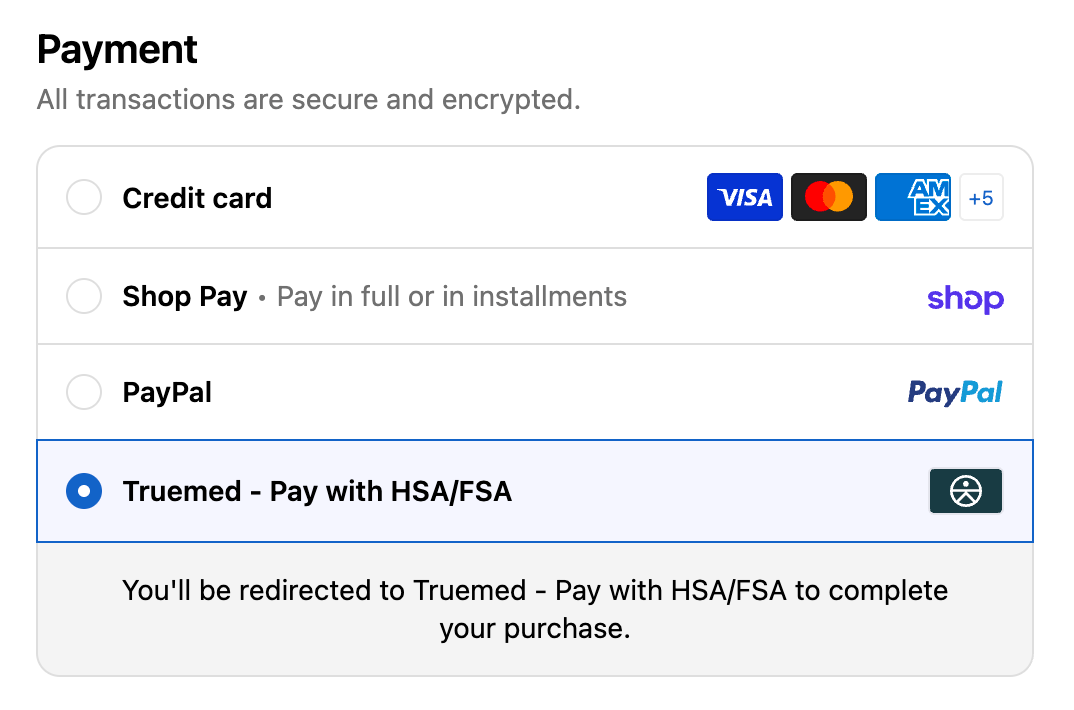
Direct payments work with both qualified medical expenses and dual-use products, though the check out process is slightly different when you purchase a dual-use product.
If your customer purchases a dual-use product using their HSA/FSA card, an integrated payment system like Truemed* will direct them to a health survey where a licensed healthcare provider will assess their survey and provide a LMN where appropriate.
Direct payments are typically the preferred payment method for ecommerce stores because it streamlines the checkout process for your customers.
*Truemed is for qualified customers. See terms at truemed.com/disclosures.
HSA/FSA Reimbursement
The second payment pathway is HSA/FSA reimbursement. With this payment flow, your customer will pay with their own debit or credit card, get a Letter of Medical Necessity if needed, and request a reimbursement from their FSA or HSA administrator at a later stage.
Here you have two options. You can let your customers get their own LMN from their medical provider or you can partner with a company like Truemed to include a LMN qualification in your checkout flow.
If you opt for the latter, your customer will be redirected to Truemed’s health survey where a licensed healthcare provider will review their survey and issue an LMN if appropriate.
Your customer can then complete the payment process on your website and then take their receipt and LMN to their administrator for a reimbursement.
Platforms like Truemed streamline this workflow by helping eligible customers obtain the documentation needed to support reimbursement requests, making the process significantly easier for both you and your customers.
Documentation Requirements for HSA/FSA Payments
Tax-advantaged accounts are an oasis for Americans needing tax relief and reduced healthcare costs. The major consideration is that HSAs and FSAs have strict compliance requirements from the IRS which is why documentation plays an important role in HSA/FSA payment processing.
Your responsibilities with regard to documentation depends on the products or services you sell.
At minimum, you’ll need to ensure that you provide your customers with an itemized receipt that includes your business name, date of purchase, description of the item or service, and the amount paid.
In the case of dual-use products you’ll need a LMN from your customer to validate eligibility if you’re accepting HSA/FSA cards.
This additional review exists to ensure that HSA and FSA funds are used only for qualifying medical expenses under IRS rules.
Why HSA/FSA Payments Matter for Ecommerce Brands
If you're researching how to accept HSA/FSA payments, understanding the business impact is just as important as understanding the technology
Accepting HSA/FSA payments does more than expand payment options for your consumers.
Customers paying with pre-tax dollars can often save an average of 30% compared to paying with after-tax income.* That added purchasing power frequently translates into larger purchases without ecommerce stores offering discounts.
This also means that customers buy more products increasing your AOV by an average of 22%.
Of course the opportunity extends beyond existing customers. Nearly half of Americans have access to an HSA or FSA, representing over $170 billion in available healthcare assets. Reaching these consumers can be a gold mine because it opens access to an audience actively looking for eligible products.
The cherry on top is that the right payment processor, like Truemed, offers consumer marketplaces that introduce your store to shoppers specifically searching for HSA/FSA-eligible products. This creates an additional customer acquisition channel rather than simply adding another payment method.
As demand for ecommerce HSA/FSA payments continues to grow, more health brands are making pre-tax payments part of their checkout experience.
*Truemed is for qualified customers. HSA/FSA tax savings vary. Learn more at truemed.com/disclosures.
FAQ
Both accounts are tax advantaged accounts but HSA payments come from an individually owned Health Savings Account and remain available year after year. FSA accounts on the other hand use employer-sponsored Flexible Spending Accounts that generally have annual spending deadlines. Both accounts allow customers to purchase eligible healthcare products using pre-tax dollars.
Yes, ecommerce businesses can accept HSA/FSA payments but you’ll need to implement compliant payment solutions that support healthcare transactions and provide for the necessary substantiation requirements from the IRS.
A Letter of Medical Necessity (LMN) is a document from a licensed healthcare provider that says a specific product or service is needed to treat, prevent, or manage a health condition. And with one, your HSA/FSA dollars can go a lot further, covering things that actually support your health, like supplements, sleep tech, diagnostics, or fitness equipment. That’s where Truemed comes in. We connect you with a licensed clinician who can evaluate your needs and, if appropriate, issue an LMN for IRS-approved products and services. No doctor visits, no insurance hoops. Just a smarter way to spend on the clinically-backed interventions that matter for your health.




See what you can do with your HSA/FSA.
Join 1.5 million Americans who have routed their healthcare dollars toward root cause health via Truemed's HSA/FSA marketplace.
New product announcements
Sales and special offers
Tips for utilizing your HSA/FSA
Editorial Standards
At True Medicine, Inc., we believe better health starts with trusted information. Our mission is to empower readers with accurate and accessible content grounded in peer-reviewed research, expert insight, and clinical guidance to make smarter health decisions. Every article is written or reviewed by qualified professionals and updated regularly to reflect the latest evidence. For more details on our rigorous editorial process, see here.