
How to Reduce Screen Time: 5 Tips to Take Back Control
Author:Kennedy Coleman
Reviewed By:Michaela Robbins, DNP
Published:
August 06, 2026



Key Takeaways
Screen time is higher than most people realize: U.S. adults spend an average of 4 to 5 hours a day on their phones, closer to 6 to 7 hours once every screen is counted.
Willpower alone usually isn't enough: Apps are deliberately designed with variable rewards, infinite scroll, and re-engagement notifications that make it hard to just "try harder."
Small, specific habit shifts help most: Turning off non-essential notifications, moving your phone out of arm's reach, and building one no-phone zone can meaningfully cut back screen time without a full digital detox.
Physical blockers like Brick may be HSA/FSA eligible: For qualified customers, tools like Brick can sometimes qualify for HSA/FSA spending when a licensed clinician issues a Letter of Medical Necessity.
Shop Eligible Products
Ready to unlock your HSA/FSA funds for qualified medical expenses?
What Is Phone Addiction, and Why Is It So Hard to Put Down?
"Phone addiction" isn't a formal medical diagnosis, but researchers use the term "problematic smartphone use" to describe a real, well-documented pattern of checking devices compulsively, feeling anxious without your phone nearby, and struggling to cut back even when you want to.
Pew Research Center has found that 44% of U.S. teens say being without their phone makes them feel anxious, and roughly four in ten U.S. adults report being online "almost constantly." On the usage side, the CDC's National Health Interview Survey found that just over half of U.S. teenagers ages 12 to 17 (50.4%) log four or more hours of daily screen time.
Many of us know we should spend less time on our phones and assume willpower alone should be enough to make it happen. Often, it isn't. The fact that so many of us feel trapped by our phone usage isn't a personal failing. It's the result of deliberate design.
The Design Tactics That Keep You Hooked
Notification systems, content feeds, and app interfaces are built by teams that study, test, and optimize all for the goal of keeping you engaged. A few tactics show up across nearly every major app:
- Variable rewards: Pull-to-refresh feeds and unpredictable notifications mirror the same reward structure that makes slot machines hard to walk away from. You never know if the next check will turn up something interesting, so you keep checking.
- Infinite scroll and autoplay: Removing natural stopping points, like the end of a page or a video, removes the moment where you'd otherwise pause and decide whether to keep going.
- Streaks and gamification: Point systems and streaks use loss aversion, the discomfort of "breaking" a streak, to pull you back into an app you might not otherwise open.
- Notifications tuned for re-engagement: Push notification timing and wording are frequently tested against real usage data to find whatever maximizes the odds you'll tap back in.
- Social comparison loops: Likes, view counts, and follower totals create a feedback loop that keeps you checking to see how you, or your last post, measured up.
Understanding these mechanisms explains why "just use more willpower" isn't the whole story. These products are engineered to outlast willpower, which is why many people need specific tips, habit changes, and sometimes even physical tools, to actually cut back on screen time.
The Health Impact of Excess Screen Time
Screen time can be a major productivity blocker, but the negative effects of screen time actually run a whole lot deeper than that. Here's what the research shows about how too much time on your phone affects your mental health, your sleep, your focus, and even your body.
Mental Health
Heavy screen use shows up again and again in research on anxiety and depression, especially in teens. The CDC found that teens who spend four or more hours a day on screens report anxiety symptoms at more than twice the rate of teens who use screens less, and a similar gap shows up for depression. Even more compelling is a 2025 clinical trial published in BMC Medicine, which had university students actually cut their screen time to two hours a day for three weeks. Their stress, mood, and depressive symptoms all improved compared with a group that kept using their phones as usual, offering real evidence that cutting back can genuinely help your mental health, not just correlate with it.
A separate, larger study out of Georgetown University backs up these findings. Psychology professor Kostadin Kushlev had nearly 500 people cut off their phones' internet access for two weeks, tracked with the Freedom app, and found that the resulting improvements in well-being and mental health were comparable to what you'd see from cognitive behavioral therapy, and larger than the typical effect of antidepressants in clinical trials.
Sleep
Scrolling in bed keeps your brain switched on right when it should be winding down, and the blue light your screen gives off suppresses melatonin, the hormone that tells your body it's time to sleep. That combination is tied to shorter, worse-quality sleep, and it shows up consistently across the research. Both the BMC Medicine trial and the Georgetown study mentioned above found the same pattern at different scales. Students who dropped to two hours a day and a much larger group who went offline for two weeks both saw their sleep quality improve, with the Georgetown group sleeping about 20 extra minutes a night on average. You don't need to go that far to see a benefit, either. A separate study found that just turning off notifications and switching your screen to greyscale improved sleep within two weeks, no willpower required.
Attention and Focus
It's not just how much time you spend on your phone, it's how often you pick it up, too. Research covered in the Washington Post, found that checking frequency, not total screen time, is what actually predicts lapses in focus and memory. Every time you unlock your phone mid-task, your brain has to re-orient itself to what you were doing before, and that adds up fast over the course of a day. In that same Washington Post piece, Stanford researcher Anna Lembke describes this behavior as a habit loop, where checking becomes almost automatic and going without it can feel surprisingly uncomfortable. The Georgetown study offers maybe the clearest evidence yet that this is reversible: after two weeks of reduced phone use, participants' ability to sustain attention improved by an amount comparable to reversing about 10 years of age-related decline.
Eyes and Posture
Staring at a screen for hours dries out your eyes, since you blink less when you're focused on something up close, and it strains your near vision the same way. This combination, known as digital eye strain or computer vision syndrome, shows up as headaches, blurred vision, and dry eyes for many adults who use screens regularly, according to the American Optometric Association. Screens also pull your head forward and down, putting a lot more pressure on your neck than most people realize. One widely cited biomechanics study found that tilting your head forward the way most people do while texting can put as much as 60 pounds of pressure on your spine, compared with roughly 10 to 12 pounds when your head is upright.
Cutting back on screen time can help with all of these negative health effects, and the good news is it doesn't take a full overhaul to start seeing a difference.
How to Stop Phone Addiction: Core Habit Shifts
Here are five small, specific changes that help cut back on screen time. These are easy, sustainable tactics, not a total overhaul, so you can actually commit to changing your tech habits.
1. Turn off non-essential notifications
Keep alerts for calls, texts from real people, and anything time-sensitive. Turn off everything else including social apps, games, news pushes. Fewer interruptions may mean fewer reasons to pick up your phone in the first place.
2. Move your phone out of arm's reach
Distance adds friction. Leaving your phone in another room while working, sleeping, or eating removes the reflexive "just check it" moment before it starts. It may even be a helpful baby step just to intentionally place your phone screen down when you’re not actively using it so you’re not tempted by every notification that pops up.
3. Interrupt the reflex, don't just resist it
Willpower alone tends to lose to habit. Instead of just trying not to reach for your phone, have something ready that disrupts the habit. Maybe that means changing your screensaver to a note that says “Why did you pick up your phone?” or perhaps every time you pick up your phone mindlessly you stand up and walk around your house for 45 seconds. It may seem silly, but having something ready to break the mindless cycle may help reduce the number of times that you pick up your device over time.
4. Use your phone’s built in tools
Both iOS (Screen Time) and Android (Digital Wellbeing) let you cap specific apps. It's a soft limit that many find too easy to override, but it adds a pause point that some people think is enough. Another great in-device option is turning on greyscale mode which lessens the colorful dopamine hit you get from looking at your phone.
5. Build one no-phone zone
Pick one place or time, like the bedroom, the dinner table, or maybe the first 30 minutes after waking up, and keep it phone-free. Maybe that looks like charging your phone in the kitchen instead of your bedroom or turning your phone completely off while eating dinner. One consistent boundary is often easier to sustain than a dozen loose rules.
Need stricter phone-blocking habits?
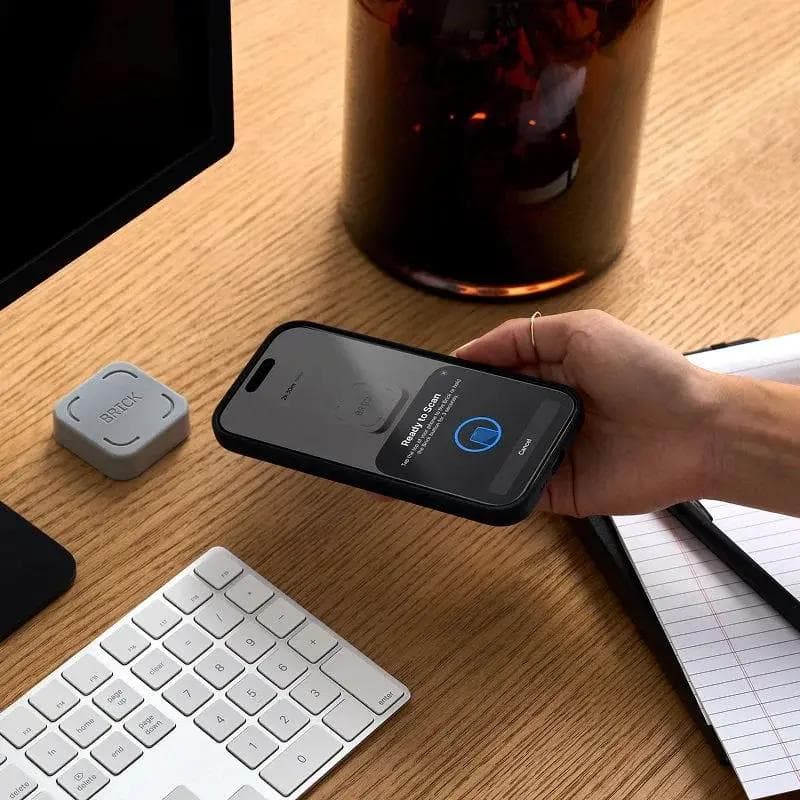
Some people find that implementing these behavioral changes are not strict enough to really reduce screen time long-term. That’s where physical blocking devices, like Brick, could be helpful.
Devices like Brick pair a small NFC tag with an app. Tap your phone to the tag to lock selected apps, and tapping again is the only way to unlock them. Leave the tag somewhere inconvenient, your car, a drawer, and the block becomes much harder to casually override than software alone. Unlike a full digital detox, you get to consciously choose which apps you want to avoid while still having access to parts of your phone that may be necessary, like calls, texts or maps.
Brick also lets you schedule lock periods directly in the app, so you don't have to remember to tap in each time. You might block social apps from 9 to 5 on weekdays to protect focus at work, or shut everything down on Saturday mornings to be fully present with family. Either way, the schedule does the work that willpower usually has to.
Brick is a one-time hardware cost rather than a subscription, and if you're weighing that cost, it's worth knowing that focus tools like Brick can sometimes qualify for HSA/FSA spending when a licensed clinician connects it to the treatment of a diagnosed medical condition and issues a Letter of Medical Necessity (LMN).
FAQ
"Problematic smartphone use" is an active area of research, but it isn't currently a standalone diagnosis in the DSM-5. Researchers often study it alongside related conditions like anxiety or depression rather than as its own category. If you're concerned about your own use, a doctor or therapist can help evaluate what's going on.
There's no universal number for adults, but screen time if often considered to be “too much” when it interferes with sleep, relationships, physical health or day to day responsibilities.
Research is mixed. Some trials show real reductions in problematic use and improved sleep while others find effects fade once the structure of the trial ends. Consistency seems to matter more than which specific app or tool you use.
For some people, yes, the physical friction of a device like Brick can succeed where a software toggle didn't, because it removes the option to talk yourself out of it in the moment.



See what you can do with your HSA/FSA.
Join 1.5 million Americans who have routed their healthcare dollars toward root cause health via Truemed's HSA/FSA marketplace.
New product announcements
Sales and special offers
Tips for utilizing your HSA/FSA

Editorial Standards
At True Medicine, Inc., we believe better health starts with trusted information. Our mission is to empower readers with accurate and accessible content grounded in peer-reviewed research, expert insight, and clinical guidance to make smarter health decisions. Every article is written or reviewed by qualified professionals and updated regularly to reflect the latest evidence. For more details on our rigorous editorial process, see here.