
Is Invisalign Covered by HSA or FSA? Every Eligible Aligner and Braces Option, Explained
Author:Kennedy Coleman
Reviewed By:Michaela Robbins, DNP
Published:
August 19, 2026


Key Takeaways
Invisalign and other orthodontic treatment are typically HSA/FSA eligible: Because the IRS classifies orthodontic care as correcting a genuine medical issue (malocclusion) rather than a cosmetic one, braces, Invisalign, other aligner brands, and retainers are generally qualified expenses without needing additional documentation.
Cost and treatment time vary widely: Options range from roughly $1,295 at-home aligners to $13,000 lingual braces, and from 4 to 36 months of treatment. Every option in that range qualifies for HSA spending the same way as long as a licensed dentist is directing care.
Untreated misalignment carries real health risks: Decay, uneven enamel wear, TMJ strain, gum recession, and speech issues are the medical basis that separates orthodontic treatment from purely cosmetic procedures like teeth whitening.
Timing matters more than payment method: Whether you pay directly with an HSA/FSA card or submit for reimbursement, funds can only cover treatment received after the account existed. Payments on treatment that started earlier don't qualify, even if you're still making installments.
Shop Eligible Products
Ready to unlock your HSA/FSA funds for qualified medical expenses?
Is Invisalign HSA/FSA eligible?
Yes, clear aligner brands, including Invisalign, are typically eligible for HSA/FSA spending. Orthodontic treatment is one of the more straightforward HSA/FSA categories because braces and aligners are already treated as a qualified medical expense rather than something that needs special documentation to prove medical necessity. That puts Invisalign in the same bucket other dental services, like fillings and root canals, which serve a medical purpose.
Certain dental products, like specialty toothbrushes, may also be HSA/FSA eligible for qualified customers, but they often require a piece of additional documentation called a Letter of Medical Necessity (LMN). An LMN is a document from a licensed clinician explaining why a particular product, treatment, or service is necessary to diagnose, treat, mitigate, or prevent the patient's medical condition. Products like these need an LMN because they can serve either a general wellness purpose or a specific medical one (defined below), depending on the patient. Orthodontic treatment doesn't need this extra step because it's classified as primarily medical and not for general wellness or aesthetic purposes.
Why does orthodontic treatment count as a medical expense, not a cosmetic one?
The IRS defines a qualified medical expense as a cost paid to diagnose, treat, mitigate, or prevent disease, or to affect a structure or function of the body. Purely cosmetic procedures that are done to improve appearance without addressing a health issue generally don't qualify. Orthodontic treatment sits on the "medical" side of that line because it corrects malocclusion which is a genuine misalignment of the teeth and jaws. There are real health implications of leaving teeth in the incorrect position which we’ll dive into later.
This definition is also why teeth whitening is not HSA/FSA eligible while braces and aligners are. Both treatments affect a smile’s appearance, but whitening doesn’t address a diagnosed dental condition while straightening a bad bite does.
The real dental health risks of leaving misalignment untreated
Crowded, gapped, or rotated teeth create problems that compound over time, including:
- Hygiene and decay risk: Overlapping or tightly spaced teeth are harder to brush and floss effectively. This misalignment lets plaque build up in places a toothbrush can't easily reach, which may raise the risk of cavities and gum disease.
- Uneven wear and enamel damage: A misaligned bite distributes chewing pressure unevenly, which can wear down enamel faster in some spots than others and may increase the risk of chips or fractures.
- Jaw strain and TMJ issues: Misaligned teeth can force the jaw muscles and joints to compensate. In somecases this misalignment can contribute to temporomandibular joint (TMJ) discomfort, clicking, or headaches, though there can be other factors at play like stress. There also is evidence of the other way around- that TMJ can cause improper biting.
- Gum recession: Uneven bite forces can wear away gum tissue over time, exposing tooth roots and increasing sensitivity.
- Speech and function: Some malocclusions make certain sounds harder to pronounce clearly or make chewing less efficient.
All of these health risks are why orthodontic treatment is functionally preventive dental care, not a cosmetic upgrade. This is the distinction that allows the IRS to treat braces and aligners as a qualified medical expense that’s eligible for HSA/FSA spending.
Every HSA/FSA-eligible way to straighten your teeth
Because the underlying issue (malocclusion) is the same regardless of which appliance treats it, most legitimate orthodontic options may qualify. Here's how the major categories work.
Traditional metal and ceramic braces
This is what many people imagine when they think of orthodontic treatment. This method involves brackets bonded to each tooth, connected by an archwire that's tightened periodically to guide teeth into position. Metal braces are the most affordable and handle the widest range of cases, including complex bite corrections that clear aligners can't. Ceramic braces work the same way but with tooth-colored brackets that are less visible.
Lingual braces
A less common variant where brackets are placed behind the teeth instead of in front, making them essentially invisible from the front. They cost more than standard braces and require a provider with special experience with the technique. Relative to labial braces, lingual appliances carry significantly more tongue pain, speech difficulty, eating difficulty, and greater difficulty maintaining oral hygiene.
Invisalign (in-office clear aligners)
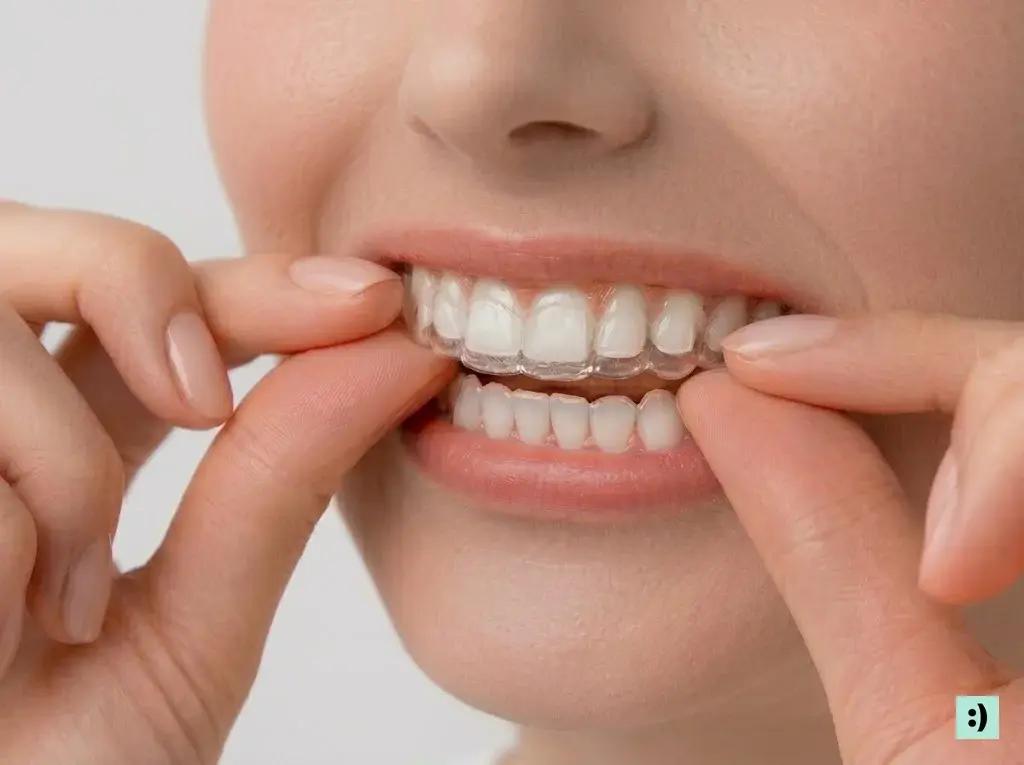
A series of custom, removable clear trays, each worn for one to two weeks before moving to the next in the sequence, gradually shifting teeth into place. Treatment is directed by a dentist or orthodontist who monitors progress with periodic in-office visits. Invisalign is discreet and removable, which is part of why it's popular with adults, but it's typically the most expensive option on this list.
Other clear aligner brands
Invisalign isn't the only doctor-directed clear aligner system. ClearCorrect, Byte, and similar brands follow a similar model (custom trays, dentist-directed treatment plans) at varying price points and levels of in-person monitoring. As a licensed provider is overseeing the case, the same IRS eligibility logic may apply.
At-home aligners like SmileSet
Some companies including SmileSet offer a largely remote version of the clear-aligner model. Rather than in-person visits, you order an at-home impression kit or obtain a scan, a licensed dentist reviews the case remotely and develops a treatment plan, and custom aligners are shipped to you with little or no in-office supervision. While remote supervision can be extremely useful and increase access to care, one caveat is that direct to consumer aligners rely on remote supervision, which is not clinically equivalent to in-office care—teledentistry is validated for screening and monitoring but can miss findings like crossbite and functional shifts. SmileSet is built for mild-to-moderate cases (small gaps, minor crowding, minor bite issues) rather than complex corrections, so candidacy is screened before treatment begins.
Retainers and night guards
Once active orthodontic treatment ends, retainers keep teeth from shifting back, and they're generally eligible the same way the aligners or braces were. Night guards for teeth grinding are typically eligible too, since grinding is a diagnosable condition with real health implications.
How do these options compare?
| Option | Typical Cost | Treatment Time | In-person Visits | HSA/FSA status |
|---|---|---|---|---|
| Metal/ceramic braces | $3,000-7,500 | 12-24 months | Frequent | Qualified expense |
| Lingual Braces | $5,000-13,000 | 18-36 months | Frequent | Qualified expense |
| Invisalign (in-office) | $3,000-8,000 (avg. ~$5,100-5,700) | 6-18 months | Periodic | Qualified expense |
| Other aligner brands (ClearCorrect, Byte, etc.) | $2,000-6,000 | 6-12 months | Varies by brand | Generally a qualified expense when doctor-directed |
| At-home aligners (SmileSet) | ~$1,295-1,795 | 4-9 months | Often none (usually fully remote) | Generally a qualified expense when doctor-directed |
| Retainers | $150-500 | Ongoing wear | Rare | Qualified expense |
How do you actually pay for orthodontic treatment with HSA or FSA funds?
Paying for pre-approved items, like most orthodontic treatment options, with HSA/FSA is simple. The first way to pay is to pay with a regular credit or debit card and then submit for reimbursement from your HSA or FSA administrator after the fact. Have questions about how HSA/FSA reimbursement works? Check out our reimbursement guide on the Help Center.
Some direct to consumer orthodontic treatment brands, like SmileSet, make it even easier to pay with HSA/FSA online by integrating an HSA/FSA payments tool like Truemed*. Here’s how it works:
- Explore the orthodontic treatment options available on SmileSet
- Add your desired treatment plan to cart
- At checkout, select “Truemed - Pay with HSA/FSA”
- Move into the Truemed payment experience and submit your HSA/FSA card details directly
One timing rule applies across both payment methods: funds can only be used for treatment received after your HSA or FSA account existed. If you started treatment before opening the account, those specific payments generally don't qualify, even if you're still making installments on them.
*Truemed is for qualified customers. HSA/FSA tax savings vary. Learn more at truemed.com/disclosures.
FAQ
No because whitening is considered cosmetic rather than treatment for a diagnosed dental condition, so it doesn't qualify. This holds true even when whitening is done alongside orthodontic work.
Yes, retainers are generally treated the same way as the braces or aligners that came before them. They are part of continued orthodontic treatment and thus are typically HSA/FSA eligible.
No, HSA/FSA eligibility is independent of what your insurance does or doesn't cover. You can use HSA/FSA funds for your out-of-pocket cost regardless of your insurance situation.
Not exactly. Both rely on a licensed dentist to direct treatment, but SmileSet's model is fully remote with no in-office visits, while Invisalign through a dentist or orthodontist includes in-person monitoring. That trade-off is a big part of why SmileSet is a more affordable option for many people. It's also the same reason SmileSet is not an appropriate option for every orthodontic case and why SmileSet conducts an initial evaluation before starting treatment.
Yes, as long as the child is your tax dependent and the treatment is otherwise a qualified expense, the same rules apply.



See what you can do with your HSA/FSA.
Join 1.5 million Americans who have routed their healthcare dollars toward root cause health via Truemed's HSA/FSA marketplace.
New product announcements
Sales and special offers
Tips for utilizing your HSA/FSA
Editorial Standards
At True Medicine, Inc., we believe better health starts with trusted information. Our mission is to empower readers with accurate and accessible content grounded in peer-reviewed research, expert insight, and clinical guidance to make smarter health decisions. Every article is written or reviewed by qualified professionals and updated regularly to reflect the latest evidence. For more details on our rigorous editorial process, see here.