
How Much Should I Contribute to My HSA?
Author:Kathleen Ferraro
Reviewed By:Michaela Robbins, DNP
Published:
February 19, 2026
Last Updated:
August 04, 2026
Truemed writers and editors independently evaluate all our product recommendations. If you make a purchase through any affiliate links we provide, we may receive compensation. Learn more.



Key Takeaways
There's no single best HSA contribution: A good HSA contribution is one you can afford to make every paycheck without creating financial strain.
It's okay to start smaller: Start by covering your expected medical costs, then increase toward your deductible or the annual limit if your budget allows.
Don't forget employer contributions: They count toward your yearly cap, so factor them in before setting your own amount.
Consider your financial situation: Maxing out your HSA can be powerful, but only after you’ve handled essentials like emergency savings and high-interest debt.
Key Takeaways
How Much Should I Contribute to My HSA? Start With These Guardrails
Before You Pick a Number: Confirm You’re Eligible to Contribute
Know the Annual Limits and What Counts Toward Them
Choose Your HSA Contribution Level (Simple Tier System)
How Much Should I Put In My HSA Each Paycheck (Make It Automatic)
Should You Max Out HSA? When It Makes Sense (and When It Doesn’t)
Average HSA Contribution: Why “Average” Isn’t the Goal
How Much Should I Have in My HSA at Retirement? A Practical Way to Think About It
Contribution Timing, Deadlines, and Common Mistakes to Avoid
Compliance & Documentation
How It Works with HSA/FSA and Truemed
FAQ
Shop Eligible Products
Ready to unlock your HSA/FSA funds for qualified medical expenses?
If you’re eligible for a health savings account, the big question is simple: How much should I contribute to my HSA?
There’s no single right number. Your ideal contribution depends on your expected medical costs, your plan’s deductible, any employer contributions, and what your monthly budget can realistically handle. Some people use their HSA to cover near-term expenses. Others build it up for future healthcare. Many do a bit of both.
This guide helps you pick a practical target you can actually stick with. We’ll cover easy contribution tiers, how to translate a yearly goal into a per-paycheck amount, and when it might make sense to aim higher.
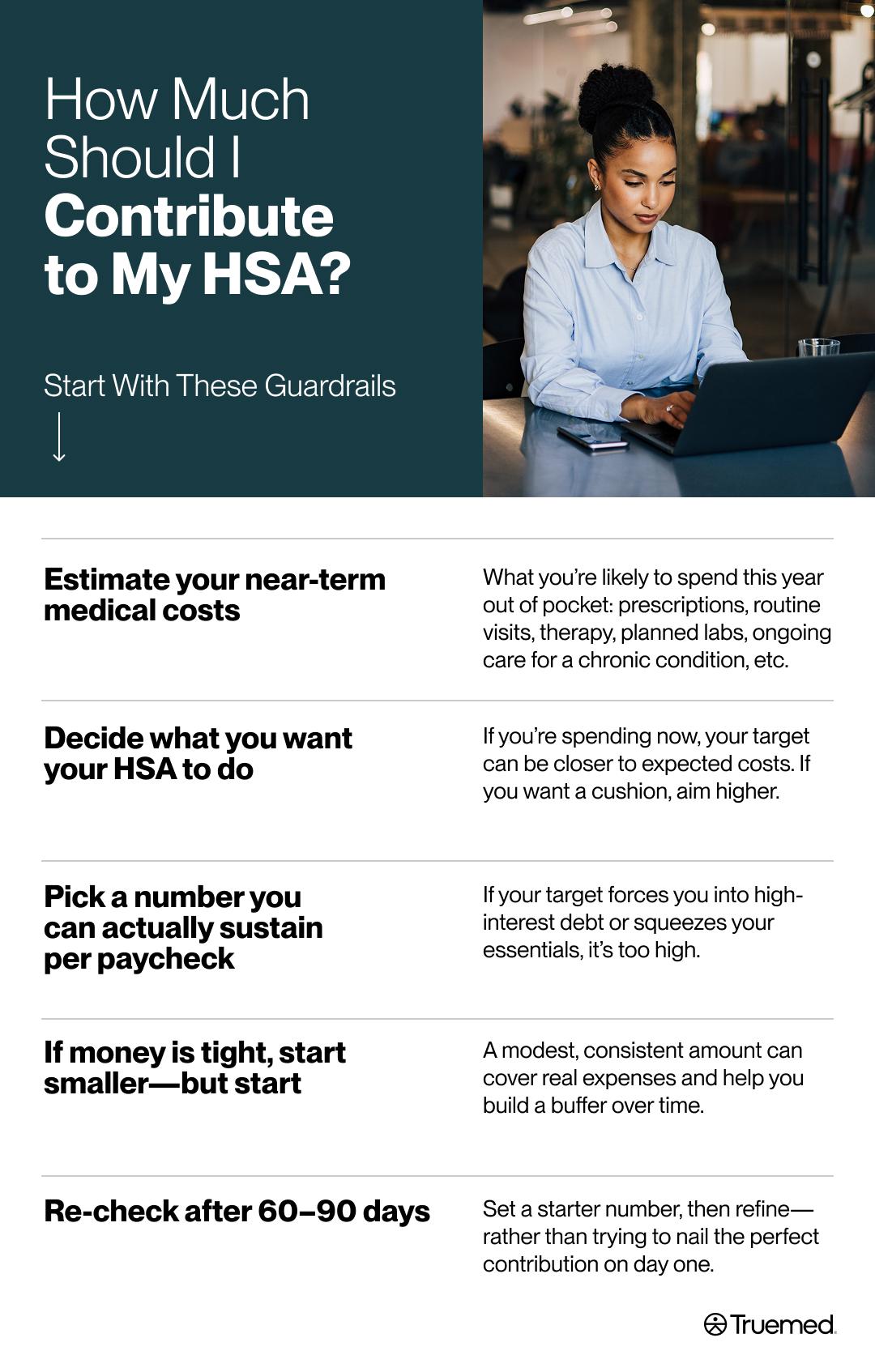
How Much Should I Contribute to My HSA? Start With These Guardrails
If you’re not sure where to begin, it helps to turn a big, abstract decision into a few small, concrete ones. Instead of guessing a yearly number, you can work step by step toward a contribution that fits your real expenses, your comfort with risk, and your actual cash flow.
The most important rule is sustainability. A contribution that forces you into credit card debt or makes it hard to cover essentials usually defeats the purpose. Put simply, HSA contributions are about what you actually have available to save, not your income on paper, says Scott Maurer, CISP, a certified IRA services professional at Advanta IRA.
Here’s how to get started:
Estimate your near-term medical costs: Start with what you’re likely to spend this year out of pocket: prescriptions, routine visits, therapy, planned labs, ongoing care for a chronic condition, and any known procedures. This gives you a realistic baseline.
Decide what you want your HSA to do: Are you using it mostly to spend this year, save for later, or both? If you’re spending now, your target can be closer to expected costs. If you want a cushion, aim higher.
Pick a number you can actually sustain per paycheck: The “best” contribution is one you’ll keep making. If your target forces you into high-interest debt or squeezes your essentials, it’s too high.
If money is tight, start smaller—but start: Contributing something is still useful. A modest, consistent amount can cover real expenses and help you build a buffer over time.
Re-check after 60–90 days: Once you’ve seen a few months of real spending, adjust. Most people do better with a “set a starter number, then refine” approach than trying to nail the perfect contribution on day one.
Before You Pick a Number: Confirm You’re Eligible to Contribute
Before you lock in any contribution amount, make sure you’re actually allowed to contribute for the year.
In general, you can only add money to an HSA if you’re enrolled in an HSA-eligible high-deductible health plan. If you have other coverage that pays for medical care before you meet that deductible, it can affect your eligibility. This is one of those areas where small details in your plan really matter.
If your coverage changes mid-year, your allowed contribution can change too. Starting or stopping HSA-eligible coverage, switching jobs, or moving onto a spouse’s different type of plan can all impact how much you’re permitted to put in for that year.
Employer contributions count toward the same annual limit as your own. So if your employer adds money to your HSA, you’ll want to subtract that from whatever total you’re aiming for to avoid going over.
If you’re unsure about any of this, check your benefits materials or ask your plan administrator or HR team before setting up contributions. A quick confirmation up front is much easier than fixing an overcontribution later.
Know the Annual Limits and What Counts Toward Them
HSA contribution limits are set each year by the IRS, and they cap the total amount that can go into your account for that year. That total includes everything: your payroll contributions, any lump-sum deposits you make yourself, and any money your employer adds. It’s one shared bucket, not separate limits.
If you’re 55 or older, you may be allowed to add an extra catch-up contribution each year. This can be a helpful way to boost your balance as healthcare needs tend to rise with age.
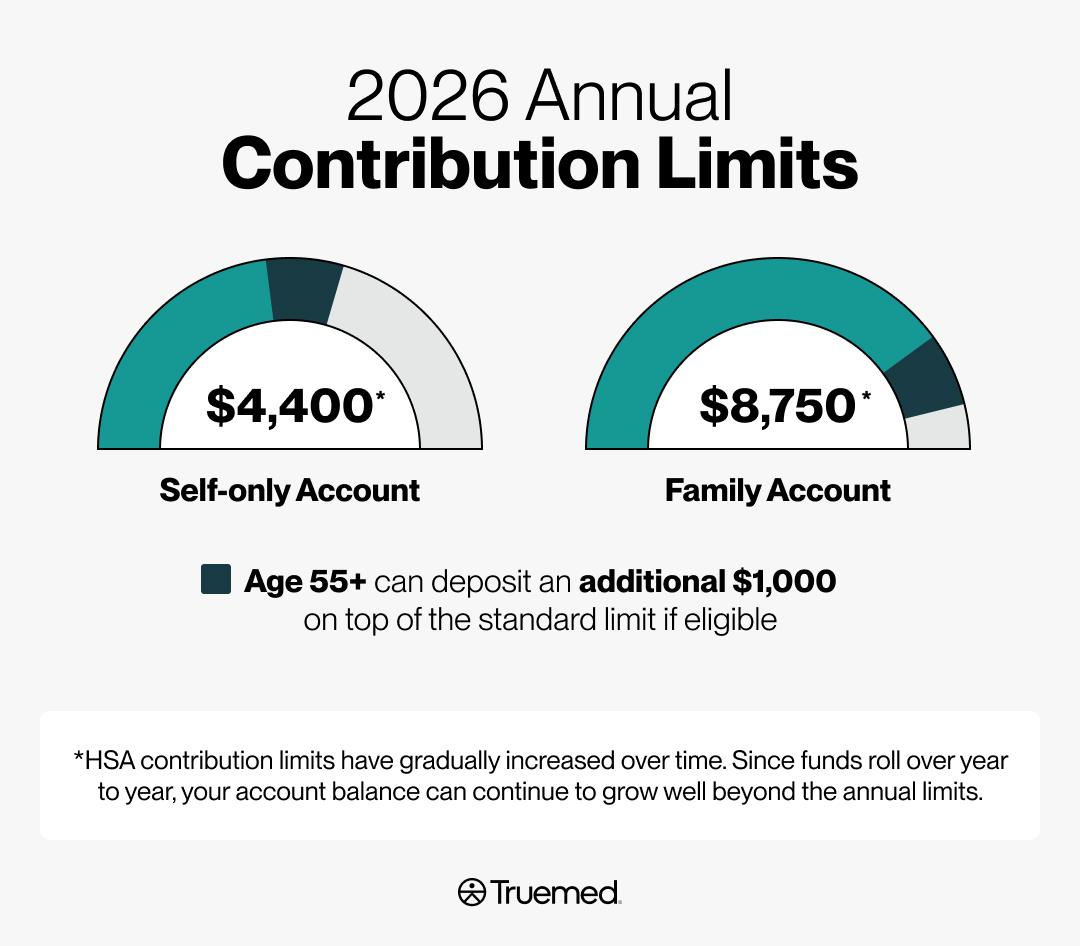
For 2026, the limits are:
- Individual (self-only) coverage: Up to $4,400 in total contributions for the year (employee + employer combined)
- Family coverage: Up to $8,750 in total contributions for the year
- Catch-up contribution (age 55 or older): An additional $1,000 on top of the standard limit if you’re eligible
Those numbers set the ceiling, but a few real-world details determine how much of that ceiling you can actually use in a given year.
For instance, if you’re only eligible for part of the year, your limit may be prorated based on the number of months you had qualifying coverage. There are special rules that can sometimes let you contribute more, but they can require you to keep eligible coverage the following year to avoid penalties.
If you have more than one HSA, the combined total across all accounts still can’t exceed your annual limit.
A practical tip: Aim a little below the exact maximum if your employer also contributes or if your paycheck amounts change during the year. That small buffer can help you avoid accidentally overcontributing, which can mean extra taxes and paperwork to correct.
Choose Your HSA Contribution Level (Simple Tier System)
Once you know your limits, the next step is choosing a contribution level that fits your life right now. Think of this less like picking a perfect number and more like choosing a lane you can comfortably stay in all year.
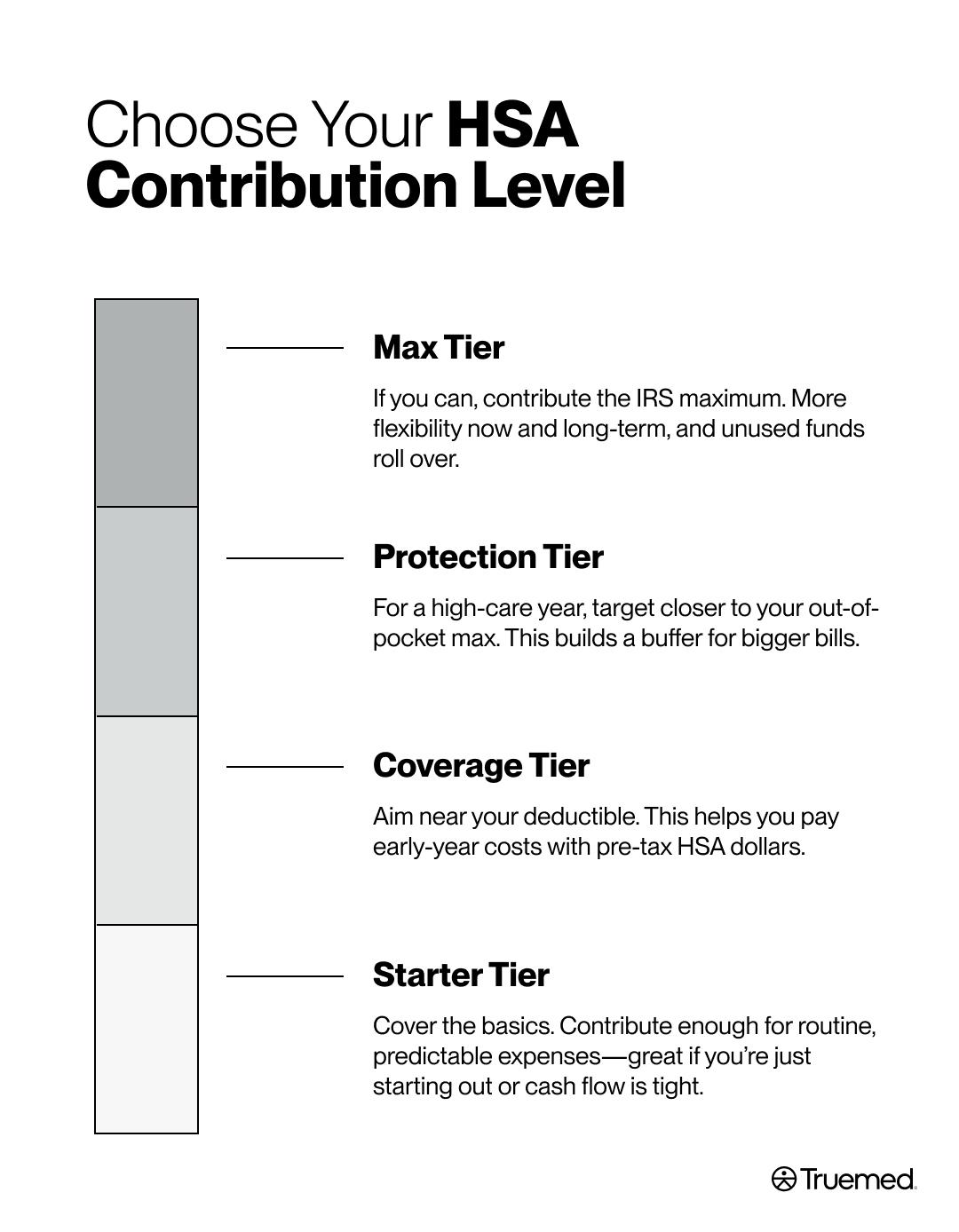
Here are the tiers to consider:
- Starter tier: Think of this tier as covering the basics. Aim to contribute enough to handle predictable, routine expenses. That might include common prescriptions, a few primary care or specialist visits, and a small cushion for surprises. This tier works well if cash flow is tight or you’re just getting used to using an HSA.
- Coverage tier: If you expect to actually use your insurance this year, a good goal is something close to your plan’s deductible. Hitting this level means you can pay most early-year costs with pre-tax HSA dollars instead of scrambling for cash.
- Protection tier: This tier is ideal if you plan for a heavy year of care. If you have ongoing care needs, a planned procedure, or dependents who use a lot of care, you might aim closer to your out-of-pocket maximum, says Maurer. This builds a stronger buffer against worst-case medical bills.
- Max tier: If your budget allows, contributing up to the IRS maximum gives you the most flexibility now and later. “It is hard to imagine a scenario in which it would not be worth it to max out your HSA,” says Maurer. “Most Americans will have more medical expenses in their lifetime than they will ever have in their HSA.” And even if you don’t spend it right away, the money stays yours to use in future years.
A simple rule of thumb: Pick the highest tier you can maintain without stressing your monthly essentials. A slightly lower contribution you keep all year is more powerful than an aggressive goal you abandon by spring.
How Much Should I Put In My HSA Each Paycheck (Make It Automatic)
Once you’ve picked a yearly target, the easiest way to hit it is to break it into small, automatic pieces.
Take your annual contribution goal and divide it by your number of paychecks. For example, if you want to contribute $3,000 this year and you’re paid twice a month (24 paychecks), that’s $125 per paycheck. If you’re paid biweekly (26 paychecks), it’s about $115 each time.
Setting this up through payroll makes it feel almost invisible. The money goes straight into your HSA before you see it, which helps with consistency and can also reduce your taxable income automatically.
If your income varies, consider setting a lower “baseline” amount you know you can afford every paycheck. Then add occasional top-ups during higher-income months, bonus periods, or when you notice your medical spending is trending higher than expected.
Revisit your per-paycheck number after big life changes like a new baby, a plan switch, or new ongoing medications. These events can quickly change what a comfortable contribution looks like.
It can also help to keep a small, separate monthly medical buffer in your regular checking or savings account. That way, if an expense hits before your HSA balance builds up, you’re not forced to reach for a credit card while waiting for contributions to accumulate.
Should You Max Out HSA? When It Makes Sense (and When It Doesn’t)
Maxing out your HSA can be a powerful move, but only if it fits comfortably into the rest of your financial life.
According to Maurer, it often makes sense to max out your HSA when:
- You can hit the annual limit without carrying credit card debt or skipping essentials
- You already have an emergency fund for non-medical surprises
- You expect meaningful healthcare costs over your lifetime and want tax-advantaged dollars set aside for them
- You like the flexibility of letting unused funds roll over for future years
- You plan to invest part of your HSA and can still keep enough in cash for near-term medical bills
There’s also research suggesting bigger, steadier HSA balances can reduce what you pay for healthcare over your lifetime. In one study, higher ongoing contributions were linked to up to 19 percent lower expected costs, which supports the idea that putting in as much as you comfortably can can pay off over time.
Still, maxing out may not make sense when:
- Reaching the limit would force you into high-interest debt
- You don’t yet have basic emergency savings
- Your monthly budget is already tight or unpredictable
- You have large, immediate medical bills and need liquidity more than long-term buildup
- You’d have to invest everything and leave no cash for likely expenses
In those cases, aim for the highest amount you can maintain comfortably. You can always increase your contribution later, but undoing financial strain is harder than dialing your HSA up over time.
Average HSA Contribution: Why “Average” Isn’t the Goal
You might be tempted to look up the average HSA contribution and use that as your target. The problem is that “average” mixes together college students, high earners, families with multiple kids, and retirees still contributing. Their needs and budgets are wildly different.
An average number can’t see your deductible, your prescriptions, or whether you’re covering dependents. It also can’t tell whether you’re using your HSA mainly to pay this year’s bills or to build a long-term healthcare reserve.
A better guide is your own plan design and spending patterns. Your deductible and out-of-pocket maximum set the outer boundaries of what a heavy medical year could cost you. Your recent receipts show what a typical year actually looks like.
It’s also normal for your “right” contribution to change. A year with a new baby, surgery, or new medications might push you toward the coverage or protection tiers. On the other hand, a quieter year might let you scale back or focus on investing what you’ve already built.
What matters more than matching anyone else’s number is consistency. A smaller contribution you make every paycheck beats an ambitious goal you stop halfway through the year. Think baseline first, then adjust as real life gives you better data.
How Much Should I Have in My HSA at Retirement? A Practical Way to Think About It
Short answer? “As much as you can,” says Maurer.
Healthcare costs tend to rise as you age, even with Medicare. In fact, the average 65-year-old spends roughly $172,500 on medical expenses during retirement, which helps explain why building a larger HSA balance can be valuable.
That doesn’t mean you need to hit that exact number before retirement to “succeed.” Instead, it can be more helpful to build toward retirement in layers:
- Use today’s annual out-of-pocket medical spending as a starting point
- Add a cushion for higher needs later in life
- Build gradually through steady yearly contributions
From there, your strategy depends on how you use the account today. If you spend from your HSA each year, you’re reducing current costs with pre-tax dollars, even if the balance grows slowly, says Maurer. If you can afford to pay current bills out of pocket and leave the HSA invested, the account can compound into a larger long-term reserve.
Either approach can work. The key is being intentional. If long-term growth is your goal, keep detailed receipts for any qualified expenses you pay out of pocket. That documentation lets you reimburse yourself from the HSA years or even decades later.
You don’t need to predict your exact future medical bills. You just need to steadily build flexible, tax-advantaged funds so your future self has options when those bills arrive.
Contribution Timing, Deadlines, and Common Mistakes to Avoid
HSA contributions are flexible, but a few easy-to-miss details can create headaches if you’re not watching for them. Common mistakes include:
- Contributing more than the annual limit: Even small overcontributions can trigger taxes and penalties unless you remove the excess in time.
- Forgetting that employer contributions count toward your limit: Your employer’s deposits share the same cap as your own contributions.
- Not adjusting contributions after mid-year coverage changes: Switching jobs, changing from individual to family coverage, or losing HSA eligibility partway through the year can change how much you’re allowed to contribute.
- Assuming you must finish contributing by December 31: You usually have until the tax filing deadline the following year to make contributions for the prior year.
- Exceeding the limit by contributing to multiple HSAs: If you change providers or have more than one HSA, the combined total across all accounts still can’t go over the annual cap.
- Setting contributions once and never revisiting them: Life events like a new baby, new medications, or a planned procedure can make your original number outdated.
- Ignoring paperwork and records: Missing contribution records or receipts can complicate reimbursements and tax reporting later.
When in doubt, confirm your totals and eligibility with your plan administrator before making last-minute deposits.
Compliance & Documentation
A well-funded HSA only helps you if you can clearly show what went in and what came out. Good recordkeeping protects you if your plan administrator ever asks for proof or if you need to report contributions correctly at tax time.
Keep records that show:
- When and how much you contributed (payroll reports, bank transfers, and your HSA statements)
- Any employer contributions and the dates they hit your account
- Receipts for qualified medical expenses you paid or plan to reimburse yourself for later
If you reimburse yourself years after an expense, the receipt still needs to prove three things: what the service or product was, when it happened, and how much you paid out of pocket.
Another pro tip? Avoid double-dipping. You generally can’t use the same expense for multiple tax benefits, like reimbursing it from your HSA and also claiming it as an itemized medical deduction.
Finally, don’t assume that paying with an HSA card automatically settles everything. Card transactions can still be reviewed, and you may be asked to provide itemized documentation to confirm eligibility.
Your plan administrator has the final say on reimbursements and substantiation. Keeping clean, organized records makes those conversations quick and uneventful instead of stressful.
How It Works with HSA/FSA and Truemed
Your HSA can be used for many common medical expenses like doctor visits, prescriptions, and vision care, as long as they meet your plan’s rules for qualified medical expenses.
There are also many health-related products and services that may qualify when they’re used to manage or treat a diagnosed condition and are supported by proper medical documentation, including items like supplements, fitness equipment, and red light therapy devices.
That’s where Truemed can help qualified customers understand when HSA or FSA funds may apply. When documentation is appropriate, the process generally looks like this:
Complete a clinical intake form describing your health needs
An independent licensed practitioner reviews your information
If appropriate, the practitioner issues a letter of medical necessity (LMN) explaining how the purchase fits into your care plan
You pay with your HSA/FSA card or submit for reimbursement, depending on your plan
The roles are important. The independent practitioner decides whether an LMN is appropriate based on medical information. Your plan administrator makes the final decision about whether a specific purchase is reimbursable under your HSA or FSA.
Contributing to your HSA gives you pre-tax dollars to cover eligible health expenses. When those expenses require medical documentation, Truemed helps qualified customers navigate that extra step while you keep itemized receipts and any supporting paperwork your plan may request.
FAQ
Take your yearly contribution goal and divide it by your number of paychecks. For example, a $3,600 annual target works out to about $150 per paycheck if you’re paid twice a month. The right amount is one you can automate and forget about without straining your monthly budget.
Contribute as much as you comfortably can after covering essentials and avoiding high-interest debt. Many people aim to at least cover their expected yearly medical costs, then increase toward their deductible or the annual limit as their finances allow.
The average varies widely and isn’t a great target. Students, single adults, families, and higher earners all contribute different amounts. A better guide is your own deductible, typical medical spending, and how much you can consistently set aside.
The 50/30/20 rule is a general budgeting guideline (50% needs, 30% wants, 20% savings). Your HSA contribution would usually come out of that savings portion. If contributing more to your HSA would crowd out emergency savings or force debt, dial it back to a sustainable level.
There’s no single magic number. Healthcare costs in retirement can be substantial, so the practical goal is to build as large a balance as you comfortably can over time. Even if you don’t use it all for medical expenses, after age 65 you can withdraw HSA funds for any reason without the extra penalty, paying only regular income tax on non-medical withdrawals.



See what you can do with your HSA/FSA.
Join 1.5 million Americans who have routed their healthcare dollars toward root cause health via Truemed's HSA/FSA marketplace.
New product announcements
Sales and special offers
Tips for utilizing your HSA/FSA
Editorial Standards
At True Medicine, Inc., we believe better health starts with trusted information. Our mission is to empower readers with accurate and accessible content grounded in peer-reviewed research, expert insight, and clinical guidance to make smarter health decisions. Every article is written or reviewed by qualified professionals and updated regularly to reflect the latest evidence. For more details on our rigorous editorial process, see here.