
Letter of Medical Necessity: Key Components & Examples
Author:Kathleen Ferraro
Reviewed By:Swapna Ghanta, MD&Michaela Robbins, DNP
Published:
July 29, 2025
Last Updated:
October 06, 2026



Key Takeaways
A letter of medical necessity explains: Why a specific treatment or product is essential for your health, to help it qualify for insurance or HSA/FSA reimbursement.
You may also need one if: you’re trying to cover non-standard treatments or appealing a denied claim.
Strong LMNs include specifics: diagnosis, ICD-10 codes, exact treatment details, medical justification, and supporting documentation.
When writing your LMN, your provider should : avoid vague language like “this will improve health.” Instead, they should tie everything clearly to your diagnosis and show clinical need.
Ensure your provider doesn’t forget the basics: official letterhead, credentials, and a signature are must-haves to avoid automatic rejection.
Truemed simplifies the LMN process by integrating directly into the checkout process of thousands of brands: During checkout, you take a telehealth survey that is sent to a licensed provider. The provider will review your health information and, if appropriate, issue an LMN for your desired health care purchase.
Key Takeaways
What Is a Letter of Medical Necessity?
When Do You Need a Letter of Medical Necessity?
Key Components of an Effective Letter of Medical Necessity
Step-by-Step: How to Write a Letter of Medical Necessity
Letter of Medical Necessity Example (Template)
Common Mistakes to Avoid
Getting Your LMN Without the Hassle
FAQ
A letter of medical necessity (LMN) can be the missing link between out-of-pocket costs and full coverage. Whether you’re trying to get reimbursed for a gym membership, a continuous glucose monitor, or red light therapy, a well-written LMN can turn a "no" from your insurance or HSA/FSA administrator into a "yes."
Note that while people may refer to LMNs by a few different names (letters of necessity, medical necessity letters, etc.) but no matter what you call it, an LMN has the same effect. In this guide, we’ll break down everything you need to know about medical necessity letters, including when you need one, what to include, and how to write one that actually works.
What Is a Letter of Medical Necessity?
A medical necessity letter is a formal document from a licensed healthcare provider explaining why a particular product, treatment, or service is necessary to cure, treat, mitigate, or prevent the patient's health [or medical] condition.
Put simply, "[it] justifies why something that’s not automatically covered should be paid for by healthcare dollars," says Anthony Giuffrida, MD, director of interventional spine and pain at Cantor Spine Center in Fort Lauderdale, FL.

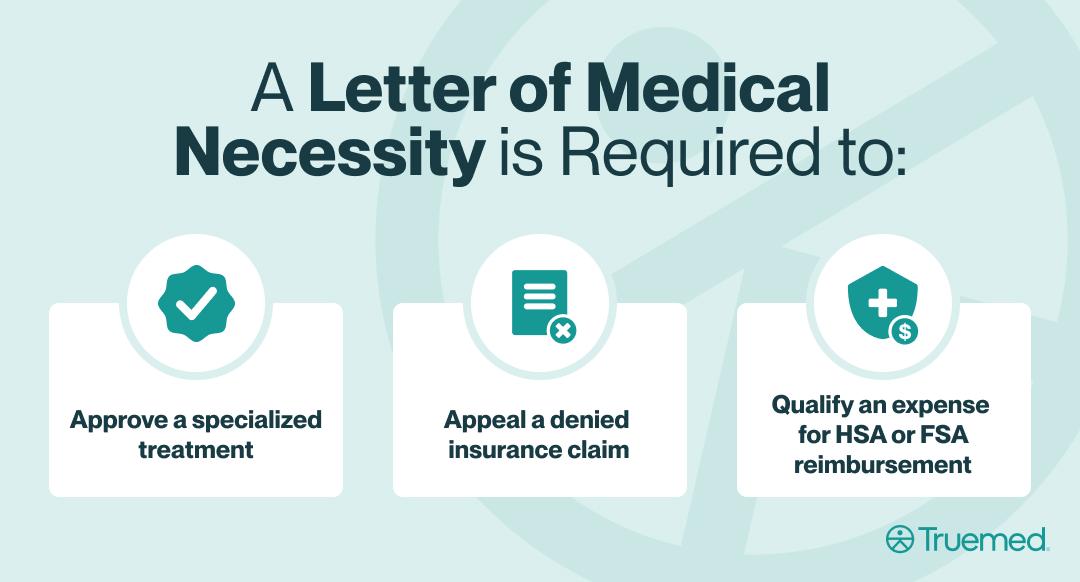
According to Austin Shuxiao, MD, a board-certified internal medicine physician at UHS Wilson Hospital in Johnson City, New York, this document is often required to:
- Approve a specialized treatment
- Appeal a denied insurance claim
- Qualify an expense for HSA or FSA reimbursement
When Do You Need a Letter of Medical Necessity?
According to Shuxiao, you may need a letter of necessity when:
- The product or service is not routinely covered by your insurance: For example, treatments like alternative therapies, off-label medications, and out-of-network services often fall outside of standard coverage.
- You’re appealing a denied claim: A well-written LMN can help overturn a denial by providing clinical justification and evidence.
- You want to use pre-tax funds from an HSA or FSA: Many preventive or lifestyle-focused medical expenses are only eligible for reimbursement if you provide an LMN.
Common HSA-eligible items that may need an LMN include:
- Gym memberships and personal training: These may be eligible when prescribed to manage conditions like obesity, high blood pressure, or diabetes.
- Fitness equipment: Equipment such as treadmills, resistance bands, or rowing machines can be covered when they’re part of a medical provider’s recommended fitness regimen.
- Cold plunges and saunas: These products may qualify as treatment for conditions related to chronic pain or inflammation.
- Medical-grade supplements and vitamins: These are eligible if prescribed to treat a specific diagnosed deficiency or condition that may benefit from this support..
- Red light therapy devices: These may be reimbursable when recommended for pain relief, recovery, or skin conditions.
- Massage therapy: This can be covered if prescribed for chronic pain, muscle recovery, or stress-related diagnoses.
- Certain mental health treatments: Therapy, psychiatric care, and medications (like antidepressants or antipsychotics) may qualify with appropriate documentation.
In each of these cases, a medical letter of necessity substantiates that a preventive or lifestyle intervention is in fact a legitimate, reimbursable healthcare cost. Truemed can make the process seamless by handling the LMN for you and offering a curated marketplace of HSA/FSA-eligible expenses.
Key Components of an Effective Letter of Medical Necessity
According to both Giuffrida and Shuxiao, a well-written letter of medical necessity should follow a clear structure and include detailed information to justify the requested treatment or service.
"Just saying 'this is necessary' typically isn’t good enough for insurance companies,” says Shuxiao. “They want proof.”
Here’s what your provider should include:
Patient Information
Shuxiao recommends clearly identifying the patient (that’s you!) in the letter. This ensures that the letter is correctly linked to your individual medical records and benefits. So, your provider should include:
- Your full name
- Your date of birth
- Your insurance identification number (if applicable)
Provider Information
The LMN must also include details about your healthcare provider who is issuing the letter, says Giuffrida. Letters must come from a licensed provider, preferably someone actively managing your care. They should make sure to include:
- Their full name and professional credentials
- Their office or clinical affiliation
- Their National Provider Identifier (NPI) number and/or relevant state medical license number
- Their practice address and contact information
- Their official letterhead, as well as the date of the letter
Diagnosis
A LMN should clearly state your medical condition and provide context for why treatment is needed, says Shuxiao. This section lays the groundwork for medical necessity by connecting the dots between condition and care. It should mention:
- Your specific diagnosis or condition being treated
- ICD-10 code(s) to support insurance claims, if applicable
- A description of your condition and how the product or service can help this medical condition
Recommended Treatment or Service
The letter should provide details about the exact treatment or service necessary for this diagnosis. Being as specific as possible here helps avoid delays or denials due to vague or incomplete information.
Just note that “the recommendation for the specific treatment, device, or service needs to be clear, fall within typical treatment guidelines, and be applicable to the patient in their current state,” says Shuxiao. Key details include:
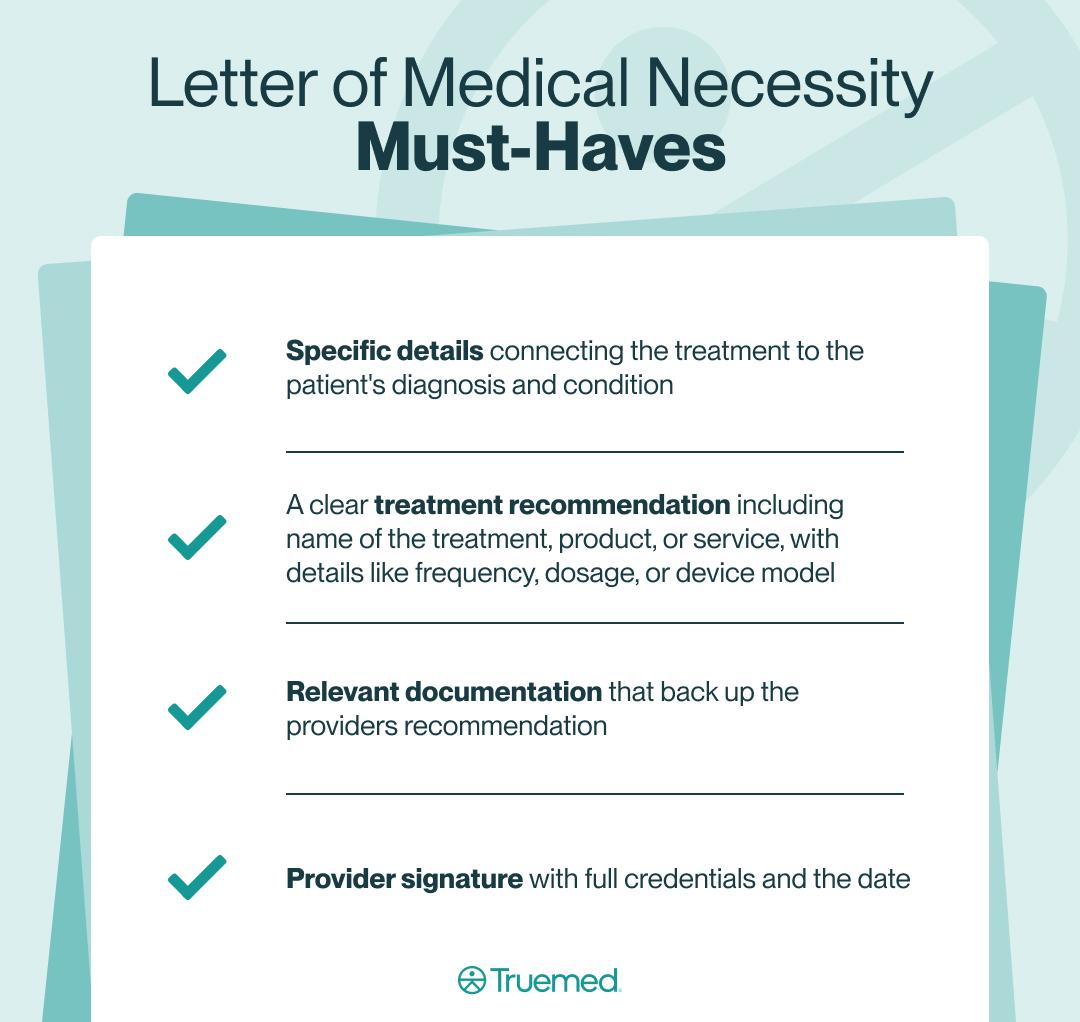
- The name of the product, therapy, service, or device
- Any relevant specifications, such as frequency, dosage, duration, or device model
- How the treatment will be delivered
Justification of Medical Necessity
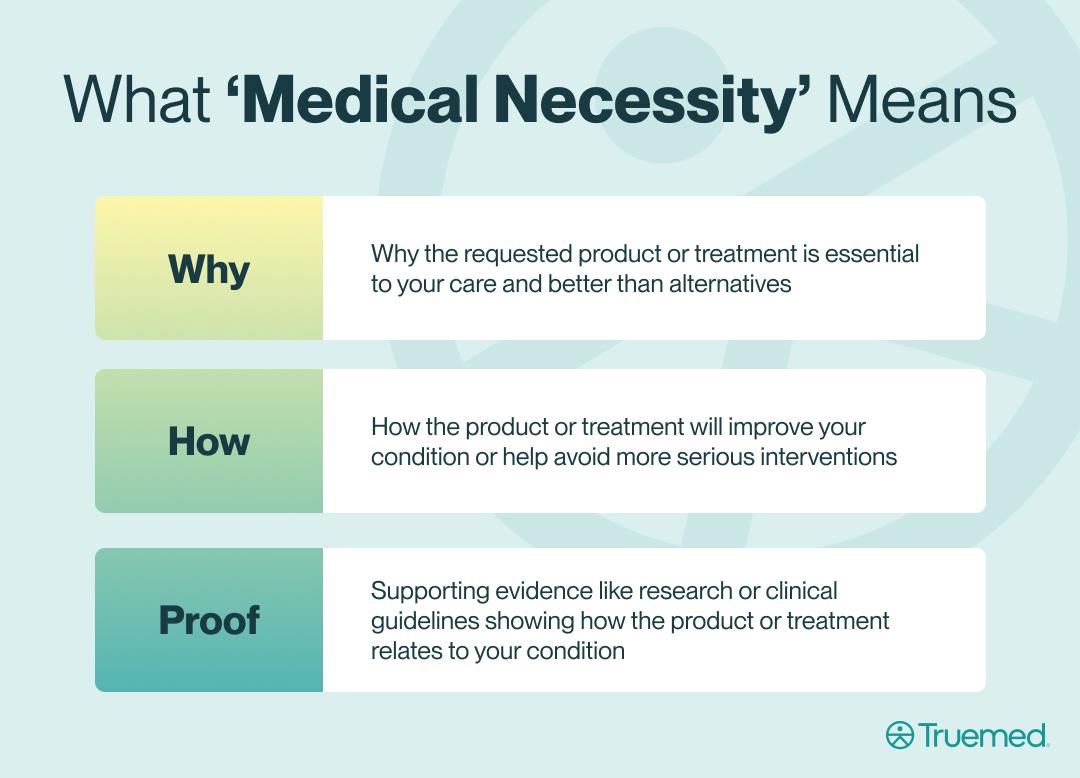
This is the heart of the letter. “It’s evidence that whatever is needed is due to actual medical necessity rather than convenience or preference,” says Shuxiao. “[Insurance companies] want proof in the form of objective data or in multiple specialties coming together to make the same claim.”
He says this section should explain:
- Why this particular treatment, product, or service is essential to your care (and why similar products wouldn’t be as effective as the proposed solution)
- How it’s expected to improve your function, prevent complications, or reduce the need for more invasive treatments (like surgery or hospitalizations)
- Any supporting rationale, such as research demonstrating the nexus between your diagnosis and the treatment, product, or service, or clinical guidelines supporting the treatment
Signature and Credentials
Finally, Giuffrida recommends closing the letter with:
- The provider’s full name, title, and credentials
- Signature
- Date
Step-by-Step: How to Write a Letter of Medical Necessity
Now that you know what makes up a strong LMN, how should your provider actually write one?
According to the experts, the key isn’t just checking boxes—it’s building a clear clinical case that ties everything together. An effective letter should walk the reviewer through your medical needs as the patient and demonstrate, step by step, why the recommended treatment is essential. Here’s how your provider should do it:
1. Gather Medical History and Records
Your provider should start by reviewing your medical history for relevant medical information. If you have them, you might tell your provider about any diagnostic tests or other clinical notes that you have available. They should collect supporting documentation—like research relevant to your condition—that they can use to strengthen the case and provide objective evidence, says Shuxiao.
2. Use a Template
Templates ensure your provider doesn't miss critical details, and many clinics offer them to make sure all required information is included, says Shuxiao. If your provider doesn’t have one on hand, Truemed’s ready-to-use template is below.
3. State the Diagnosis and Treatment Clearly
Your provider should write out your diagnosis in plain language alongside the correct ICD-10 code, says Giuffrida. Then, they should describe how the condition impacts your daily functioning or quality of life. This helps reviewers understand the severity of the issue, especially if they don’t have a clinical background.
Next, your provider should be as specific as possible when describing what they’re recommending. Generic terms like "exercise program" or "therapy" are less likely to be approved.
4. Justify the Medical Necessity
“The most important piece is the medical reasoning,” says Giuffrida. Your provider should “spell out why this [treatment] is needed, using clear clinical facts backed by data and research.” They should emphasize how this treatment will improve your health as the patient or prevent complications, and they should mention any supporting research or clinical guidelines that back their recommendation.
6. Sign, Date, and Submit
While it may feel repetitive, this final section confirms the letter’s authenticity and ensures it comes from a qualified medical provider, reducing the chances of denial due to missing or incomplete documentation, says Giuffrida. Your clinician should ensure the letter is:
- Signed and dated by the provider
- Printed on official practice or institutional letterhead
- Accompanied by the provider’s full credentials and contact information
Letter of Medical Necessity Example (Template)
Here’s a simple template to help get started—just make sure the final product is on your medical provider or clinic’s letterhead.
[Provider’s name, title, and credentials]
[Provider contact information]
[NPI and/or license number]
[Practice name and address]
[Practice contact information]
[Date]
To Whom It May Concern:
Treatment: I am writing this letter of medical necessity on behalf of my patient [patient’s full name], DOB: [MM/DD/YYYY]. [Patient name] has been diagnosed with [diagnosis and ICD-10 code]. I am recommending [specific product/service], to be used [frequency/duration and location].
Clinical Rationale: This treatment is necessary because [include clinical justification and guidelines supporting the treatment]. This condition results in [description of symptoms or impact on daily function].
Relevant documentation—including [the patient’s medical history, diagnostic imaging, records of previous treatments, and supporting evaluations from specialists]—is included to provide additional clinical context and substantiate the medical necessity of the recommended intervention.
Role of intervention: [Explain why the product is necessary to facilitate the intervention]
Conclusion: In light of the patient’s diagnosis and research indicating clinical benefit, [product/service] is medically necessary as part of the treatment plan.
Sincerely,
[Provider’s name, title, and credentials][Date][Signature]
Here’s a completed sample of the letter itself:
To Whom It May Concern:
I am writing this letter of medical necessity on behalf of my patient John Doe, DOB: 01/15/1980..
Treatment: Mr. Doe has been diagnosed with essential (primary) hypertension (ICD-10: I10). I am recommending moderate intensity exercise for at least 90 minutes a week via a structured gym membership with supervised personal training for at least six months, at a local fitness center. This treatment is medically necessary as part of a non-pharmacological management plan for hypertension.
Clinical Rationale: Hypertension results in persistently elevated blood pressure, which increases his risk of cardiovascular disease and has already begun to impact his daily life by contributing to fatigue, shortness of breath during physical activity, and increased anxiety around health.
Clinical guidelines from the American Heart Association recommend regular aerobic and resistance exercise as a first-line intervention for blood pressure reduction. Given John’s prior lack of response to lifestyle advice alone, a structured environment with professional supervision is essential to ensure safety, adherence, and therapeutic benefit.
Role of Gym Membership: The gym membership provides the environment and equipment necessary to facilitate aerobic exercise at the frequency and duration to treat hypertension.
Conclusion: In light of Mr. Doe’s hypertension and the research supporting aerobic exercise in the management of hypertension, a gym membership is medically necessary as part of the patient’s treatment plan.
Common Mistakes to Avoid
Even well-intentioned letters of medical necessity can get denied if they’re missing key details or written too generically. Here are the most common pitfalls your provider should avoid, along with how to fix them:
- Being too vague: Broad statements like “this treatment will improve the patient’s health” aren’t enough, says Giuffrida. You need to connect the treatment directly to the patient’s diagnosis and explain how it addresses their specific condition. For example, instead of saying “massage therapy will reduce stress,” say: “Massage therapy is recommended to relieve chronic neck pain due to cervical radiculopathy (ICD-10: M54.12), which has not responded to medication or physical therapy.”
- Omitting a clear treatment recommendation: Your provider should not just state your condition; they should specify exactly what they’re recommending, says Shuxiao. They should name the treatment, product, or service, and include details like frequency, dosage, or device model. A vague phrase like “exercise” may not be enough; instead, they should write: “Three months of supervised gym-based resistance training, 3x per week, to manage insulin resistance and support weight loss in a patient with prediabetes (ICD-10: R73.03).”
- Leaving out supporting evidence: Your provider should always include relevant documentation that backs their recommendation, says Shuxiao. For example, if they’re recommending red light therapy for your chronic joint pain, they should reference the imaging that confirmed your joint degeneration and clinical notes showing failed response to NSAIDs.
- Not signing the letter: An unsigned or undated letter is likely to be dismissed or returned for correction, says Giuffrida. Your provider should always include their full signature, credentials, and the date at the bottom of the letter.
Getting Your LMN Without the Hassle
Writing an effective letter of medical necessity takes more than a template. It takes the right documentation, a provider willing to make the clinical case, and a letter that connects your diagnosis to the treatment in specific, evidence-backed language. Miss any one of those pieces and you risk a denial, which means starting the process over.
That's the piece Truemed handles for you. HSA and FSA funds are reserved for qualifying medical expenses, and many of the products people want to use them on, from red light therapy devices to fitness equipment to cold plunges, don't automatically qualify on their own. Instead of tracking down a provider, building your own case, and hoping the letter holds up, Truemed connects you with an independent licensed practitioner who reviews your health history and, if you're a fit, issues the LMN for you. No templates to fill out, no back-and-forth with your insurance, just a straightforward review that saves you the time and guesswork of doing it yourself.
Once you have your LMN, you can put it to work right away. Explore the health products that may qualify for HSA/FSA with a Truemed LMN and start saving, about 30% on average*, on purchases you were already planning to make.
*Truemed is for qualified customers. HSA/FSA tax savings vary. Learn more at truemed.com/disclosures.
FAQ
Your provider should start with a structured template to ensure nothing gets missed. The letter should include your diagnosis (with ICD-10 code), a detailed description of the recommended treatment or service (including frequency, duration, or dosage), and a clear clinical justification explaining why it’s necessary for your health. Back up your recommendation with relevant documentation. Finally, make sure the letter is signed, dated, and printed on official provider letterhead.
Only certain licensed healthcare providers can issue an LMN. This includes physicians (MD or DO), nurse practitioners (NP), physician assistants (PA), and other clinical specialists directly involved in your care. Truemed’s licensed physicians can also provide an LMN.
A letter of necessity is used to justify health-related expenses that aren’t automatically covered by insurance or reimbursed through an HSA or FSA. The LMN helps prove that these items are essential for treating or managing a diagnosed condition.
“Oftentimes, the provider is the one to suggest that the patient needs a certain treatment or device, and will send the LMN on their end without the patient themselves even requesting,” says Shuxiao. Otherwise, he recommends first contacting your insurance company to learn why they denied a previous claim or to find out if they require any specific documentation beyond an LMN. Then, talk to your healthcare provider. Come prepared with details about the product or service you’re seeking coverage for, and explain how it relates to your medical condition or treatment plan.
Talk to your provider about how structured physical activity can help treat or manage a specific medical condition (like obesity, hypertension, type 2 diabetes, arthritis, or depression). If your provider agrees, they can issue an LMN stating that a gym membership or personal training is medically necessary. Be sure the letter includes the diagnosis, frequency of use, and clinical reasoning based on guidelines or failed alternatives. You can also obtain an LMN directly through Truemed when you shop the Truemed marketplace or Truemed partner brands for products or services that are HSA-eligible. Shop any of Truemed’s partner brands, choose “Pay With Truemed” when checking out, and you’ll be guided through a brief telehealth survey that will be submitted to a licensed provider for review. If you’re eligible, they’ll issue your LMN for your HSA purchase.



Editorial Standards
At True Medicine, Inc., we believe better health starts with trusted information. Our mission is to empower readers with accurate and accessible content grounded in peer-reviewed research, expert insight, and clinical guidance to make smarter health decisions. Every article is written or reviewed by qualified professionals and updated regularly to reflect the latest evidence. For more details on our rigorous editorial process, see here.