
The 5 Best Exercise Bikes for Your Home Fitness Goals
Author:Kathleen Ferraro
Reviewed By:Bo Hickey, CSCS
Published:
January 09, 2026
Last Updated:
October 06, 2026
Truemed writers and editors independently evaluate all our product recommendations. If you make a purchase through any affiliate links we provide, we may receive compensation. Learn more.


Key Takeaways
Consistency is key: The best exercise bike for home is the one you’ll actually use, which is why comfort, fit, noise level, and ease of use matter more than flashy features.
Different bikes serve different needs: Upright bikes balance comfort and intensity, recumbent bikes prioritize joint support, and indoor cycling bikes support higher-intensity training.
Proper fit and adjustability matter: They reduce discomfort and injury risk and make longer, more regular rides easier to maintain.
You could use HSA/FSA funds: An exercise bike may be eligible for HSA or FSA use when a licensed provider determines it’s medically necessary and issues an LMN.
Key Takeaways
Best Exercise Bike for Your Home: How This Guide Helps You Choose
Types of Exercise Bikes for Home: Upright, Recumbent, and Indoor Cycling
Buying Guide: What to Look For in the Best Stationary Bike
Matching an Exercise Bike for Home to Your Fitness Goals and Health Needs
Top Picks: Best Exercise Bike Options by Category
Comfort, Setup, and Space Planning for Your Indoor Cycling Corner
Staying Motivated: Turning the Best Exercise Bike into a Long-Term Habit
Safety, Maintenance, and When to Avoid Certain Bikes
Using HSA/FSA Funds for an Exercise Bike: How Truemed Helps
FAQ
Shop Eligible Products
Ready to unlock your HSA/FSA funds for qualified medical expenses?
Choosing the best exercise bike can feel overwhelming. Between upright bikes, recumbent bikes, indoor cycling bikes, and air bikes—plus a wide range of prices and features—it’s hard to know what truly matters for home use.
A well-chosen exercise bike for home can support heart health, strength, and energy—but only if it’s comfortable and easy to ride consistently. A bike that’s too loud, awkward to adjust, or uncomfortable for your joints often goes unused, no matter how advanced it looks. That’s why the best stationary bike for home is the one that fits your body, space, and routine.
Below, we’ll break down how to choose the best exercise bike for your home fitness goals, covering bike types, key features, and how, if qualified, you may be able to use your HSA/FSA dollars to make your purchase.
Best Exercise Bike for Your Home: How This Guide Helps You Choose
Not all top-rated exercise bikes work for all people. A studio-style bike may be overkill (and too loud) for an apartment. A smart bike isn’t a great value if you don’t want a subscription. And a bike built for performance training may feel uncomfortable if you’re prioritizing joint-friendly cardio.
This guide will help you cut through the noise and make a practical choice by unpacking how key specs translate to everyday use. You’ll learn how to:
- Match bike types to common home fitness goals and physical needs
- Focus on features that actually matter for comfort and safety
- Use a simple checklist and short fit test to narrow your options
- Avoid common mistakes that lead to unused fitness equipment
We’ll also touch on budget expectations and explain how, for some qualified customers, an exercise bike may qualify for HSA or FSA spending when used to address a diagnosed medical condition.
Types of Exercise Bikes for Home: Upright, Recumbent, and Indoor Cycling
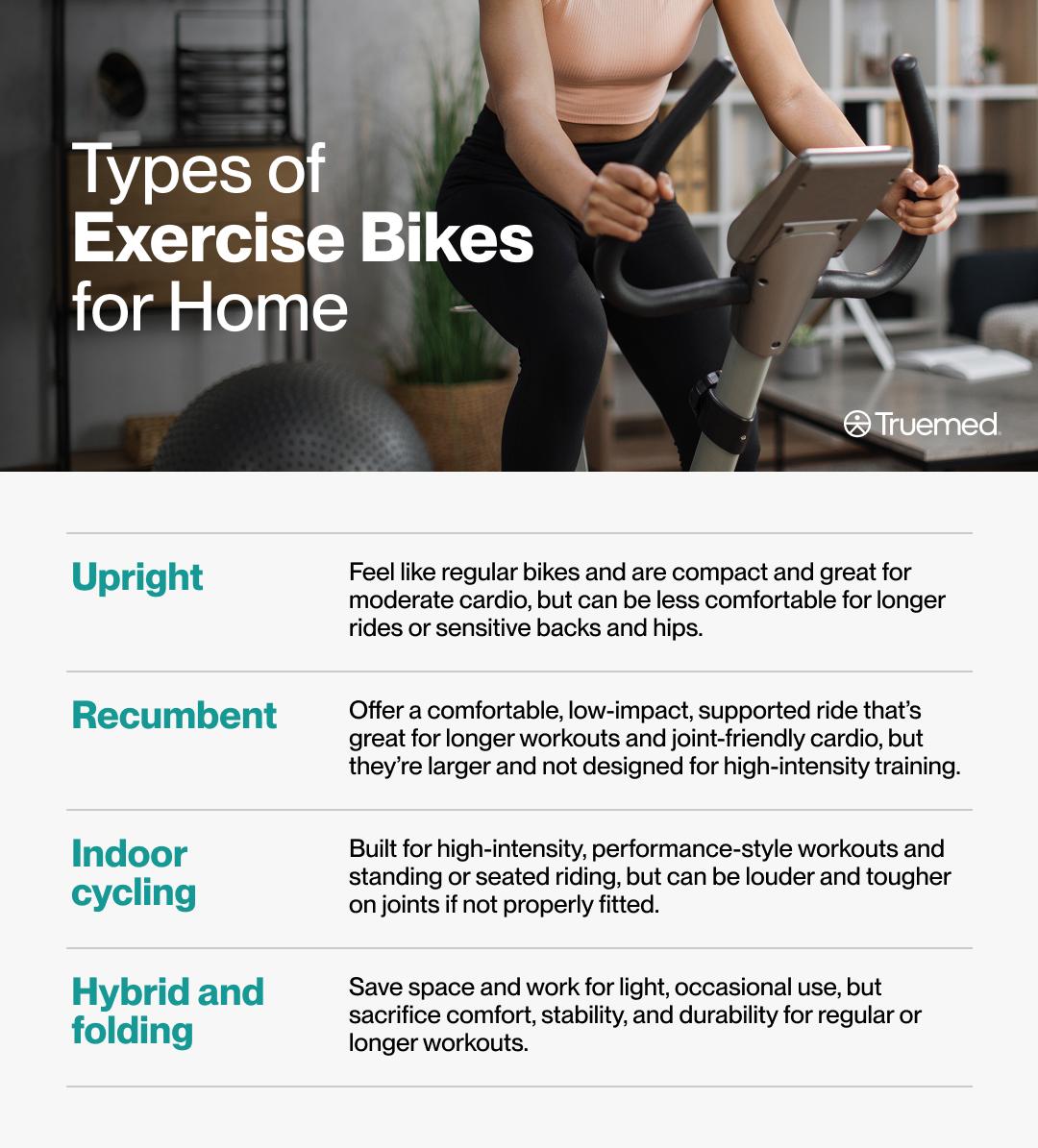
Before comparing brands or features, it helps to understand the main types of exercise bikes and what each one is best at. Choosing the right style upfront can save you time, money, and frustration later.
“Not all exercise bikes serve the same purpose,” says Josh Schlottman, CPT, a certified personal trainer and strength coach at Trainer Josh Fitness. “Picking the right at-home exercise bike matters because different models are designed for different goals.”
Here’s the breakdown:
- Upright exercise bikes: These bikes feel most similar to a traditional outdoor bike, with pedals positioned under your body and handlebars in front. They’re usually more compact than other styles, making them a good fit for smaller home gyms. Upright bikes work well for steady, moderate-intensity cardio and general fitness, but the narrower seat and upright posture may feel less comfortable for longer rides or for people with back or hip sensitivity.
- Recumbent exercise bikes: Recumbent bikes place you in a reclined, chair-like position with a wide seat and back support, and pedals set in front of your body. This reduces strain on the lower back, hips, and knees, making it a common choice for older adults, people with balance concerns, or those recovering from injury. They’re ideal for longer, lower-impact workouts focused on comfort and consistency, though they typically take up more space and aren’t built for high-intensity training.
- Indoor cycling bikes (spin bikes): Indoor cycling bikes are designed for higher-intensity workouts and performance-focused training. They use a heavier flywheel and allow for both seated and standing riding, closely mimicking studio cycling classes or outdoor road cycling. These bikes support interval training and strength-based rides, but they can be louder and less forgiving on joints if fit and setup aren’t dialed in properly.
- Hybrid and folding bikes: Hybrid and folding bikes are built with space-saving in mind and can be easier to store in small homes or apartments. They may work for light, occasional use or for beginners testing consistency, but they often sacrifice stability, resistance range, and adjustability. For frequent or longer workouts, they’re generally less comfortable and less durable than full-size bikes.
Buying Guide: What to Look For in the Best Stationary Bike
Once you’ve narrowed down the type of bike that fits your goals, the next step is focusing on the features that actually affect how the bike feels and functions day to day. Screens and subscriptions get a lot of attention, but comfort, adjustability, and ride quality are what determine whether a bike becomes part of your routine.
Here’s what the experts have to say:
- Fit and adjustability: A bike should fit your height, weight, and proportions without forcing an awkward posture, says Kayleigh Ray, an ACSM-certified exercise physiologist at Treadmill Review Guru. Seat height is the minimum adjustment to look for, but fore-aft seat movement and adjustable handlebars make it much easier to dial in a comfortable position. Proper fit also helps reduce strain on the knees, hips, and lower back. “The more comfortable you are using the bike, the more likely you are to work out longer and more regularly,” Ray explains.
- Resistance: Resistance affects how smooth, quiet, and maintenance-heavy a bike feels over time. Friction resistance bikes have pads that press against the flywheel and can become noisier as parts wear down, says Ray. Magnetic resistance is typically quieter and requires less upkeep, she adds. Belt-driven bikes also tend to run quieter than chain-driven models, which can matter in apartments or shared living spaces.
- Console and metrics: Most stationary bikes display basics like time, distance, speed, and estimated calories, says Schlottman. More advanced consoles may also track cadence, heart rate, connect to apps via Bluetooth, or even include a built-in TV—all of which are worth considering if they could help you stick to your cycling routine, he adds.
- Subscriptions: Ray recommends thinking carefully about training programs before you buy. Subscription-based platforms are popular, she says, but if you don’t plan to use them long term, “most of the features will be locked behind the paywall,” leaving you with a bike that can’t do much without ongoing fees.
- Comfort features: Small design details can have an outsized impact on comfort. Seat shape and padding, multiple hand positions, step-through frames, and appropriate weight limits all matter, especially for longer rides.
- Noise level: Noise is one of the most overlooked factors when choosing an exercise bike for home use. Air bikes and friction-based systems can be loud enough to disrupt others, while magnetic resistance bikes are generally much quieter. Ray points out that choosing the wrong style can affect how often you use it—a noisy air bike, for example, may not be ideal if you have young children or live in close quarters.
- Footprint: Consider the bike’s length, width, and any extra clearance needed for mounting, dismounting, or standing rides, says Schlottman.
Matching an Exercise Bike for Home to Your Fitness Goals and Health Needs
Thinking through your goals, physical needs, and daily routine helps narrow your options quickly. Even better, it ups the odds that the exercise bike you choose will support long-term progress, not just short-term motivation.
Here’s what to keep in mind, according to Ray and Schlottman:
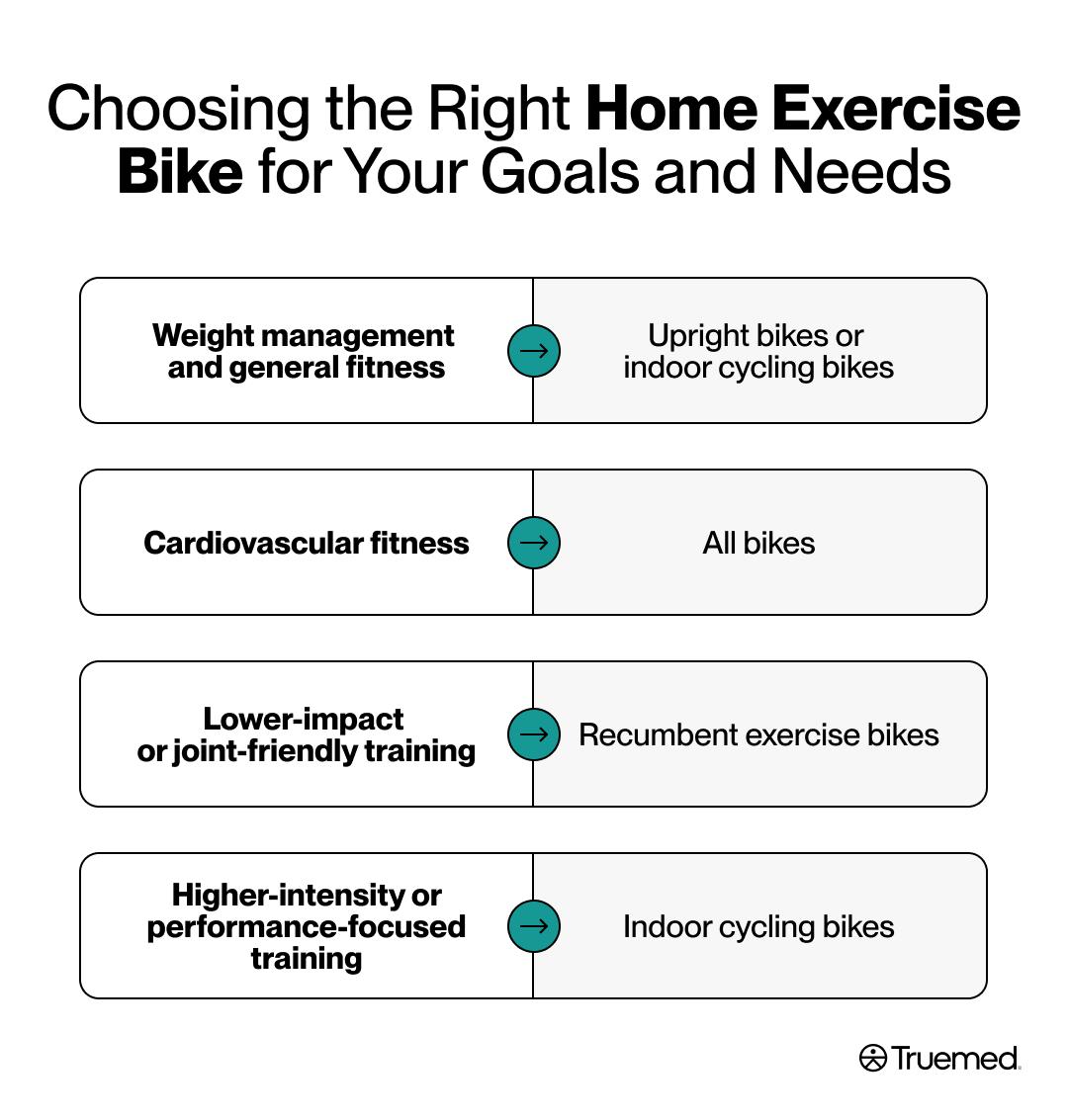
- Weight management and general fitness: For many people, the goal is steady, repeatable cardio that fits easily into daily life. Upright bikes and indoor cycling bikes both work well here, offering enough resistance to elevate heart rate without requiring complex programming. Upright bikes tend to feel more approachable for beginners, while indoor cycling bikes allow more intensity as fitness improves.
- Cardiovascular fitness: Research shows that regular aerobic activity supports long-term heart health. In that sense, “getting an at-home exercise bike matters because it makes it easier to stay consistent,” says Schlottman. After all, removing barriers like weather, commute time, and gym schedules makes it simpler to stick to regular movement over time.
- Lower-impact or joint-friendly training: If you’re managing knee, hip, or back discomfort or easing back into exercise after injury, recumbent bikes are often the most comfortable option. Their reclined position and back support reduce joint stress while still allowing meaningful aerobic work. Schlottman notes that horizontal or recumbent bikes are commonly used in rehabilitation settings and can be a better fit for people with circulation issues or balance concerns.
- Higher-intensity or performance-focused training: Indoor cycling bikes are designed for riders who want harder efforts, intervals, and the option to ride standing. Their heavier flywheels and wider resistance ranges support strength-focused cardio and power-based training. However, these bikes require careful setup; without proper fit, higher resistance and standing work can increase joint strain.
- Lifestyle and schedule considerations: Beyond physiology, it’s important to be realistic about how and when you plan to ride. Short, frequent rides may favor an easy-to-adjust upright bike in a shared space, while longer planned sessions may justify a more robust indoor cycling setup.
Top Picks: Best Exercise Bike Options by Category
With so many models on the market, it’s easy to get stuck comparing specs instead of narrowing in on what actually fits your needs. Below, we’ve curated standout exercise bikes based on the most common home fitness goals.
Best Overall Exercise Bike for Most Home Users: Bowflex C6 Indoor Cycling Bike
Best for: Versatile training, quiet rides, and no required subscription
The Bowflex C6 ($799) is Ray’s top pick for most home riders. It offers smooth magnetic resistance, a sturdy frame, and wide adjustability to fit different heights and riding styles. It’s quiet enough for apartments, supports both steady rides and harder intervals, and works well with third-party apps if you want guidance without ongoing fees.
Best Stationary Bike for Home in Small Spaces: Echelon EX-5s Connect Bike
Best for: Apartments, shared living spaces, and compact setups
If space is limited, the Echelon EX-5s Connect ($1,299.99) offers a relatively small footprint without sacrificing ride quality. Its magnetic resistance keeps noise low, making it a good option for early-morning or late-night workouts. While it’s compatible with subscription content, it can also be used independently, which adds flexibility for riders who want simplicity over built-in programming.
Best Indoor Cycling Bike for High-Intensity Training: Peloton Bike
Best for: Interval training, standing rides, and structured classes
For riders who thrive on high-energy workouts and instructor-led motivation, the Peloton Bike ($1,495) remains a popular option. Its heavy flywheel supports smooth transitions between seated and standing riding, making it well-suited for interval-based and performance-focused training. According to Ray, smart bikes like Peloton make the most sense if you plan to use their content ecosystem consistently—otherwise, many features go unused.
Best Recumbent Bike for Comfort and Joint Support: Spirit XBR55 Recumbent Bike
Best for: Joint-friendly cardio, longer rides, and added back support
The Spirit XBR55 ($1,699.99) stands out for its supportive seat, stable frame, and smooth resistance. This style is often a better fit for people managing joint discomfort or those easing back into exercise after injury. While it takes up more space than upright models, it excels at steady, lower-impact sessions.
Best Budget-Friendly Exercise Bike: Schwinn IC3 Indoor Cycling Bike
Best for: Beginners testing consistency without overspending
Testers frequently recommend the Schwinn IC3 ($649) for its solid build quality and good adjustability at a more accessible price point. It’s a practical entry point if you want to establish a routine before investing in higher-end features.
Comfort, Setup, and Space Planning for Your Indoor Cycling Corner
Where and how you set up your exercise bike can make a bigger difference than most people expect. A thoughtful setup improves comfort, reduces noise, and lowers the risk of aches or minor injuries, making it easier to stick with regular riding.
Start by choosing a stable location. Place your bike on a flat surface with enough clearance on all sides to mount and dismount safely. If you plan to ride standing up, make sure there’s adequate ceiling height and room to move without feeling cramped. Access to an outlet may also matter if your bike has a console or touchscreen.
Proper setup is key for comfort and injury prevention. Your seat should be set so your leg can extend comfortably without locking out, and your knee feels centered over your foot when the pedals are level. Handlebars should let you sit tall and relaxed, without hunching or shrugging your shoulders. Spending a few minutes on these adjustments can make the difference between a bike that feels good and one you can’t wait to get off.
Small accessories can also go a long way. For example, a fan can improve comfort during longer rides, and a nearby shelf or stand for water, a towel, or your phone makes workouts feel more seamless.
Finally, think about visibility and aesthetics. Research on habit formation suggests behaviors become easier to repeat when they’re anchored to consistent cues, like doing the same activity in the same spot. In other words, a bike you can see and access easily is simply more likely to get used. Bikes tucked into dark corners or blocked by clutter, on the other hand, are far easier to ignore.
Staying Motivated: Turning the Best Exercise Bike into a Long-Term Habit
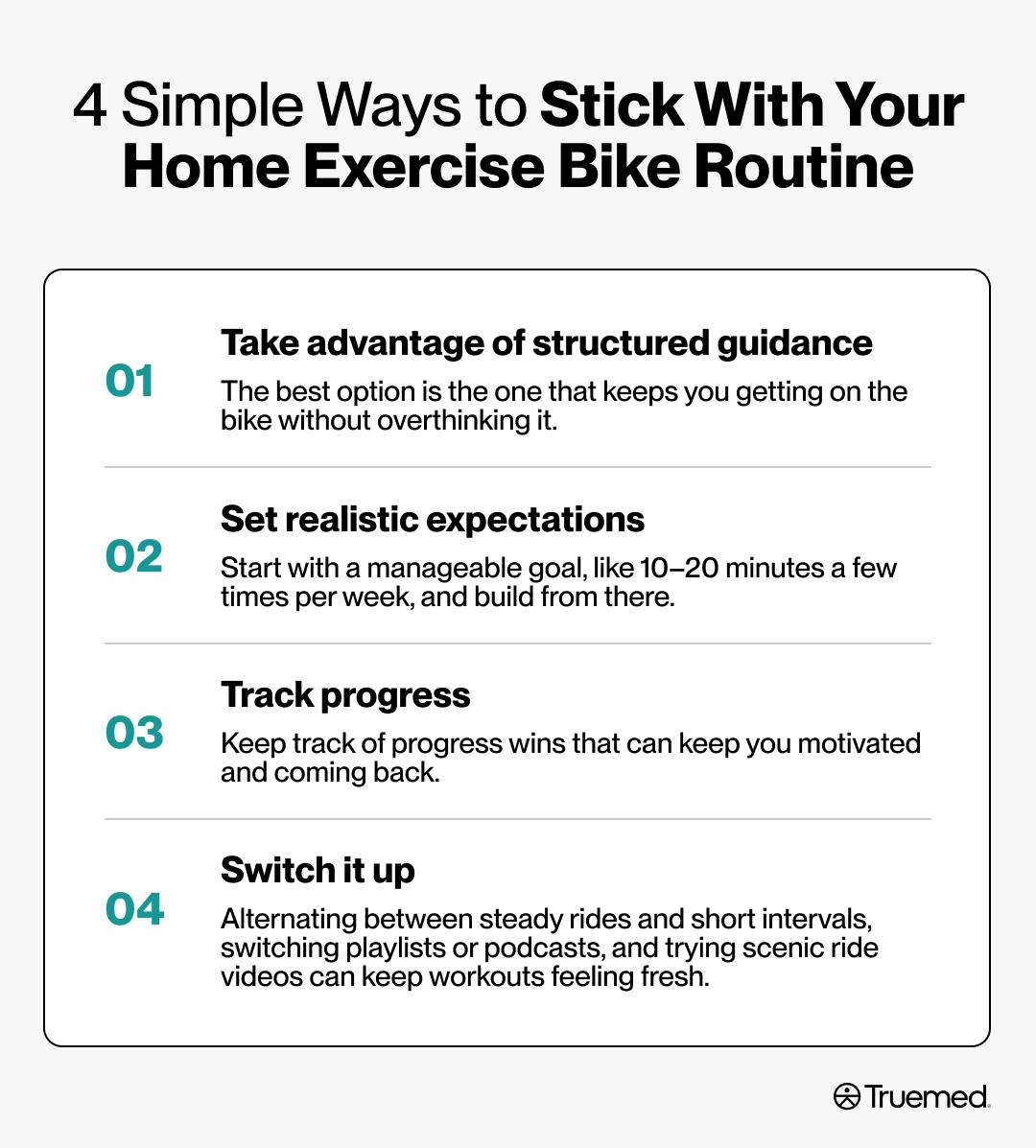
Even the best exercise bike won’t deliver results if it only gets used for a few weeks. Here are some tips to help you stay motivated:
- Take advantage of structured guidance: Some people stay consistent with trainer-led classes or programs, while others prefer simple, self-guided rides paired with music, podcasts, or TV, says Ray. There’s no single right approach—the best option is the one that keeps you getting on the bike without overthinking it.
- Set realistic expectations: Instead of aiming for daily long rides, start with a manageable goal, like 10–20 minutes a few times per week, and build from there. Short, repeatable sessions are often more effective for long-term adherence than more ambitious workouts.
- Track progress: Riding a little longer, pushing higher resistance, improving cadence, or noticing quicker heart-rate recovery are all wins that can keep you coming back.
- Switch it up: A little variety goes a long way in keeping workouts engaging and preventing burnout. Alternating between steady rides and short intervals, switching playlists or podcasts, and trying scenic ride videos can keep workouts feeling fresh.
Safety, Maintenance, and When to Avoid Certain Bikes
Exercise bikes are generally safe and low-impact, but a few basic habits make a big difference for comfort, safety, and longevity.
Wear supportive shoes, warm up briefly before riding, and cool down afterward—especially at higher resistance. Mount and dismount slowly, using the handlebars for balance if needed. If you’re new to cycling or returning after time off, start with shorter, easier rides and build gradually.
If you have unstable balance, joint pain, recent injury or surgery, or certain heart conditions, check with a healthcare provider before starting a cycling routine. The wrong bike type or intensity can increase the risk of discomfort or setbacks.
Simple upkeep also helps your bike stay rideable over time. “Wipe off your exercise bike after each use to prevent rusting and damage,” says Ray. She also notes that many bikes—especially those with touchscreens—aren’t designed for garages or outdoor storage, which can affect performance and warranty coverage.
Schlottman adds that using a non-slip mat under your bike to protect floors, reduce noise, and keep the bike from shifting during harder efforts.
Using HSA/FSA Funds for an Exercise Bike: How Truemed Helps
A bike doesn’t automatically qualify for HSA or FSA spending. In some cases, it may be considered an eligible expense under IRS §213(d) when a licensed healthcare provider determines the exercise equipment is medically necessary to help manage or treat a diagnosed condition, rather than for general fitness.
For example, a provider may recommend an exercise bike to support joint health, heart disease, or recovery after injury. To use HSA or FSA funds, you’ll need a letter of medical necessity (LMN) from a licensed provider that documents your diagnosis and explains how the bike fits into your care plan.
If you qualify, Truemed can help you through the process. Here’s what to expect:
- Complete a health intake form
- A licensed provider reviews your information and issues an LMN if appropriate
- Pay with your HSA/FSA card at checkout or submit for reimbursement, depending on your plan
Because plan rules vary, it’s always a good idea to double-check your eligibility with your HSA or FSA administrator before you buy.
FAQ
The best exercise bike for home use is the one that fits your body, your space, and your goals well enough that you’ll use it regularly. For many people, that means a quiet bike with good adjustability, a comfortable seat, and resistance that matches their fitness level rather than the most expensive or feature-heavy option.
Riding a stationary bike can support fat loss by increasing overall calorie expenditure and improving cardiovascular fitness. However, spot reduction isn’t possible—fat loss happens gradually across the body. Consistent cycling, paired with a balanced diet and other movement, can contribute to reductions in overall body fat over time.
For many people, yes. Research shows that regular aerobic activity—even when broken into shorter sessions—can support cardiovascular health and overall fitness. What matters most is consistency. Shorter rides done regularly can be just as beneficial as longer sessions, especially if they’re easier to maintain.
In some cases, yes. An exercise bike may qualify as an HSA- or FSA-eligible expense under IRS §213(d) when a licensed healthcare provider determines it’s medically necessary to treat or manage a diagnosed condition and issues an LMN. Eligibility depends on your health situation and your specific plan, so it’s important to confirm details with your plan administrator before purchasing.



See what you can do with your HSA/FSA.
Join 1.5 million Americans who have routed their healthcare dollars toward root cause health via Truemed's HSA/FSA marketplace.
New product announcements
Sales and special offers
Tips for utilizing your HSA/FSA
Editorial Standards
At True Medicine, Inc., we believe better health starts with trusted information. Our mission is to empower readers with accurate and accessible content grounded in peer-reviewed research, expert insight, and clinical guidance to make smarter health decisions. Every article is written or reviewed by qualified professionals and updated regularly to reflect the latest evidence. For more details on our rigorous editorial process, see here.