
Can I Use My HSA for Glasses? What to Know to Maximize Your Money
Author:Kathleen Ferraro
Reviewed By:Katherine Janosz, MD
Published:
February 05, 2026
Last Updated:
September 02, 2026
Truemed writers and editors independently evaluate all our product recommendations. If you make a purchase through any affiliate links we provide, we may receive compensation. Learn more.


Key Takeaways
You can often use HSA funds for eyewear: Most prescription glasses and contacts are commonly HSA-eligible, as long as they correct your vision and you can document the purchase.
Sunglasses are a common gray area: Prescription sunglasses usually qualify, while non-prescription pairs are often treated as accessories.
You can buy eyewear online: Buying glasses online is usually fine, but only if you keep a current prescription and an itemized receipt that clearly shows what you paid for.
Paperwork matters more than people expect: Vague or bundled receipts are one of the biggest reasons reimbursement gets delayed or denied.
HSAs and FSAs both work for vision expenses: However, they follow different rules around timing, rollover, and reimbursement, so don’t assume they’re interchangeable.
Key Takeaways
HSA Glasses Eligibility: The Quick Rules
What Vision Expenses Are Commonly Eligible (Glasses, Contacts, and Exams)
Glasses vs Contacts: How to Think About “HSA Eligible Glasses”
Are Sunglasses HSA Eligible? What Usually Qualifies
Can I Use My HSA to Buy Glasses Online? What to Check First
Common “Gotchas” That Can Make a Purchase Harder to Substantiate
Compliance & Documentation (What to Save for HSA Eyeglasses Purchases)
HSA vs FSA for Vision Purchases (Quick Differences for Shoppers)
How It Works with HSA/FSA and Truemed
FAQ
Shop Eligible Products
Ready to unlock your HSA/FSA funds for qualified medical expenses?
Using your health savings account (HSA) for glasses sounds simple … until you’re at checkout wondering which upgrades count and whether your receipt will actually pass muster later.
Fortunately, prescription glasses and contacts are commonly HSA-eligible expenses. The confusion shows up in the details: frames versus lenses, add-ons like blue-light filters, prescription sunglasses, and how online purchases are itemized. And while you can often pay with an HSA card, that alone doesn’t guarantee reimbursement. Final decisions rest with your plan administrator, and documentation matters.
We’ll cover what’s typically eligible, where people get tripped up, and how to shop and save receipts so you can make the most of your HSA without surprises.
HSA Glasses Eligibility: The Quick Rules
You can often use your HSA for glasses, so long as they’re necessary for vision correction, according to Gregg Feinerman, MD, FACS, a board-certified ophthalmologist and medical director of Feinerman Vision.
Here are a few simple rules to keep in mind as you shop:
- Vision correction is commonly HSA-eligible: Prescription eyeglasses and prescription contact lenses usually qualify because they’re used to correct eyesight.
- Prescription matters: Glasses purchased as part of a prescription setup are generally treated very differently than non-prescription or fashion eyewear. When your receipt clearly ties frames and lenses to a prescription, things tend to go more smoothly.
- Upgrades can qualify, but receipts need to be clear: Coatings, tints, or transitions may still qualify when they’re part of a prescription pair—but only if your receipt spells that out. When everything is bundled together under a vague “eyewear” line item, substantiation gets harder.
- Sunglasses depend on whether they’re prescription: Prescription sunglasses are commonly eligible because they still correct vision. Non-prescription sunglasses are often treated as accessories, though some plans interpret the rules differently.
- Your plan administrator has the final say: IRS rules set the framework, but keeping the right documentation—including prescriptions and itemized receipts—is what usually keeps things simple later.
What Vision Expenses Are Commonly Eligible (Glasses, Contacts, and Exams)
When it comes to HSA-eligible glasses, it helps to think in terms of “vision correction first.” Here are the purchases that most commonly qualify:
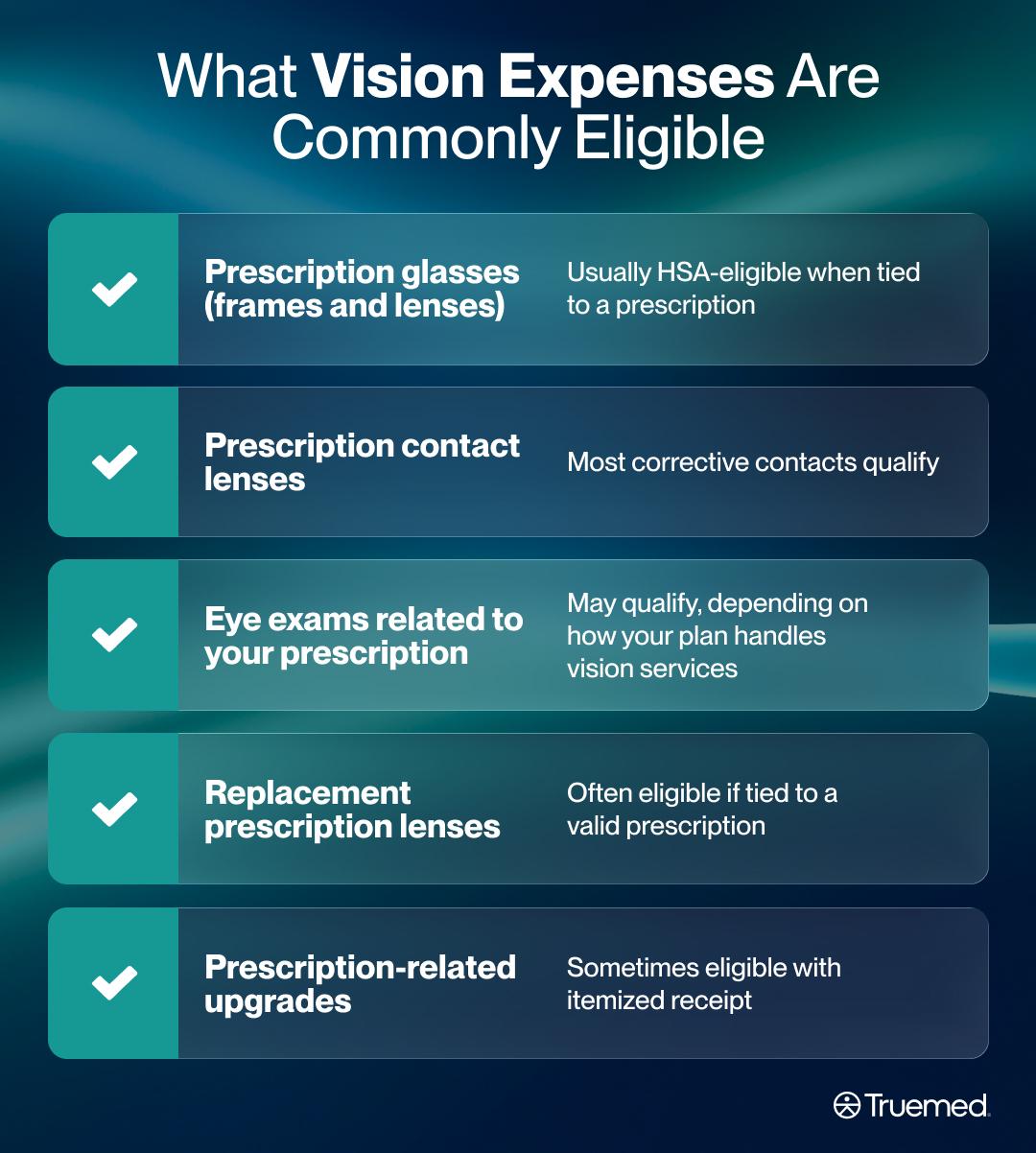
- Prescription glasses (frames and lenses): This is the most straightforward case. When you buy frames and prescription lenses together to correct your vision, the purchase is often considered HSA-eligible (especially if your receipt clearly shows both items tied to a prescription).
- Prescription contact lenses: Corrective contacts are typically eligible as well. That includes most daily, biweekly, or monthly contacts, and sometimes specialty lenses when they’re prescribed for a specific vision need.
- Eye exams related to your prescription: Exams used to diagnose vision issues or update your prescription may qualify, depending on how your plan handles vision services. This is one area where rules can vary, so it’s worth checking if exams are treated separately from eyewear.
- Replacement prescription lenses: Already love your frames? Replacing just the prescription lenses may still qualify, as long as the purchase is clearly connected to a valid prescription.
- Prescription-related upgrades: Add-ons like coatings or tints can sometimes qualify when they’re part of a prescription pair. These are more plan-dependent, which is why clean, itemized receipts matter so much.
If you’re ever unsure, a good rule of thumb is this: The closer the item is to correcting your vision, the more likely it is to be eligible.
Glasses vs Contacts: How to Think About “HSA Eligible Glasses”
Glasses and contacts both correct your vision, but they don’t always appear the same way on receipts or reimbursement reviews. Thinking about them a little differently can save you some friction later.
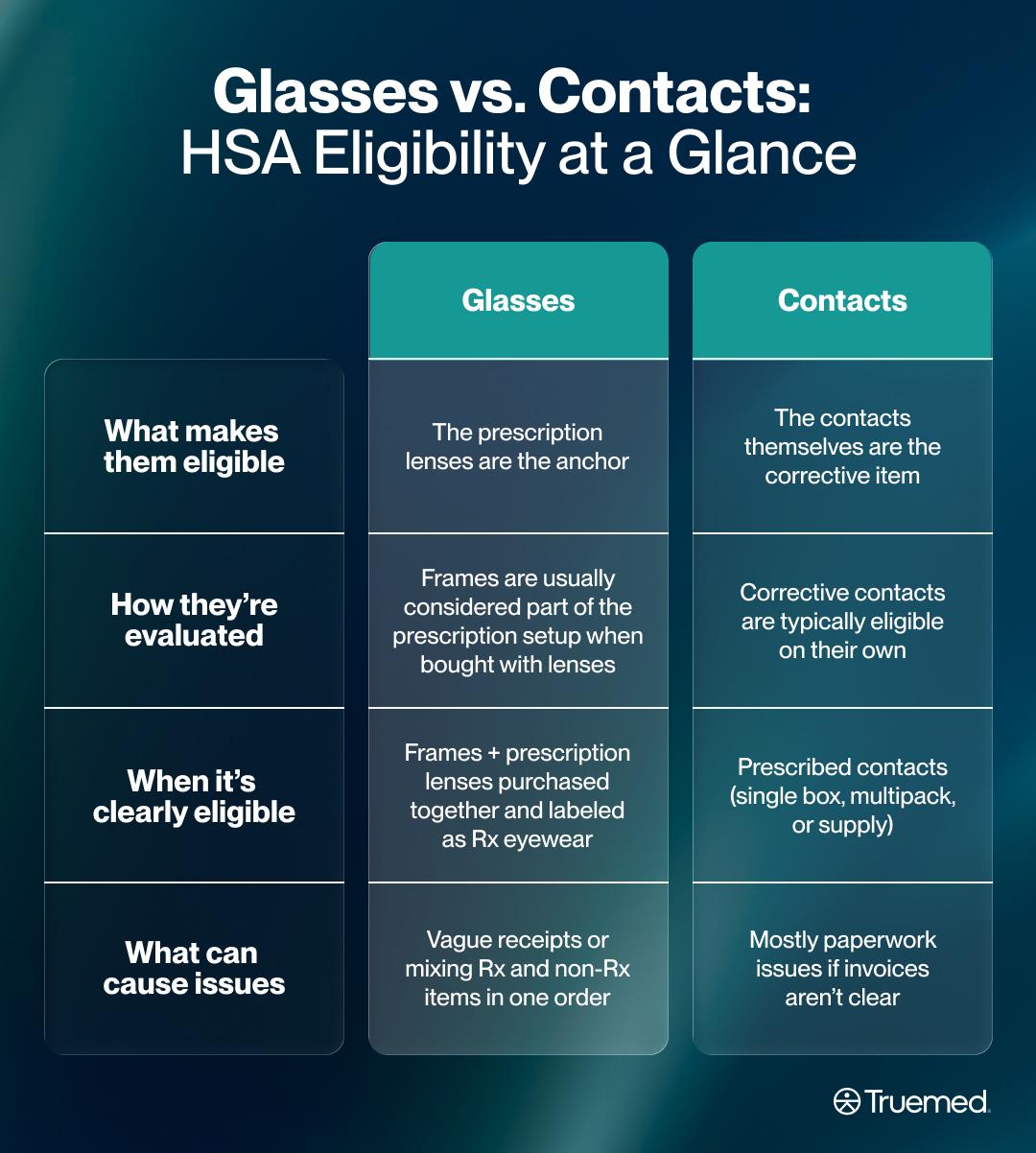
With glasses, the prescription is the anchor. The lenses are the clearly corrective part, and frames are usually evaluated as part of that prescription setup. When frames and lenses are purchased together and clearly labeled as prescription eyewear, they’re commonly treated as HSA-eligible glasses. Things get messier when receipts are vague or when prescription and non-prescription items are mixed in the same order.
Contacts tend to be more straightforward. Corrective contact lenses are typically eligible when they’re prescribed, whether you’re buying a single box or a longer supply. If you’re ordering multipacks or subscriptions, keep invoices that show what was purchased and when—this helps if questions come up later.
One place people run into trouble is bundling. If you buy glasses and contacts in the same transaction, or combine eligible items with clearly non-eligible accessories, make sure the receipt breaks everything out line by line. That detail can make proving your purchase (and getting reimbursed!) much easier.
When in doubt, it helps to adopt a simple mindset: Treat glasses and contacts as “likely eligible, but document carefully.” Save the prescription, keep itemized receipts, and hang onto order confirmations. A little organization upfront can prevent a lot of back-and-forth later, according to Feinerman.
Are Sunglasses HSA Eligible? What Usually Qualifies
The short answer: Sometimes.
“The keyword here is ‘prescription,’” says Feinerman. “The inclusion of your prescription is the medical component that flips the purchase from cosmetic to eligible.”
If the sunglasses are prescription, they’re commonly eligible. Even though they look like sunglasses, they’re still correcting your vision, which puts them in the same bucket as regular prescription glasses. In other words, from an HSA perspective, prescription sunglasses are usually treated as vision correction, not a fashion accessory.
Non-prescription sunglasses are a different story. These are often considered general-use or lifestyle items, which means they’re commonly non-eligible. Even if you wear them every day or need them for comfort, many plans won’t view them as a medical expense unless there’s a corrective component.
Then there’s the gray area: clip-ons, transitions, and tinted lenses. These can be eligible when they’re part of a prescription setup and clearly itemized. If your receipt just says “sunglasses” or “eyewear,” it’s much harder to show that the purchase was for vision correction rather than style.
Can I Use My HSA to Buy Glasses Online? What to Check First
“As long as they are prescription lenses, you can absolutely use your HSA to buy glasses online,” says Feinerman. However, this is also where small details matter the most.
Before you hit “place order,” make sure you have a current prescription and keep a copy somewhere easy to find. Even if no one asks for it at checkout, it’s one of the first things a plan administrator may want if they review your purchase.
Next, take a close look at the receipt or invoice the site provides. You want itemization that clearly breaks out frames, prescription lenses, and any add-ons. Receipts that lump everything into a single “eyewear” line item are much harder to substantiate later.
“I’ve seen patients attempt to use their HSA card on fashionable sunglasses, only to be declined because the merchant filed it under accessories instead of medical equipment,” adds Feinerman. “Any reputable online optical that accepts HSA cards will ask you for your prescription and file a merchant category that defines the transaction as medical.”
If you’re ordering multiple things at once—say, prescription glasses plus a case or cleaning kit—it helps to separate eligible and non-eligible items when possible. Mixing everything into one cart without line-item detail is a common source of reimbursement issues.
Promotions and discounts are another thing to watch. Save the final receipt showing what you actually paid, not just the list price. If your plan ever asks for documentation, the numbers need to match exactly.
For higher-cost orders, it’s also smart to keep order confirmations and delivery emails. You may never need them, but having a paper trail makes it much easier to respond quickly if questions come up later.
Common “Gotchas” That Can Make a Purchase Harder to Substantiate
Most HSA glasses issues don’t come from people doing something wildly wrong. Instead, they often come from small, easy-to-miss details. These are some of the most common ways an otherwise reasonable purchase can turn into a paperwork headache:
- Assuming non-prescription blue-light glasses are automatically eligible: If there’s no prescription and no vision correction, these are often treated as general-use eyewear rather than a medical expense, says Feinerman.
- Receipts that bundle everything together: When a receipt just says “eyewear” or “optical purchase,” it’s hard to show what portion was for prescription lenses versus optional extras.
- Mixing eligible and clearly non-eligible items in one cart: Throwing in accessories like cases or cleaning kits without itemization can complicate reimbursement, especially if everything shows up as one total.
- Returns or exchanges that change the final amount paid: If you swap frames or return part of an order, make sure you save the updated receipt. Your documentation needs to match what you ultimately paid.
- Using HSA funds for someone who isn’t an eligible dependent: HSAs can generally be used for yourself, your spouse, or tax dependents—but not everyone in your household automatically qualifies.
Compliance & Documentation (What to Save for HSA Eyeglasses Purchases)
This is the unglamorous part of using your HSA for glasses—but it’s also the part that saves you the most stress later. If your purchase is ever reviewed, documentation is what turns “this should be eligible” into “this is approved.”
Here’s what to keep, and why each piece matters:
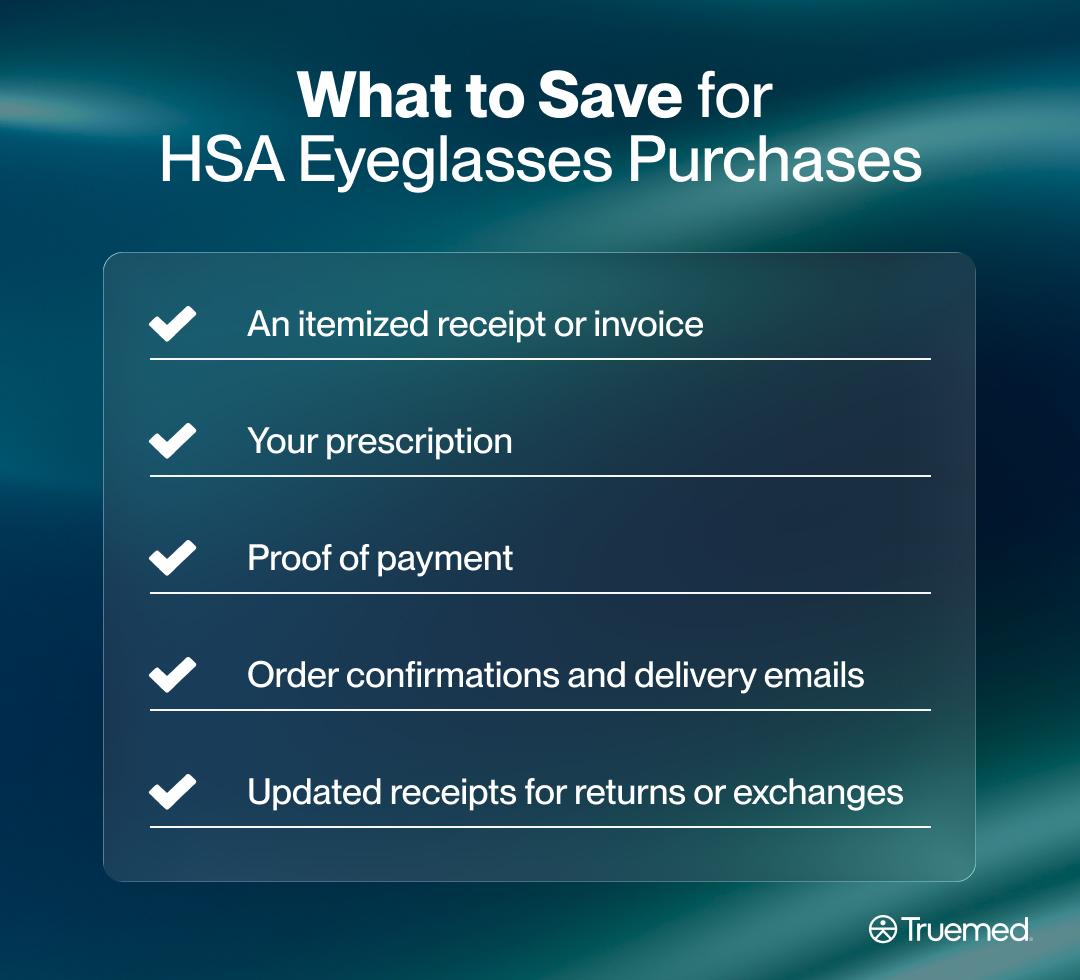
- An itemized receipt or invoice: This is the big one. Your receipt should show what you bought, when you bought it, and how much you paid. Ideally, it breaks out frames, prescription lenses, and any add-ons as separate line items. The clearer the receipt, the fewer follow-up questions you’re likely to get.
- Your prescription: For glasses, contacts, and prescription sunglasses, keep a copy of the prescription that matches the purchase. Even if no one asks for it upfront, it’s often the fastest way to show the item was for vision correction.
- Proof of payment: If you paid with an HSA card, save the transaction record. If you paid out of pocket and plan to reimburse yourself later, keep the same receipt and reimbursement confirmation so your records are complete.
- Order confirmations and delivery emails: These aren’t always required, but they’re helpful (especially for online or higher-cost purchases). They can back up dates, totals, and what was actually delivered.
- Updated receipts for returns or exchanges: If you return frames, swap lenses, or exchange part of an order, make sure you save the final receipt that reflects what you paid in the end.
HSA vs FSA for Vision Purchases (Quick Differences for Shoppers)
HSAs and flexible spending accounts (FSAs) often get lumped together, but they don’t work exactly the same—especially when you’re buying glasses or contacts. Knowing the differences can help you decide when to spend and what to save.
With an HSA, unused funds generally roll over year to year. That means there’s usually less pressure to rush a purchase, and you can reimburse yourself later as long as you keep good records, according to Feinerman.
An FSA often comes with use-it-or-lose-it rules, depending on your plan. That can make vision purchases a popular end-of-year move, but it also means timing matters more, he adds.
Vision correction can be both HSA- and FSA-eligible. Where the two accounts differ is in how payments are handled. Some merchants accept FSA debit cards easily, while others require you to pay upfront and submit for reimbursement. Either way, receipts are still important, even if a card is accepted at checkout.
If you have both an HSA and FSA, keep things clean. Be clear about which account paid for what, and don’t mix documentation. And if you’re planning a larger purchase—like multiple pairs of glasses or prescription sunglasses—it’s smart to confirm with your plan administrator before you buy so there are no surprises later.
How It Works with HSA/FSA and Truemed
For prescription glasses or contacts, most people buy directly through an optician or an online retailer. In those cases, eligibility usually comes down to having a valid prescription and an itemized receipt.
Truemed comes into play when you’re looking beyond standard vision care and want to use HSA or FSA funds for other health-related purchases that may require medical documentation. In those situations, eligibility depends on whether a licensed healthcare provider determines the purchase is medically necessary under IRS §213(d).
If you qualify, Truemed can help you through the process. Here’s what to expect:
- Complete a health intake form
- A licensed provider reviews your information and issues a letter of medical necessity (LMN) if appropriate
- Pay with your HSA/FSA card at checkout or submit for reimbursement, depending on your plan
The licensed practitioner determines whether an LMN is appropriate, and your plan administrator makes the final call on reimbursement. Because plan rules vary, it’s smart to confirm details before you buy and keep clean records either way.
FAQ
In most cases, yes. Prescription glasses are commonly considered HSA-eligible expenses when they’re used to correct vision. To keep things simple, save an itemized receipt and a copy of your prescription, since plan administrators may ask for both.
It depends on the type. Prescription sunglasses are often eligible because they still correct vision. Non-prescription sunglasses are often considered ineligible accessories, though plan rules can vary. Clear labeling and documentation make a big difference here.
Usually, yes. You can often use your HSA to buy glasses online as long as the purchase is for prescription eyewear. Make sure you have a current prescription and an itemized receipt that breaks down the cost of frames, lenses, and any add-ons. Those details matter if your purchase is reviewed later.
Upgrades may still qualify when they’re part of a prescription pair, but this is more plan-dependent. Coatings, transitions, or tints are easier to substantiate when they’re clearly listed as part of prescription lenses rather than bundled into a vague “eyewear” charge.
In most cases, yes. A valid prescription is usually what distinguishes HSA-eligible glasses from non-eligible eyewear. Keeping a copy of that prescription is one of the simplest ways to avoid reimbursement issues later. Over-the-counter readers are generally not eligible.



See what you can do with your HSA/FSA.
Join 1.5 million Americans who have routed their healthcare dollars toward root cause health via Truemed's HSA/FSA marketplace.
New product announcements
Sales and special offers
Tips for utilizing your HSA/FSA
Editorial Standards
At True Medicine, Inc., we believe better health starts with trusted information. Our mission is to empower readers with accurate and accessible content grounded in peer-reviewed research, expert insight, and clinical guidance to make smarter health decisions. Every article is written or reviewed by qualified professionals and updated regularly to reflect the latest evidence. For more details on our rigorous editorial process, see here.