
The Best Adjustable Dumbbells to Add to Your Workout
Author:Cheyenne Buckingham
Reviewed By:Bo Hickey, CSCS
Published:
January 06, 2026
Last Updated:
October 06, 2026
Truemed writers and editors independently evaluate all our product recommendations. If you make a purchase through any affiliate links we provide, we may receive compensation. Learn more.


Key Takeaways
Adjustable dumbbell sets make it easier to fit workouts into a busy schedule: If you only have 20 minutes to move your body, commuting to and from a gym can eat up that time. An adjustable dumbbell set lets you access multiple weights at home using one compact piece of equipment.
There’s no one-size-fits-all “best” adjustable dumbbell set: Personal preferences matter, and the right option depends on your training goals, how quickly you need to adjust the weight, and your budget.
An LMN is typically necessary for an adjustable dumbbell set: If you want to buy an adjustable dumbbell set with your Health FSA, you will likely need to provide an LMN from an independent licensed healthcare provider through Truemed confirming the item is part of your treatment or prevention plan for a specific health condition.
Truemed makes it easy: Truemed simplifies the LMN process and offers a curated marketplace of evidence-backed health interventions that may be eligible for HSA/FSA spending for qualified individuals. It takes the guesswork out of the process so you can focus on your health, not navigating the fine print.
Key Takeaways
How This Guide Helps You Choose the Best Adjustable Dumbbells
Why Adjustable Dumbbells Are So Popular (vs a Traditional Dumbbell Set)
Key Decisions Before You Shop (Goals, Space, and Budget)
Buying Guide: What to Look For in the Best Adjustable Dumbbells
Types of Adjustable Dumbbell Sets (Dial, Plate-Loaded, Selector, Hybrid)
Matching Adjustable Dumbbells to Your Workouts
Top Picks – Best Adjustable Dumbbells by Category
Safety, Setup, and Maintenance for Adjustable Dumbbells
Programming Basics: Where Adjustable Dumbbells Fit in Your Weight Set
How It Works with HSA/FSA and Truemed
When to Talk to a Healthcare Provider Before Lifting Heavier
FAQ
Shop Eligible Products
Ready to unlock your HSA/FSA funds for qualified medical expenses?
When you want to get a workout in but don’t have time to commute to a gym, or don’t want to deal with crowds, an at-home adjustable dumbbell set can be a major time saver. They may also save you cash—buying multiple sets of fixed dumbbells to build out a home gym can get expensive fast, not to mention take up a lot of space. Adjustable dumbbells let you reap the benefits of strength training without building an elaborate home setup or leaving your house.
Consider this your go-to guide for understanding how adjustable dumbbells work, which features matter most, and how to fit them into your strength-training routine. If the adjustable dumbbells are deemed medically necessary by an independent licensed clinician, you may also be able to use a Letter of Medical Necessity (LMN) to purchase them with HSA or FSA funds.
How This Guide Helps You Choose the Best Adjustable Dumbbells
This guide is designed for anyone building or refining a dedicated exercise area in their home—from beginners lifting for the first time to more experienced lifters looking to streamline their equipment. Whether you’re working with limited space, sharing weights with others in your household, or upgrading from lighter dumbbells to heavier sets, the goal is to help you choose an adjustable dumbbell set that fits your needs now and as your training evolves.
Learn the basics of how adjustable dumbbells work, plus which brands may be best to buy for you and your fitness goals and health needs. You don’t have to be a gym buff to train with adjustable dumbbells or a fitness professional to make the right purchase for you. Here, we cover everything from light-to-moderate options for general fitness to heavy adjustable dumbbells built for those chasing major strength gains.
Why Adjustable Dumbbells Are So Popular (vs a Traditional Dumbbell Set)
Adjustable dumbbells come with a lot of wins that can complement your lifestyle.
“Adjustable dumbbells let you have multiple weight options in one compact set, so you don’t need a full rack of individual dumbbells taking up space,” says Daniel Giordano, PT, DPT, CSCS, founder of Bespoke Physical Therapy in NYC and Rally medical advisory board member. “They’re perfect for small home gyms or apartments and make it easy to increase or decrease weight quickly during a workout.
A full dumbbell set can cost you up to $1,000, depending on how comprehensive a set you want. One set of adjustable dumbbells allows you to save hundreds of dollars while still challenging your strength.
Because the weight can be changed quickly, adjustable dumbbells work well for drop sets, circuit training, and shared home gyms—without the need to swap out multiple pairs of dumbbells or interrupt your workout, explains Mike Poirier, CSCS, vice president of fitness at The Edge Fitness Clubs.
Adjustable dumbbells are also versatile—you can get a full body workout with them and thanks to their customizable features, you can change the weight based on where your fitness is at that day. They also provide a travel-friendly option to stay consistent with training; you can take them in the car during trips and stay consistent without having to pay for a day pass at a gym.
Key Decisions Before You Shop (Goals, Space, and Budget)
Before you buy, it helps to get clear on which adjustable dumbbell set makes the most sense for your goals, lifestyle, space, and budget.
- Training goals. If you’re focused on rehabilitating an injury or maintaining a regular fitness routine, a lighter-to-moderate weight range may be ideal. For progressive strength and muscle gains, look for adjustable dumbbells that offer heavier maximum loads and smaller weight increments.
- Who will use them? If you live alone, you may only need a limited weight range, compared to those who live in homes with several people who may benefit from adjustable sets that accommodate many strength levels.
- Space considerations. Even though one set of adjustable dumbbells doesn’t take up a fraction of the space a whole rack of dumbbells does, it does still require some room. Some adjustable dumbbells require stands or cradles, for instance, to store them properly. You also want to consider how much room you have in your dedicated gym area to exercise and move around. For example, overhead movements like shoulder presses need enough ceiling and floor clearance.
- Budget. Entry-level sets tend to be simpler and more affordable, while mid-range and premium adjustable dumbbells often offer smoother adjustments and better durability.
Buying Guide: What to Look For in the Best Adjustable Dumbbells
Not all adjustable dumbbells are built the same. Paying attention to a few key features can help you choose a set that feels good to use, supports your training goals, and stays intact for the long haul.
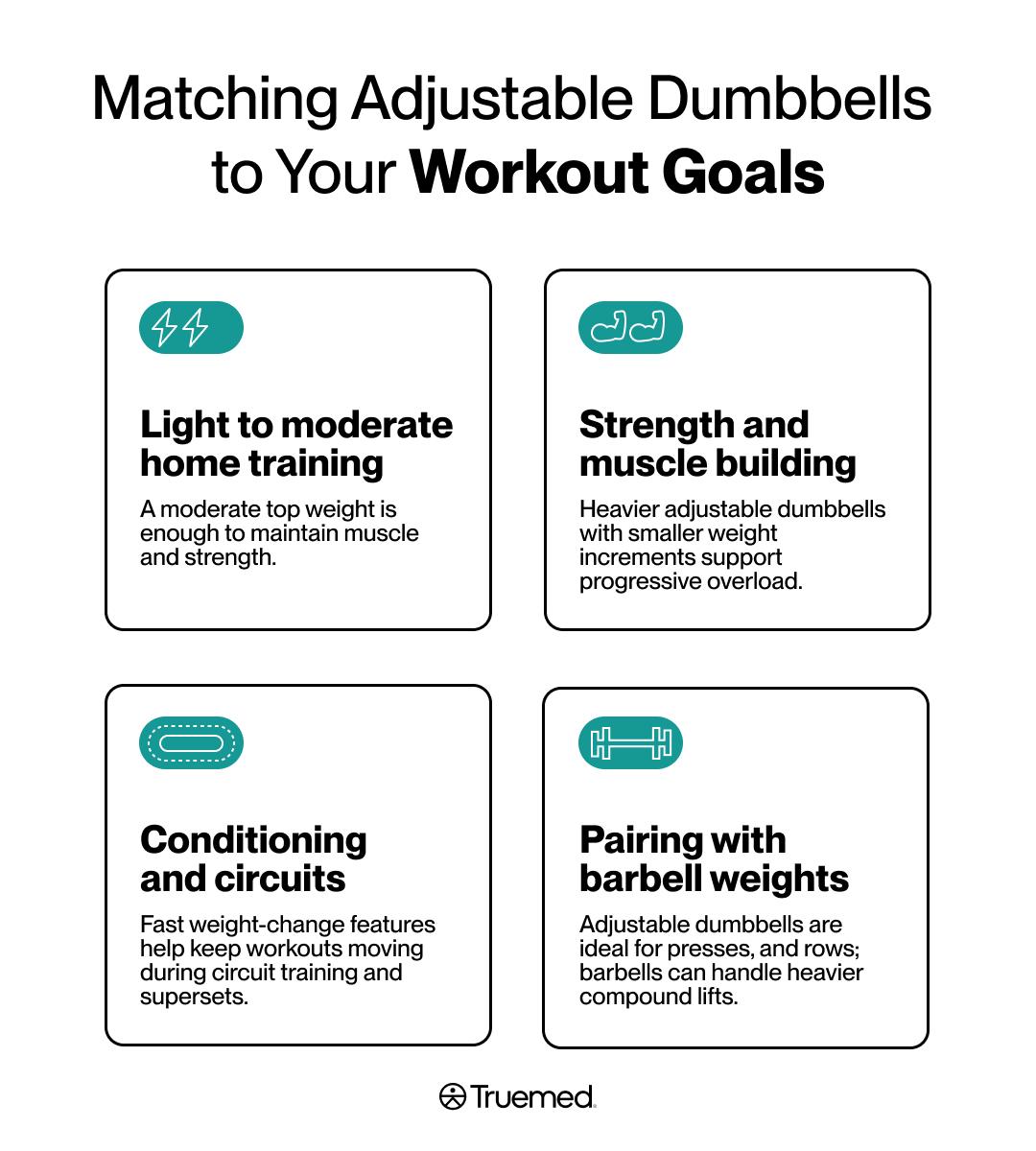
- Weight range. Look for adjustable dumbbells that start light enough for you to get your muscles warmed up for your workout, but also go heavy enough to challenge your strongest lifts. “Some sets go up to 50 lbs, while others [surpass] 100 lbs,” Giordano says. “Make sure it goes heavy enough for your strongest lifts but also light enough for warm-ups or rehab exercises.”
- Increment size. Smaller weight jumps—often 2.5 to 5 pounds—make it easier to progress gradually, especially for upper-body exercises or for when you’re coming back from an injury.
- Adjustment mechanism. Adjustable dumbbells use different systems, including dials, selector pins, or plate-loaded designs. Faster mechanisms make it easier to change weights during circuits or drop sets, while simpler plate-loaded options may take longer to adjust but offer fewer moving parts and a more classic “gym equipment” feel. Poirier’s advice? Choose the set that is “durable, easy to modify, and the minimum/maximum loads suit your current/desired fitness level.”
- Handle feel and grip. Pay attention to handle thickness, grip texture, and overall comfort. Knurled handles (found on most traditional dumbbell sets) can make your grip feel more secure—this is especially helpful if your hands tend to get sweaty when you work out. Smoother handle finishes may feel better for higher-rep or rehab-focused workouts. Figure out which type of handle is best for you before you hit the checkout counter.
- Footprint and shape. Some adjustable dumbbells are bulkier than traditional fixed dumbbells, which can affect how they feel during certain movements like chest presses, shoulder presses, bicep curls, or even goblet squats. Test out a few reps to get an idea of how your body moves with the set. Ask yourself questions like, does it affect your form or do you feel comfortable when you use them?
- Stability and safety. A secure locking system is arguably the most important piece of this buying guide. Plates should stay firmly in place during lifts and feel stable when set down. “Look for a set that’s easy to adjust, feels sturdy in your hands, and locks securely so the plates don’t shift,” Giordano says.
Types of Adjustable Dumbbell Sets (Dial, Plate-Loaded, Selector, Hybrid)
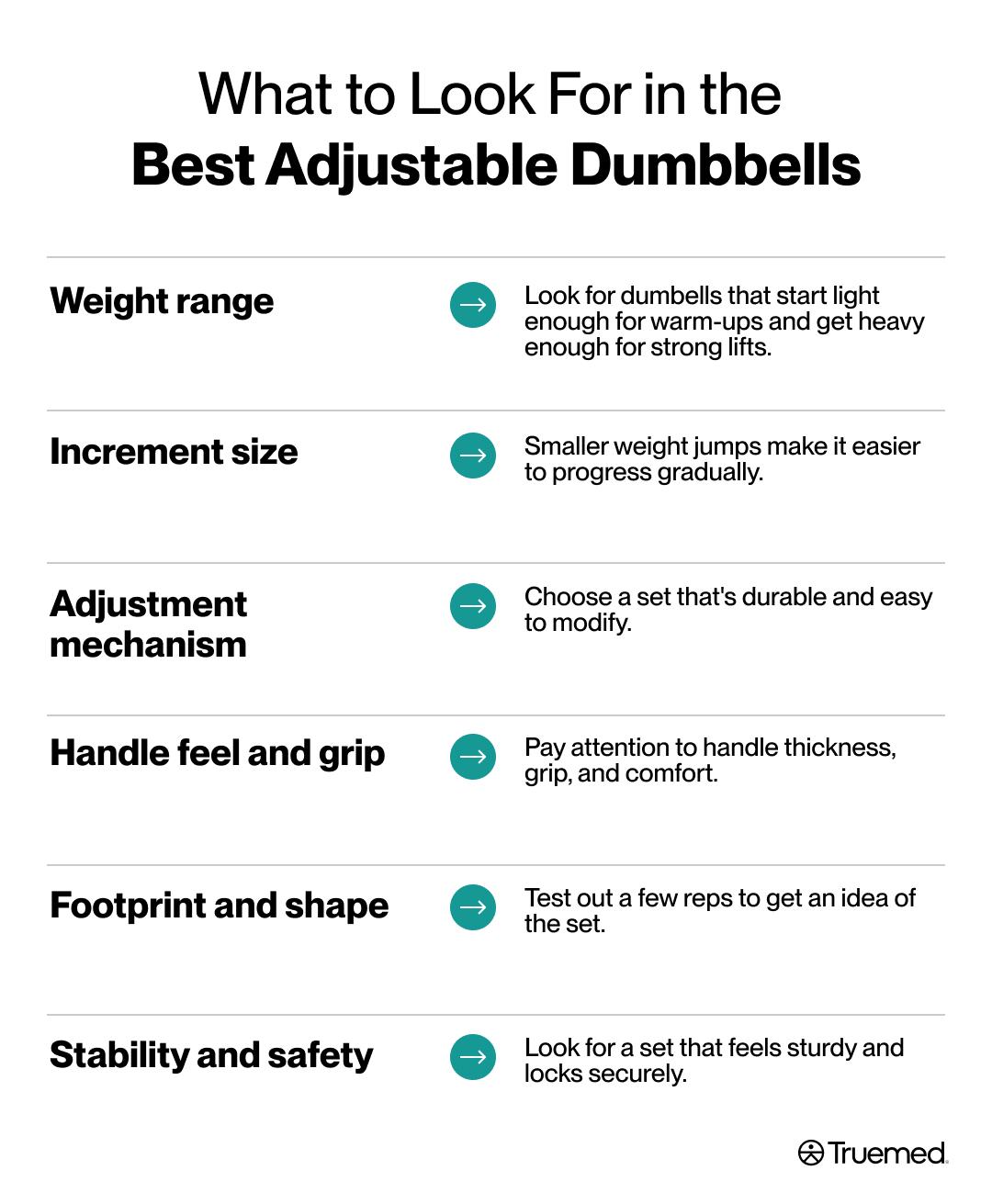
Adjustable dumbbells come in a few main styles, and each type affects how quickly you can change weights, how they feel when using them, plus how well they fit into different training styles.
- Dial-based systems. These adjustable dumbbells typically have dials on either end of the handle that support fast weight changes. If you’re someone who does circuit training or drop sets, this style may be a good option for you. Some cons include bulkier shapes and more moving parts.
- Plate-loaded adjustable dumbbells. This type of set is a more traditional, often lower-cost option that uses removable plates. They may offer a familiar feel, especially if you’re used to using a barbell. and high durability. One pitfall is that it can take longer to adjust the weight between sets.
- Selector pin or stack-style designs. These dumbbells allow you to change the weight by moving a pin or selector. These sets are often heavier than other styles and can feel different in certain lifts due to their boxy shape.
- Hybrid systems. These weight sets are compatible with barbell weights or more expansive home-gym setups. This style offers more options for lifters who want to build a more exhaustive weight set.
So, how do you choose a style based on how you train? The short answer: Faster-adjusting styles work well for circuit training and in homes where more than one person is using the set and needs to quickly adjust the weight. Plate-loaded or hybrid options are great for heavier lifts and slower-paced strength work.
Matching Adjustable Dumbbells to Your Workouts
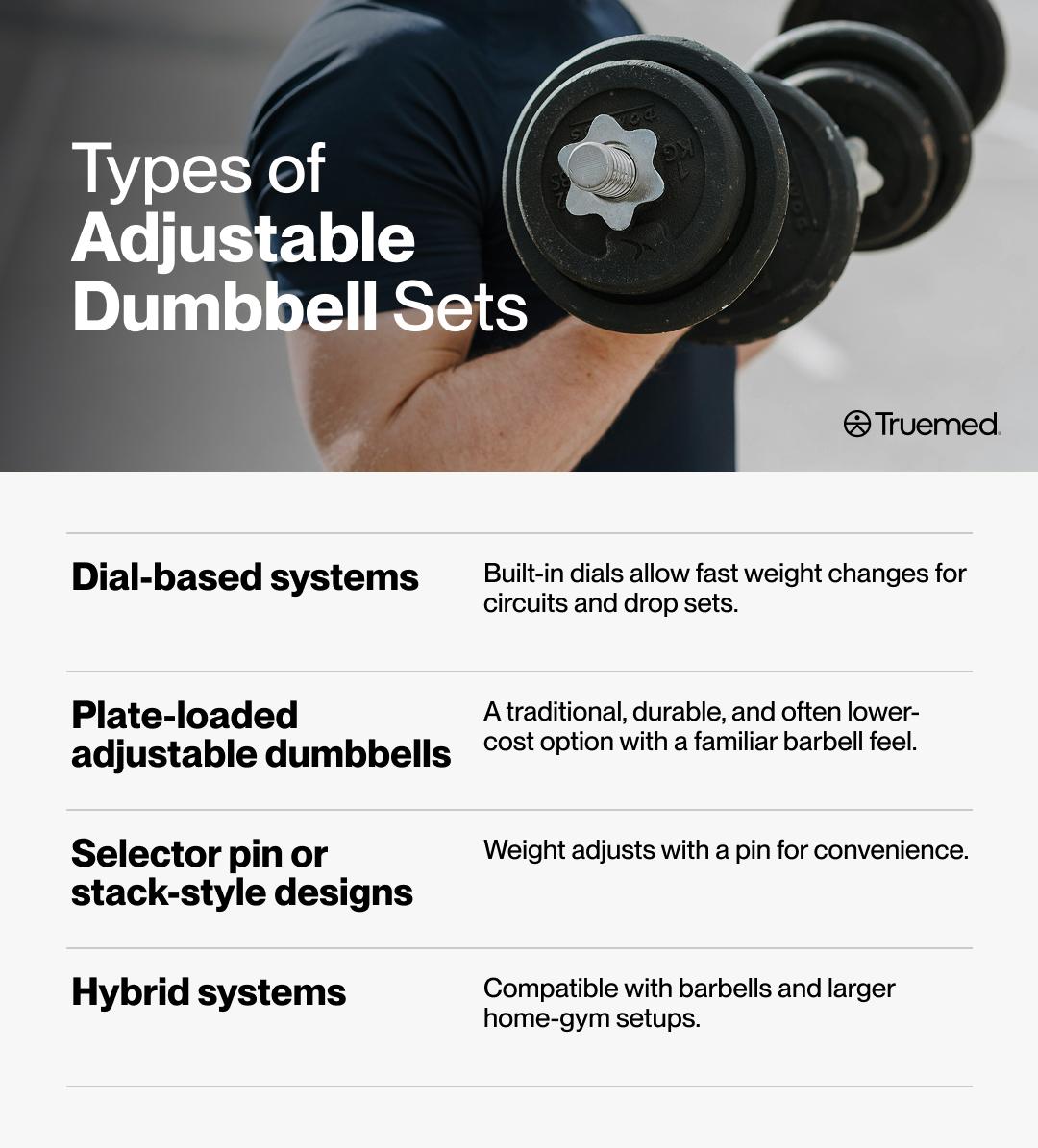
Here’s a quick crash course based on five different workout goals.
- Light to moderate home training. For those who want to maintain their current muscle mass and strength, or who can only train as time allows, choosing a set with a moderate top weight is often sufficient.
- Strength and muscle building. Heavier adjustable dumbbells with smaller weight increments support progressive overload. “Heavier weights are best for building strength and power,” says Giordano. “These lifting programs usually focus on fewer reps with more effort.”
- Conditioning and circuits. Fast weight-change features and durable construction help keep workouts moving during circuit training, supersets, or higher-intensity sessions. You’ll also want to go a bit lighter if you’re trying to build muscular endurance on conditioning days. “Lighter weights work better for endurance or for maintenance, with training programs usually having higher rep schemes,” Giordano says.
- Pairing with barbell weights. Adjustable dumbbells are ideal for presses, rows, and accessory movements, while barbells can handle heavier compound lifts in a more comprehensive home setup. Being able to transform your dumbbells into a barbell set can give you more options for a workout and help you target different muscle groups.
Top Picks – Best Adjustable Dumbbells by Category
Not every adjustable dumbbell set will be the right fit for every person and home gym. Below are top picks by category, based on weight range, ease of adjustment, footprint, and overall training versatility.
- Best All-Around Adjustable Dumbbell Set for Most Home Gyms: Core Home Fitness Adjustable Dumbbells. This set offers a balanced mix of weight, features that allow for quick adjustment, and durability, making them a strong fit for most at-home strength routines—from everyday fitness to progressive lifting.
- Best Heavy Adjustable Dumbbells for Strength Training: SMRTFT NÜOBELL 80 lb Adjustable Dumbbells or the Bells of Steel NÜOBELL Adjustable Dumbbells 50 lb. With a higher top weight and a more traditional dumbbell feel, this set is ideal for lifters who enjoy chest and shoulder pressing, rowing, and heavier strength work, along with fast adjustments and no plate loading.
- Best Compact Adjustable Dumbbells for Small Spaces: PowerBlock Pro Series Adjustable Dumbbells. Known for their compact, stack-style design, these dumbbells are easy to store and work well in apartments or smaller home gyms where floor space is limited. They’re good for stability as well, since they won't roll when on the floor and when you’re using them for exercises like plank rows.
- Best Adjustable System to Pair with Barbell Weights: Rogue Dumbbell Handles with Olympic Plates. This mini-barbell set integrates seamlessly with standard barbell plates, which is helpful if you plan to build a cohesive home gym setup that supports both types of weight training.
Safety, Setup, and Maintenance for Adjustable Dumbbells
To create a safe at-home gym space, make sure you have enough room to move freely. Clear space for presses, rows, lunges, and overhead lifts so that obstacles on the floor or low ceilings don’t limit your range of motion.
Before your workout, always check that all plates or selectors are fully locked into place, so you don’t risk injuring yourself. “Start with lighter weights to get used to the movement and make sure the plates are locked in before lifting,” Giordano says. “Lift with controlled tempo. Do not drop the weights. Instead, gently place them down so you do not break the dumbbell system.”
Finally, take care of your equipment. Inspect adjustment mechanisms regularly for looseness, wear, or damage—especially on dial- or selector-based systems with moving parts. Wipe down handles and plates after use to reduce sweat and bacteria buildup. These steps can help keep you safe and get more life out of your adjustable dumbbells.
Programming Basics: Where Adjustable Dumbbells Fit in Your Weight Set
Adjustable dumbbells are versatile enough to be the main piece of equipment for your entire at-home strength training routine. You can design an upper body, lower body, or full-body workout with just one of these adjustable sets, says Poirier.
Progression comes from gradually increasing the challenge over time—by adding weight, reps, or sets—rather than rushing load increases. “Be mindful of trying to adjust too quickly, jumping up in weight too fast, or overloading too quickly,” Poirier says. “Growth takes time.”
Adjustable dumbbells also pair well with barbell weights and bodyweight exercises for a balanced home setup that’s friendly to those just starting a resistance training routine. Best of all, they allow you to get in a quality workout when you’re low on time.
How It Works with HSA/FSA and Truemed
Building out a home gym can be expensive, which is why you may be wondering if you can use your pre-tax income to cover the costs of certain pieces of equipment, like an adjustable dumbbell set. While fitness equipment usually isn't automatically HSA/FSA-eligible, you may be able to qualify to spend your pretax dollars on certain fitness equipment with the help of a letter of medical necessity (LMN).
If you have a specific cardiac, metabolic, or musculoskeletal condition, for example, shop the Truemed* marketplace for available options that are often HSA/FSA-eligible for qualified individuals with an LMN. It’s a straightforward process: at checkout, you’ll complete a clinical intake form, and an independent licensed clinician will determine whether an adjustable dumbbell set is medically necessary. If approved, you will receive an LMN to use your HSA/FSA funds to cover the costs.
How you pay may depend on the dumbbell brand. Some brands allow qualified customers to pay with an HSA/FSA card directly at checkout, while others will require you to pay out of pocket upfront and then submit for reimbursement with your account provider. Keep your receipt and your LMN for reimbursement purposes.
Even if you pay with either tax-free account at checkout, it’s always a good idea to keep your LMN and receipt, as your plan may request these documents at a later date. In general, aim to review your plan’s guidelines before using HSA/FSA funds, as your plan administrator often has the final say on what gets reimbursed and what doesn’t.
*Truemed is for qualified customers. See terms at truemed.com/disclosures.
When to Talk to a Healthcare Provider Before Lifting Heavier
Whether you’re returning to strength training after time off or starting for the first time following a health diagnosis, it’s a good idea to check in with a healthcare provider about when and how to increase lifting intensity.
People with heart disease, uncontrolled high blood pressure, or those recovering from surgery should be especially cautious before ramping up their strength routine. While lifting heavier weights isn’t inherently dangerous—and is often associated with benefits like improved bone density—symptoms such as dizziness, chest pain, or shortness of breath may signal the need for medical evaluation.
A doctor or physical therapist can help you determine appropriate exercises, loads, and progression based on your health history, fitness level, and goals.
FAQ
In many cases, yes. Some premium adjustable dumbbell sets provide a wide range of weights that can cover much of what you’d get from a traditional fixed dumbbell set, especially for home workouts.
That’s completely up to you and what you want out of your training. If you’re trying to build strength or muscle mass, a heavier set may help you achieve either (or both) of those goals.
You don’t necessarily need barbell weights if you have heavy adjustable dumbbells. Adjustable dumbbells can support most strength-training movements and are enough for many at-home routines. That said, some strength programs benefit from using a variety of equipment, and barbells can be useful for very heavy compound lifts. If you enjoy barbell work, think of adjustable dumbbells as a versatile part of your routine rather than a complete replacement.
Absolutely, especially if you start with a low to moderate top weight set. Always consult with your doctor before trying any new exercise program.
You may be able to use HSA/FSA funds if the set is used to address a specific health condition and you have a Letter of Medical Necessity (LMN) from a licensed provider. Truemed works with several fitness equipment brands; qualified customers can use their HSA/FSA funds on eligible items with an LMN.



See what you can do with your HSA/FSA.
Join 1.5 million Americans who have routed their healthcare dollars toward root cause health via Truemed's HSA/FSA marketplace.
New product announcements
Sales and special offers
Tips for utilizing your HSA/FSA
Editorial Standards
At True Medicine, Inc., we believe better health starts with trusted information. Our mission is to empower readers with accurate and accessible content grounded in peer-reviewed research, expert insight, and clinical guidance to make smarter health decisions. Every article is written or reviewed by qualified professionals and updated regularly to reflect the latest evidence. For more details on our rigorous editorial process, see here.