
4 Key HSA Benefits: Is an HSA Worth It?
Author:Jennifer Chesak
Reviewed By:Michaela Robbins, DNP
Published:
October 21, 2025
Last Updated:
September 09, 2026


Key Takeaways
An HSA serves as: a way for you to pay for qualifying medical expenses with pre-tax dollars.
An HSA can also add: to your retirement savings strategies and help you save for future medical expenses.
Truemed helps you maximize your options for : what you can spend your HSA dollars on, while streamlining the process.
If you’ve ever been frustrated by having to pay healthcare expenses not covered by insurance and having to give part of your paycheck to the government to pay federal income tax, a health savings account (HSA) may be for you.
HSAs offer a tax-saving solution for paying out-of-pocket expenses related to your health—now and later. Some basic highlights of HSAs include that the funds aren’t subject to income tax, they can grow just like other investments, they don’t expire at the end of the year, and you can take the funds with you regardless of employment. Plus, using these pre-tax funds for medically necessary expenses throughout the year can save you major cash in the long run.
“[An] HSA has the unique benefit of being tax-deductible, allowing you to grow your funds without paying taxes, and allowing you to take tax-free withdrawals for qualified medical expenses,” says Sherman Standberry, CPA, the CEO and managing partner of CPA Coach. “This is what makes HSAs such a great savings tool.”
We get it though: Wading through information on how HSAs work and whether one is right for you can make your head spin. That’s why we put together this easy-to-understand guide to the benefits of an HSA.
4 Key Benefits of an HSA
Now let’s unpack the advantages of an HSA, including how they can reduce your tax burden and more.
1. Triple tax advantage
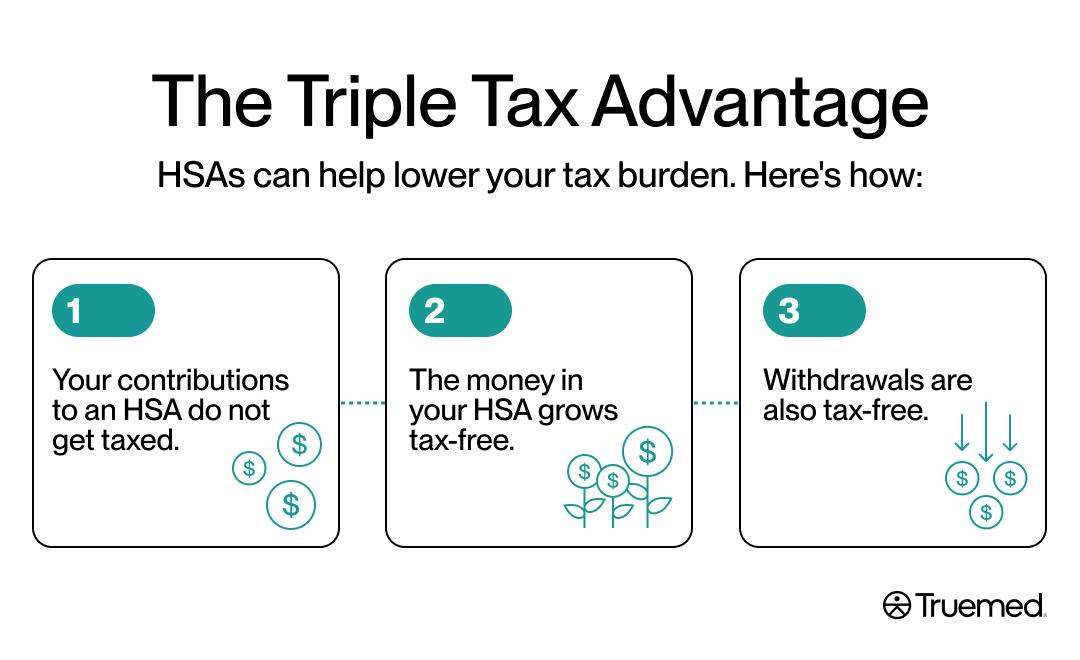
The point you probably hear most regarding an HSA is that they can help lower your tax burden, but you may not realize that this benefit applies in three distinct ways.
“The triple tax advantage is what makes them unique,” says Clayton Eidson, founder and CEO of AZ Health Insurance Agents. “Contributions are tax deductible, the growth remains tax-free, and the disbursements for qualified medical expenses are also tax-free. That combination is rare indeed in any financial vehicle.”
Your contributions to an HSA do not get taxed. This means that if you make contributions directly from your payroll, those contributions are taken out of your paycheck and placed in your HSA before your employer withholds income and payroll tax. If you have self-employed income, your contributions to an HSA are tax deductible. Here’s an example if your paycheck is $1,000 and you’re in the 22% tax bracket. With an HSA, you would take home about $78 less than without an HSA, but you would also save $22 on taxes while also placing $100 in your HSA account to be used for qualifying expenses down the road. (This is a simplified example—it’s at bit more complicated since there are other taxes such as payroll and state income tax.).
The money in your HSA grows tax-free. You can even invest the money that’s in your HSA in stocks, mutual funds, and more. This growth isn’t subject to taxes.
Withdrawals are also tax-free. You can withdraw money from your HSA to use for qualifying medical expenses without paying taxes on the withdrawal amount. After age 65, you can withdraw money from your HSA to be used for any reason, not just qualifying medical expenses. However, nonmedical expenses are taxed like regular income at that point.
2. Portability
The funds in your account carry over from year to year, meaning you don’t lose the funds if you don’t use them by year’s end. And, just like a 401K or an IRA (individual retirement account), the account is portable through a rollover, meaning you can take the account with you if you switch jobs, retire, or change health plans.
3. Long-term planning and flexibility
You can treat your HSA like a “stealth IRA.” Think of it as a stealthy way to save for medical expenses down the road. “Treating an HSA as a stealth IRA requires strategic timing of withdrawals,” says Lisa A. Cummings, Esq., at Cummings & Cummings Law. “When an individual pays out-of-pocket for current medical expenses and retains receipts, they can later reimburse themselves tax-free—even years later. This allows the funds within the HSA to remain invested, potentially growing like a traditional IRA.”
And remember: You can use those HSA funds tax-free for qualifying medical expenses at any time. You can also withdraw whatever remains in the account when you turn 65.
4. Employer incentives
Your employer might offer HSA-related incentives, but these will vary based on the company. Here are a few examples:
- Flat contributions: Some employers contribute a flat amount to your HSA, even if you don’t contribute to it. The amount will likely be different based on whether you have individual or family coverage.
- Matching contributions: Some employers match your contributions dollar for dollar up to a maximum amount.
- Wellness incentives: Some employers contribute to your HSA if you complete certain wellness or health-screening programs.
Is an HSA Worth It?
Now that you have the details on what an HSA entails, you might be weighing the pros and cons and whether opening one is right for you. Only you can decide, perhaps with the help of a financial planner. But here are a few considerations.
Is an HSA a good fit for you? What’s the Best-Case Scenario?
When considering an HSA, you might encounter two schools of thought.
- Regularly use your HSA funds as needed (now and over time) for qualified medical expenses: This offsets your tax burden, helps you pay for medical expenses, including those you incur at the doctor or pharmacy and those that help you make lifestyle changes now that reduce your risk for health complications down the road and help you live your best life in retirement. This strategy can be beneficial for many people.
- Save your HSA funds to be used for qualifying medical expenses in retirement or as general retirement funds: This strategy only works best if you can answer yes to the following three questions:
Are you relatively healthy? If so, your HSA will be able to grow over time rather than being depleted. A growing HSA allows for investing opportunities and more tax savings in the long run.
Do you have predictable spending? If your healthcare costs are low and relatively predictable, you’ll be able to keep more funds in investments and spur account growth.
Can you afford small medical bills without using the HSA? In some cases, you may wish to pay small medical bills with your general funds, rather than using your HSA, to allow the HSA to grow in investments over time or to save up for big-ticket health items.
Does your employer contribute, and are you in a high tax bracket?
- Does your employer contribute to your HSA? If so, not having one is essentially leaving extra money on the table.
- Do you have a high tax burden? If you’re in a high tax bracket, an HSA is a great way to reduce your taxable income by potentially thousands of dollars. For example, if you are in the 32% tax bracket and you contribute the annual family maximum to your HSA, ($8,550) you could save $2,736 on your annual federal income taxes.
Do the trade-offs and budgeting strategies work for you?
HSAs require you to have a high-deductible health plan (HDHP). These plans mean you will pay more for out-of-pocket costs before your insurance kicks in to cover expenses.
If you’re relatively healthy and don’t typically have to pay the full amount of your deductible, or if you have a sizable income with room to cover a high deductible, then an HDHP likely won’t be an issue. But if you are on a tight budget and have high medical costs, then an HDHP may impact your budget too much and you may be better off with a lower-deductible plan—if you have that option.
In some cases, your employer may only offer an HDHP. If this is the case for you, then an HSA might still be beneficial, even if you have high medical costs or a tight budget. This is because whatever you contribute to the HSA will still lower your tax burden, which can help with budgeting.
Another consideration: One financial strategy with an HSA is to have a cash reserve within the account to pay for your deductible (and perhaps additional qualifying medical expenses) and then designate any contributions above that general amount for investments. Many providers offer a function to “auto-sweep to investments” the amount contributed above your designated cash buffer threshold.
That being said, you don’t have to avoid spending the money in your HSA. If you’ve got qualifying medical expenses now, think of your HSA as a way to pay for them. Ultimately, an HSA is another way of paying yourself with some of the money you’d normally have to put toward taxes if you didn’t have an HSA.
Especially with LMN in place, you can pay for your gym membership, yoga classes, supplements, and more—all stuff you might already be paying for with your taxable income. With that auto-sweep to investments feature in place, you can still save any surplus for later.
What if you’re self-employed? First, you have to decide if an HDHP is right for you. If it is, then consider the tax breaks. Self-employed folks must pay both income and self-employment tax, making their tax burden somewhat hefty. You can reduce what you pay in federal income tax by using the HSA. For example, if you’re in the 22% federal tax bracket and you contribute $3,000 to your HSA throughout the year to cover your high deductible, then you will save $600 in income tax. If you max out your contributions, you will save even more. And you may be able to buy that home treadmill or indoor cycle you’ve been eyeing.
Health Savings Account Pros and Cons
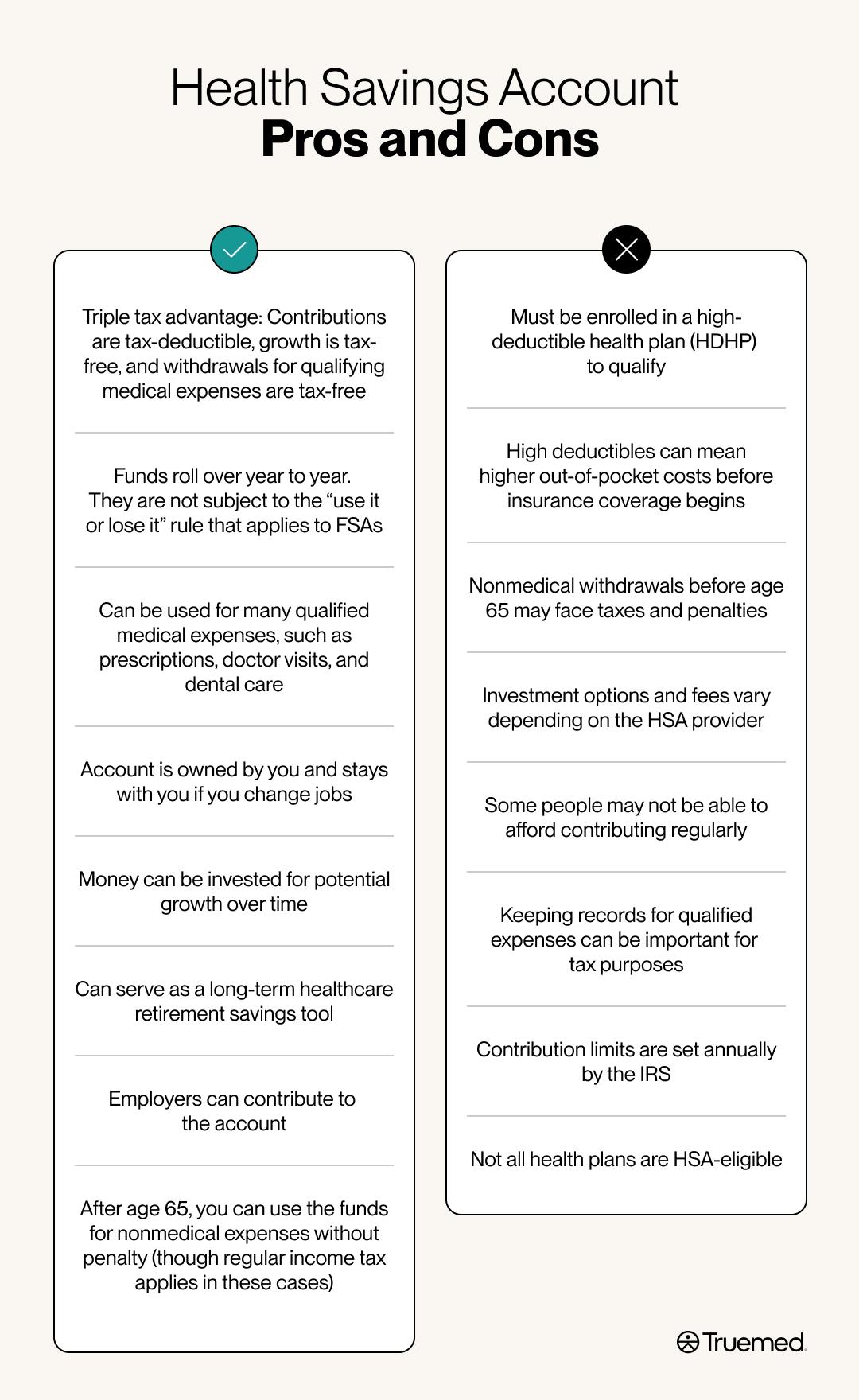
Now that you’ve had an in-depth look at the benefits and potential drawbacks of HSAs, you might need a quick recap of the basics.
| HSA pros | HSA cons |
|---|---|
| Triple tax advantage: Contributions are tax-deductible, growth is tax-free, and withdrawals for qualifying medical expenses are tax-free | Must be enrolled in a high-deductible health plan (HDHP) to qualify |
| Funds roll over year to year. They are not subject to the “use it or lose it” rule that applies to FSAs | High deductibles can mean higher out-of-pocket costs before insurance coverage begins |
| Can be used for many qualified medical expenses, such as prescriptions, doctor visits, and dental care | Nonmedical withdrawals before age 65 may face taxes and penalties |
| Account is owned by you and stays with you if you change jobs | Investment options and fees vary depending on the HSA provider |
| Money can be invested for potential growth over time | Some people may not be able to afford contributing regularly |
| Can serve as a long-term healthcare retirement savings tool | Keeping records for qualified expenses can be important for tax purposes |
| Employers can contribute to the account | Contribution limits are set annually by the IRS |
| After age 65, you can use the funds for nonmedical expenses without penalty (though regular income tax applies in these cases) | Not all health plans are HSA-eligible |
How It Works with an HSA and Truemed
You’ve got one more thing to consider regarding whether an HSA might be worth it for you. Just because an item isn't automatically HSA-eligible doesn’t mean it’s off the table. Many health products and services could qualify when they’re medically necessary to treat or prevent relevant medical conditions and supported by proper documentation (like an LMN).
For example, you might be able to purchase a red-light therapy device with your HSA dollars. Such a device might be an eligible expense if you’re using it to address a specific medical condition. If approved by an independent licensed clinician, such conditions might include alopecia (if a device for hair), chronic pain, or rheumatoid arthritis.
You might need a letter of medical necessity (LMN). An LMN is a formal document from a licensed healthcare provider that explains why a certain product, treatment, or service is necessary to treat, mitigate, or prevent a medical condition.
Certain health products and services may be eligible for qualified customers with an LMN issued by an independent practitioner when the item is used to address a specific medical condition.
Truemed* specializes in helping you maximize your HSA and other health-related benefits (such as an FSA):
- First, you can check whether a product or service is normally considered a qualifying medical expense or whether you might need an LMN.
- Complete a health intake survey that will be reviewed by an independent licensed clinician.
- Buy the item; either pay directly with your HSA/FSA card at checkout, or pay with a regular credit/debit card and seek HSA/FSA reimbursement afterward.
- The independent licensed practitioner will review your medical history, and if you qualify, will issue an LMN. Truemed itself does not make eligibility determinations.
- Truemed also offers support in the event you get a denial of reimbursement and need to provide substantiation documentation.
*Truemed is for qualified customers. HSA/FSA tax savings vary. Learn more at truemed.com/disclosures
FAQ
You can use your HSA dollars to pay for out-of-pocket costs (not covered by insurance), including vision and dental expenses, medical expenses (including prescription or over-the-counter medications), family-planning needs (contraception, fertility treatments, etc.), and more. Obtaining a letter of medical necessity (LMN) can help you get additional needs covered, including gym memberships, exercise equipment, and more, if a provider deems these things medically necessary for your health.
One downside of an HSA is that you are only eligible for one if you have a high-deductible health plan (HDHP), which means you may have high out-of-pocket costs before your insurance kicks in. For example, if your deductible is $5,000, you will need to pay that amount in healthcare costs before your insurance pays for medical expenses. However, your plan must cover preventive medical costs, such as for an annual checkup or recommended cancer screenings, regardless of whether you’ve met your deductible.
An HSA can be worth it if you generally have low and predictable medical expenses, have a solid budget that allows for paying a high deductible (since you will be required to have a high-deductible health plan, aka HDHP), or would like to reduce your federal income tax burden.
Whether you choose to put money into a 401K or an HSA will depend on several factors. A 401k is an invested retirement savings account that grows over time. You can access your 401K funds for your retirement starting at age 59.5. You will pay taxes on the funds as you take distributions. If you need the money from your 401K before age 59.5, you will incur a 10% early withdrawal penalty, though there are some exceptions. An HSA is a health savings account. You can use your HSA dollars to pay for qualifying medical expenses at any time. You can also invest your HSA funds and watch them grow, just as you would a 401K. After you turn 65, you can use your HSA dollars to support you in retirement. You will only pay taxes on the funds if you use them for something other than qualifying medical expenses.
An HSA can help lower the amount that you pay in income tax because you contribute to an HSA with pre-tax dollars. The HSA also grows tax-free. You only pay taxes on HSA dollars when you take a distribution after turning 65 if you use the funds to pay for something other than qualifying medical expenses.If you use your HSA dollars for a qualifying medical expense at any age, you do not pay taxes on the money.



Editorial Standards
At True Medicine, Inc., we believe better health starts with trusted information. Our mission is to empower readers with accurate and accessible content grounded in peer-reviewed research, expert insight, and clinical guidance to make smarter health decisions. Every article is written or reviewed by qualified professionals and updated regularly to reflect the latest evidence. For more details on our rigorous editorial process, see here.