
Top 50 Fitness/Nutrition Programs Commonly Approved via LMN
Author:Mia Taylor
Reviewed By:Bo Hickey, CSCS
Published:
February 20, 2026
Last Updated:
September 17, 2026



Key Takeaways
Eligibility: HSA or FSA funds may cover the cost of fitness and nutrition programs when the program is used to address a specific health condition.
Documentation: A Letter of Medical Necessity (LMN) is often the missing link that's required in order to justify using HSA or FSA savings for fitness or nutrition program expenses.
Weight Loss Programs: Weight loss programs used to treat a specific issue diagnosed by a physician, such as obesity, diabetes, heart disease hypertension, may qualify for HSA or FSA coverage.
Fitness Programs: Fitness programs that are part of a condition-specific therapeutic plan, may be covered by HSA or FSA plans, but general gym membership is often denied.
Key Takeaways
Fitness Program Eligibility Basics
HSA and FSA Rules: Where Fitness and Nutrition Programs Fit
Conditions and Use Cases That Often Support Medical Necessity
What Clinicians Usually Confirm Before an LMN Makes Sense
Top 25 Fitness and Nutrition Programs to Consider
Common Reasons Programs Don’t Qualify
How It Works with HSA/FSA and Truemed
FAQ
Signing up for a fitness and nutrition program can be a great way to address many different types of health issues, including medically diagnosed conditions. But with the cost of nearly everything skyrocketing lately, you may be looking for a little help covering the cost of these types of expenses to ease the strain on your wallet. And here's the good news: If you have a health savings account (HSA) or a flexible spending account (FSA), you may be able to tap into those funds to cover the cost of fitness and nutrition programs that are used to address a specific health condition.
Obtaining a Letter of Medical Necessity (LMN) is often the missing link that's required in order to justify using HSA or FSA savings for fitness or nutrition program expenses. Not familiar with an LMN or what it does? Read on. This guide will explain what an LMN is and how you use this type of document. We'll also cover how to shop for fitness and nutrition programs that are more likely to qualify for HSA or FSA coverage. And along with all of that, we'll provide a list of 25 programs that may be considered medically supportive versus just being general fitness or nutrition programs.
Whether you're just beginning to consider a fitness or nutrition program, or you're already paying for one, this guide can provide a more predictable path to HSA or FSA eligibility.
Fitness Program Eligibility Basics
Let's start by diving a little deeper into what an LMN is and when it can be helpful specifically for fitness or nutrition programs.
An LMN is a formal document provided by a licensed healthcare provider. It establishes the medical necessity for a particular product, treatment or service, explaining why these expenses might be necessary to cure, treat, mitigate, or prevent the patient's health or medical condition.
This type of document can be especially helpful when it comes to connecting the dots regarding the medical need for a fitness or nutrition program. Here's why: "Only expenses to treat or mitigate a specific medical condition are eligible [for HSA or FSA coverage], not general health expenses," explains Hillary Lin, MD, a Stanford-trained longevity physician.
The important takeaway here is that a fitness or nutrition program's eligibility for HSA or FSA coverage is never automatic. Eligibility varies not only based on the rules of your particular HSA or FSA plan, but also based on your individual circumstances and medical needs.
The goal of this guide is to help you reduce out-of-pocket costs for medically necessary care, not for a general gym membership or nutrition program meant to help achieve a New Year's goal of dropping 10 pounds.
It's also important to point out that the list of potentially eligible fitness and nutrition programs we've rounded-up for this guide is merely a starting point. Researching programs that match your specific health need or condition is a critical step as well.
HSA and FSA Rules: Where Fitness and Nutrition Programs Fit
In general, your HSA and FSA funds are meant to cover eligible medical expenses. But what does that mean exactly? While the exact rules vary from plan to plan, HSAs and FSAs can generally be used to cover the cost of everything from doctor visits to treatments that manage or prevent chronic conditions.
So, how does all of the fitness and nutrition programming out there fit into the spectrum of allowable spending? Let's take a closer look.
When it comes to weight-loss programs, for instance, the expense may qualify "when [the program is being used to] treat a specific disease diagnosed by a physician. Qualifying conditions include obesity, diabetes, heart disease, or hypertension," explains Amit Gupta, MD, a physician who led the legislative work that established HSAs in the United States.
The IRS, Gupta adds, explicitly excludes programs for general weight loss or for improving one's appearance. There must be a clinical reason for the program.
Nutrition counseling and behavior-change programs, meanwhile, are increasingly recognized as medical care when they address a chronic condition, says Gupta. "As an example, a patient who has Type 2 diabetes and is prescribed a clinical nutrition program to manage blood glucose levels would be a clear candidate for HSA/FSA reimbursement," he says.
Looking at fitness programs, these types of costs are more likely to qualify when the program is structured like a therapeutic plan and is being used to address a specific issue.
"If fitness programs are part of a condition-specific therapeutic plan, they will be covered. A general gym membership is often denied," says Gupta, who adds: "A prescribed exercise program for the treatment of chronic back pain, often called medical exercise, is viewed as a treatment, similar to physical therapy, making it much easier to substantiate to a plan administrator."
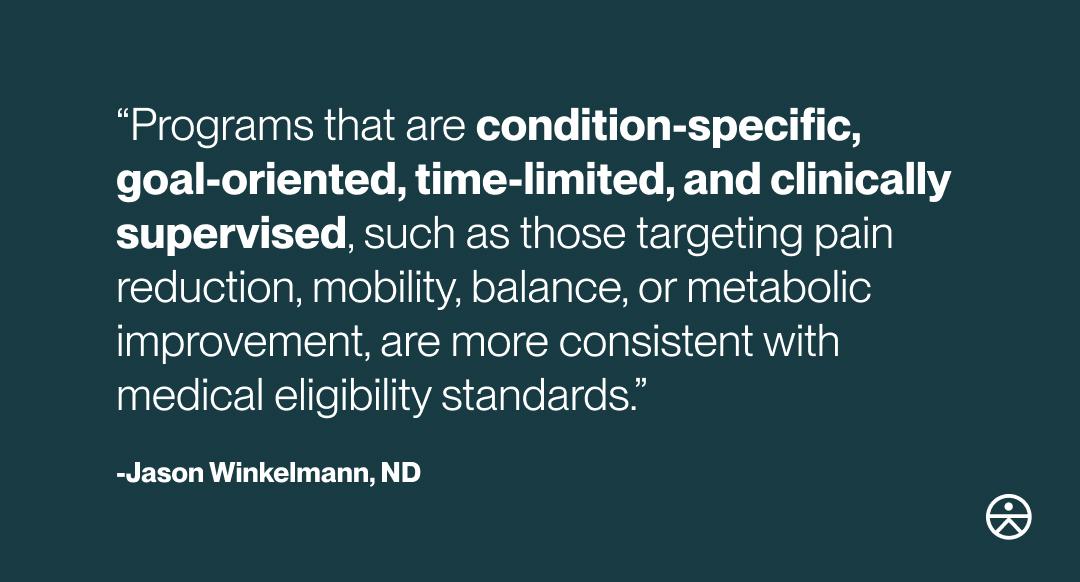
Jason Winkelmann, ND, of True Health Centers, says fitness programs are far more likely to qualify when they're structured as therapeutic or rehabilitative interventions, not open-ended gym access. "Programs that are condition-specific, goal-oriented, time-limited, and clinically supervised, such as those targeting pain reduction, mobility, balance, or metabolic improvement, are more consistent with medical eligibility standards," says Winkelmann.
While all of this information is helpful to know, remember that reimbursement eligibility is ultimately determined by your HSA or FSA plan administrator. So before spending any money, it's a good idea to check with your plan about what may, or may not qualify.
Conditions and Use Cases That Often Support Medical Necessity
To help you shop more confidently for eligible fitness and nutrition programs, we asked the experts to identify some of the most common conditions or use cases that may potentially qualify for reimbursement. Here's a closer look at some of the examples:
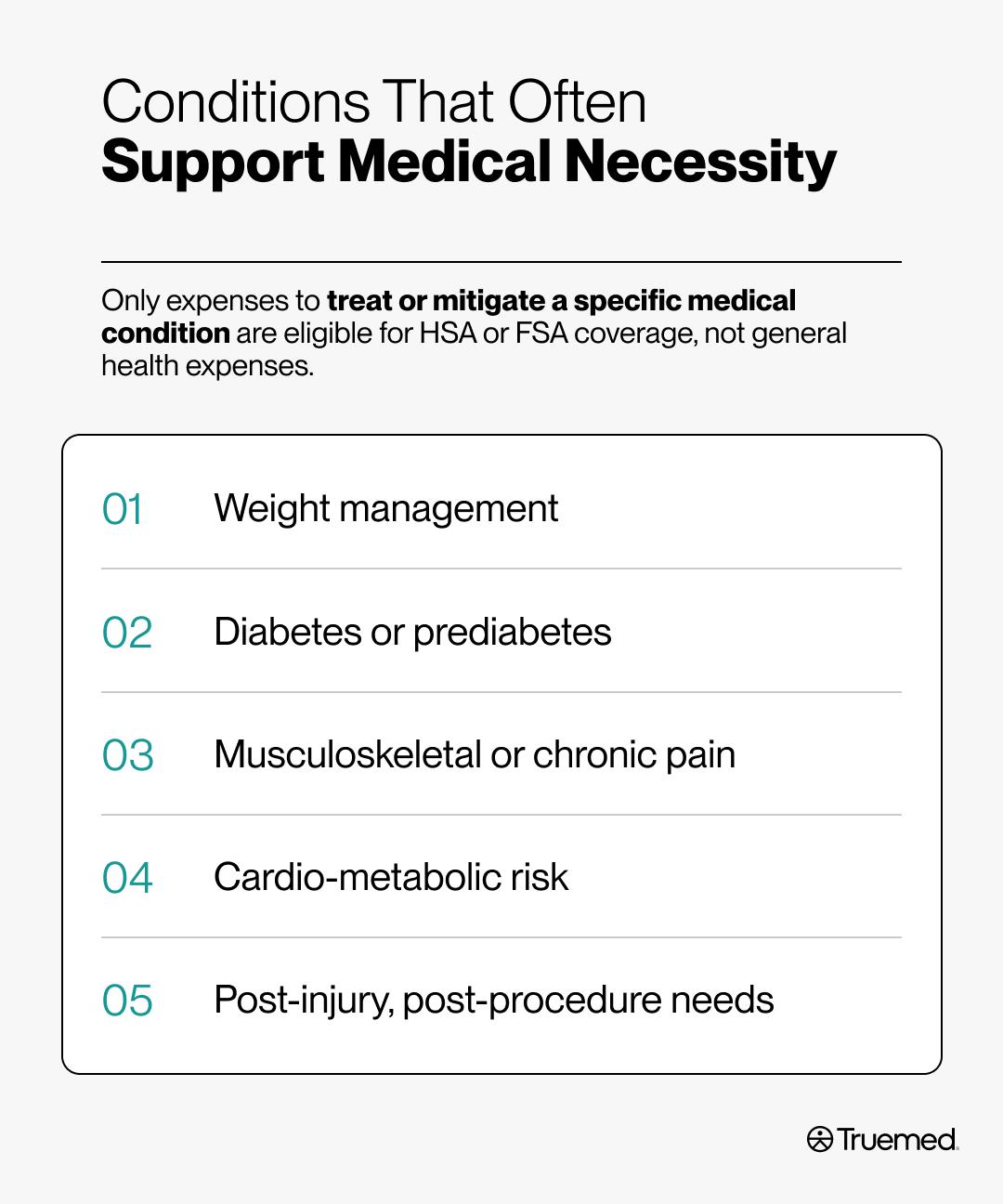
- Weight management: Cases of obesity, diabetes, heart disease, or hypertension may justify enrollment in a weight-management program, says Gupta.
- Diabetes or prediabetes: Programs that assist with activity and nutrition behavior change are typically supported treatments for individuals who have diabetes or prediabetes. "We often prescribe 'exercise snacks; or post-prandial walking protocols to blunt glucose spikes," says Lin. "Programs supporting this behavior change are medically necessary for glycemic control."
- Musculoskeletal or chronic pain: Do you suffer from musculoskeletal or chronic pain? You may be able to use HSA or FSA funds to pay for programs to address such these conditions. "Structured programs that improve mobility and functional strength are essential for treating conditions like chronic lower back pain or osteoarthritis," says Lin.
- Cardio-metabolic risk: "If a doctor prescribes exercise to lower blood pressure or improve lipid profiles, the costs associated with that structured program are usually covered," Gupta explains.
- Post-Injury, post-procedure needs: "These are effectively 'rehab-style' programs and are almost always considered medically necessary," says Gupta.
What Clinicians Usually Confirm Before an LMN Makes Sense
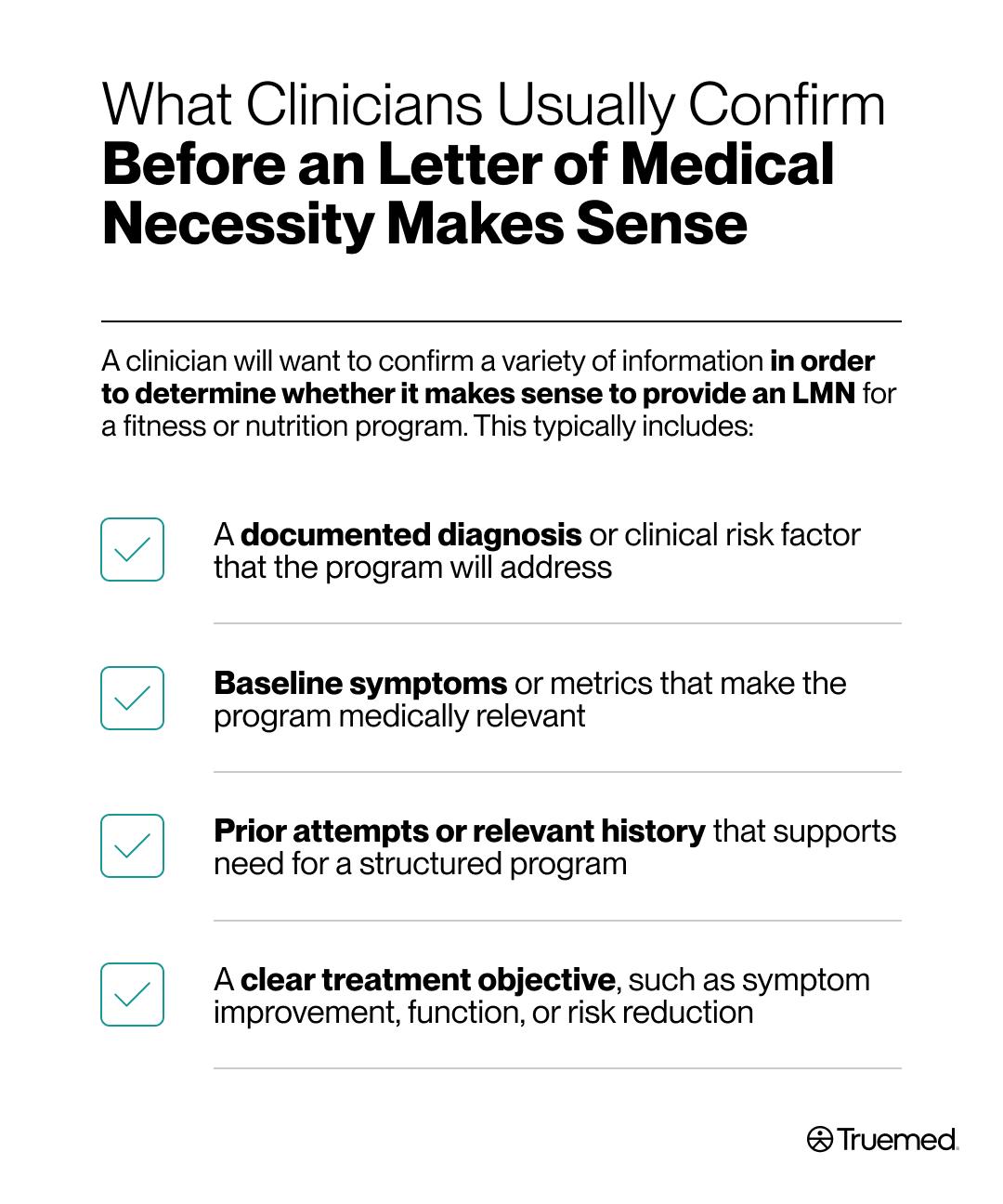
A clinician will want to confirm a variety of information in order to determine whether it makes sense to provide an LMN for a fitness or nutrition program. This typically includes:
- A documented diagnosis or clinical risk factor that the program will address
- Baseline symptoms or metrics that make the program medically relevant
- Prior attempts or relevant history that supports need for a structured program
- A clear treatment objective, such as symptom improvement, function, or risk reduction
"It is not enough to simply write a note; we must establish a clear 'chain of necessity,'" says Lin.
"Like all other covered health benefits, we must anchor the request in a specific medical code," Lin explains. There must also be a therapeutic rationale, she continues. "I need to explain why this specific purchase, whether it's cold plunge, a gym membership, or a coaching app, is the appropriate treatment for that physiology."
"It also helps to specify the duration and frequency, just as I would with a drug prescription," adds Lin.
Top 25 Fitness and Nutrition Programs to Consider
Before diving into our list, a few notes about what we included. The programs included here were identified because they meet some, or all, of the following criteria:
- Identifiable purpose: The program can plausibly support a medical purpose and does not appear designed for general fitness or entertainment.
- Structure: The program offers a clearly described and structured curriculum, condition-specific tracks, or progress monitoring.
- Documentation-friendliness: The program provides clear invoices, itemized subscription details, or receipts, making it easier to obtain the documentation needed for HSA or FSA programs.
Weight loss programs
Nutrition programs and coaching
- Black Iron
- Healthy Steps Nutrition
- Body Tutor
- Nourish
- Kate Lyman Nutrition
- Working Against Gravity
- Top Nutrition Coaching
- Daily Burn Coaching
- Good Nutrition
Fitness programs
- Orangetheory Fitness
- Body Fit Training
- Barre3
- Eager2Motivate Fitness
- Discover Strength
- Row House
- Stretch Lab
- Club Pilates
Common Reasons Programs Don’t Qualify
Though it can be disappointing to learn that your request to use HSA or FSA funds for a fitness or nutrition program does not qualify, there's a variety of reasons why this might be the case. Some examples include:
- The request lacking a clear medical purpose or condition tie-in.
- A vague or generic program description, such as "fitness membership" or "gym access" and no clearly structured program component. "A receipt that just says 'gym access' implies a recreational expense. A receipt that says '12-week metabolic reset program' implies a therapeutic intervention," says Lin.
- Poor documentation. The supporting receipts or documents include an unclear vendor name or non-itemized charges. Or your missing receipts altogether.
- Overpromising language, such as “guaranteed weight loss,” “approved,” “everyone qualifies,” can also cause the request to be denied.
"The most common point of failure is vagueness," notes Lin, adding that this includes overly general health claims. "If the LMN says the program is for 'preventative health' or 'general wellness,' it will likely be rejected."
The program must treat an active diagnosis or risk factor, says Lin. Another Lack of Structure: A receipt that just says "Gym Access" implies a recreational expense. A receipt that says "12-Week Metabolic Reset Program" implies a therapeutic intervention. - Bundled Ineligibles: Trying to expense the actual food or supplements (which are rarely eligible) alongside the coaching service (which is eligible) often causes the whole claim to be flagged.
How It Works with HSA/FSA and Truemed
You can browse the Truemed platform to find gyms or fitness programs that may be eligible for HSA or FSA spending for qualified customers. If you find an option that you're interested in learning more about, click on the "Shop Now" button to be taken to the brand's own website.
As part of this process, you will be prompted to complete a health survey, which a licensed provider will review to determine whether you're eligible for HSA/FSA spending.
If it's determined that the program is medically necessary based on your health information, an LMN will be issued (It will be sent to the email address you provided). Be sure to save the LMN for your records.
FAQ
Weight loss programs typically only qualify for FSA reimbursement when they treat a specific disease diagnosed by a physician. Qualifying conditions generally include obesity, diabetes, heart disease, or hypertension.
Gym memberships and fitness classes are HSA or FSA-eligible when used to treat or prevent a qualifying medical condition. The IRS explains that fitness programs qualify when the membership was purchased for "the sole purpose of affecting a structure or function of the body…or the sole purpose of treating a specific disease diagnosed by a physician."
Maintaining documentation surrounding your fitness or nutrition program expenses is very important. Hang on to the detailed receipt that shows the date of the expense, how much you spent and where. In addition, maintain a copy of your LMN.




Editorial Standards
At True Medicine, Inc., we believe better health starts with trusted information. Our mission is to empower readers with accurate and accessible content grounded in peer-reviewed research, expert insight, and clinical guidance to make smarter health decisions. Every article is written or reviewed by qualified professionals and updated regularly to reflect the latest evidence. For more details on our rigorous editorial process, see here.