
Can You Have an HSA and FSA at the Same Time?
Author:Jennifer Chesak
Reviewed By:Michaela Robbins, DNP
Published:
February 16, 2026
Last Updated:
September 02, 2026



Key Takeaways
Pairing an HSA and FSA: In some instances, but not all, you can contribute to both of these accounts at the same time.
You can only pair these accounts together if: you have a limited-purpose, dependent care, or post-deductible FSA.
Truemed specializes in: helping you maximize your FSA, HSA, and other health-related benefits.
Key Takeaways
Can You Have an HSA and FSA? The Short Answer
Is an FSA the Same as an HSA? Quick Differences that Matter
When Can You Contribute to an HSA and FSA at the Same Time?
When You Generally Can’t
How a Limited-Purpose FSA Works with an HSA
How a Dependent Care FSA Works with an HSA
How a Post-Deductible FSA works with an HSA
How an HSA and FSA Work with Truemed*
FAQ
Shop Eligible Products
Ready to unlock your HSA/FSA funds for qualified medical expenses?
So you want to have your cake and eat it too, eh? And you’re wondering if that’s possible. This article is clearly not about cake. But it does explain whether you can have a health savings account (HSA) and contribute to a flexible spending account (FSA) at the same time.
The short answer is that it depends on the circumstances regarding your FSA type. In some cases an HSA and FSA play well together, while in other instances, you can only contribute to one or the other. Both products have tax-savings advantages while helping you pay for qualifying out-of-pocket healthcare expenses.
In this article, we explain the difference between an FSA and HSA and whether you can have an HSA and FSA at the same time. Don’t worry: We keep it simple, or shall we say a piece of cake?
Can You Have an HSA and FSA? The Short Answer
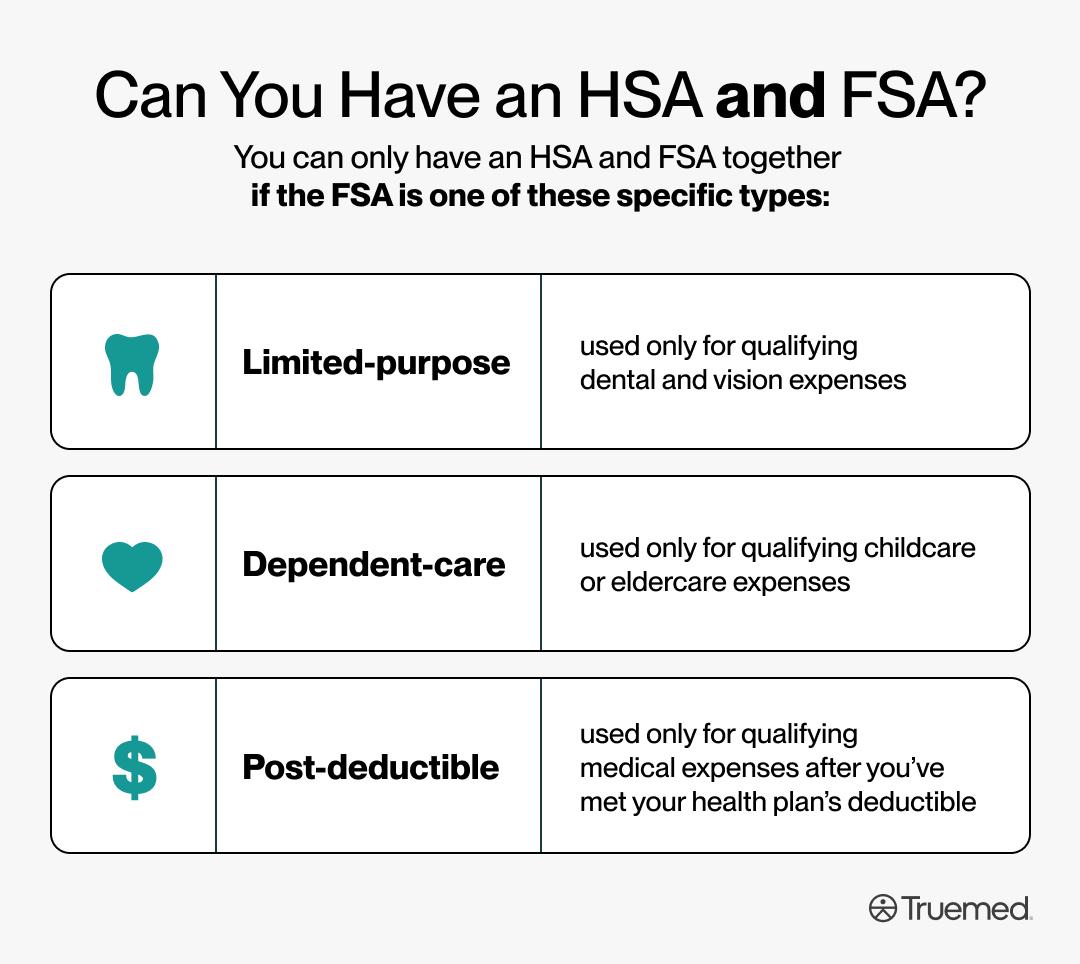
We will explain these topics in depth throughout the article, but the short answer is that you can only contribute to an HSA and FSA together if the FSA is one of these specific types:
- Limited-purpose FSA: used only for qualifying dental and vision expenses
- Dependent-care FSA: used only for qualifying childcare or eldercare expenses
- Post-deductible FSA: used only for qualifying medical expenses after you’ve met your health plan’s deductible
Is an FSA the Same as an HSA? Quick Differences that Matter
“The confusion around HSAs and FSAs usually comes from the fact that they sound similar but are designed to do very different things,” says Kasey Devine, the founder and CEO of Entravia.
How they are similar: Both accounts can be used to pay for qualifying out-of-pocket medical expenses with pre-tax dollars.
- HSA: This is a personal savings account, meaning you own it and get to take it with you if you leave your job, and the funds rollover year to year. It can only be used if you have a high-deductible health plan (HDHP).
- FSA: This is an employer-owned account that you cannot take with you if you leave your job. The funds are meant to be used within the plan’s year, with exceptions for grace periods and carryovers.
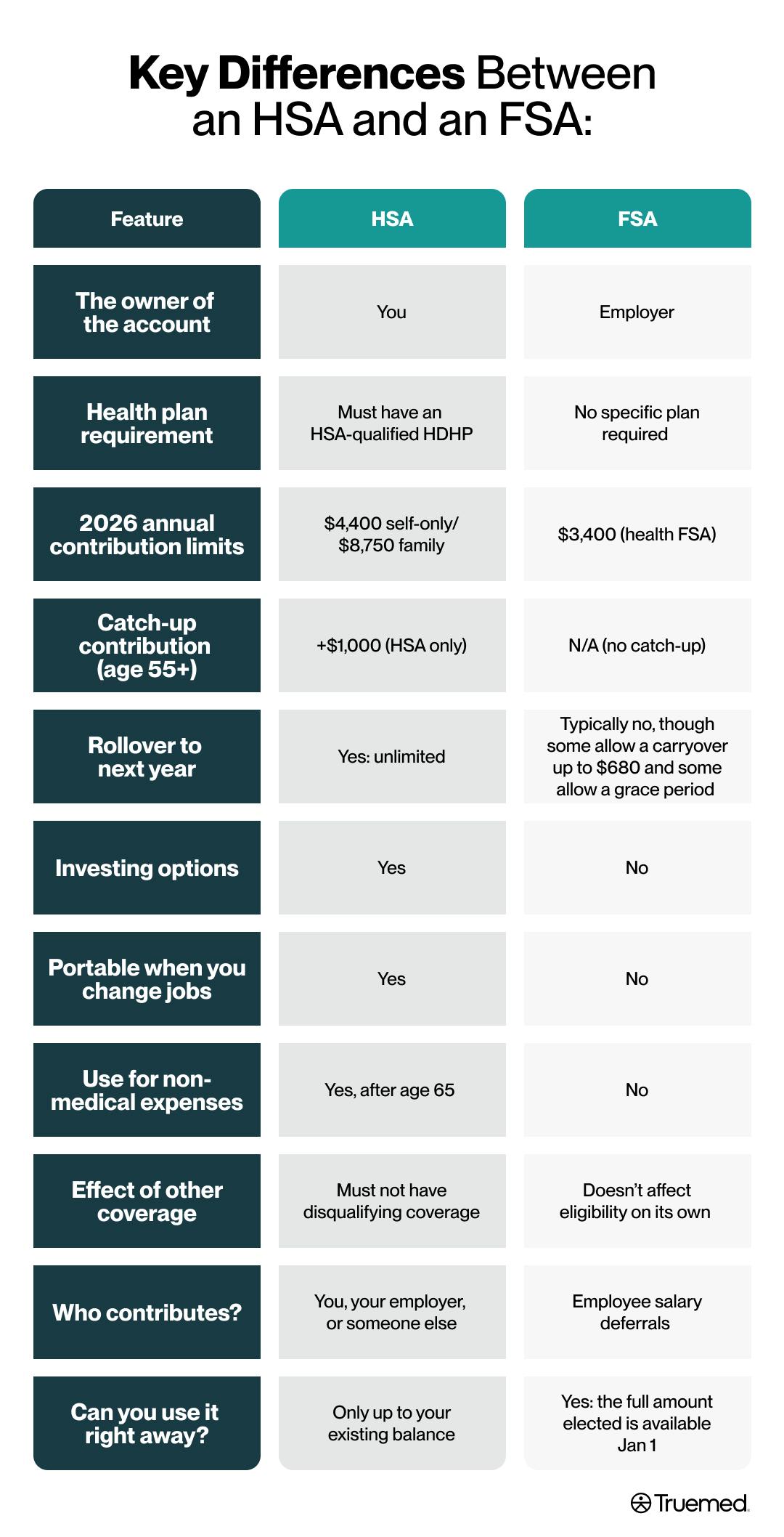
Key differences between an HSA and an FSA:
| Feature | HSA | FSA |
|---|---|---|
| The owner of the account | You | Employer |
| Health plan requirement | Must have an HSA-qualified HDHP | No specific plan required |
| 2026 annual contribution limits | $4,400 self-only/$8,750 family | $3,400 (health FSA) |
| Catch-up contribution (age 55+) | +$1,000 (HSA only) | N/A (no catch-up) |
| Rollover to next year | Yes: unlimited | Typically no, though some allow a carryover up to $680 and some allow a grace period |
| Investing options | Yes | No |
| Portable when you change jobs | Yes | No |
| Use for non-medical expenses | Yes, after age 65 | No |
| Effect of other coverage | Must not have disqualifying coverage | Doesn’t affect eligibility on its own |
| Who contributes? | You, your employer, or someone else | Employee salary deferrals |
| Can you use it right away? | Only up to your existing balance | Yes: the full amount elected is available Jan 1 |
When Can You Contribute to an HSA and FSA at the Same Time?
Whether you can pair these products depends on the type of FSA you have.
Some types of FSAs can be paired with an HSA. “The most common is pairing an HSA with a limited-purpose FSA,” Devine says. “A limited-purpose FSA is restricted to certain expenses, usually dental and vision.” Since the accounts would pay for different types of qualifying medical expenses, these products work well together.
“You also can have an HSA alongside a dependent-care FSA,” Devine says. “A dependent-care FSA is used for childcare or dependent care expenses, not medical expenses, so it has no impact on HSA eligibility.”
Finally, a post-deductible FSA can work with an HSA. With this type of FSA, the funds can only be used after you’ve met your plan’s deductible. “Because it does not cover general medical costs before the deductible, it does not interfere with HSA eligibility,” Devine says.
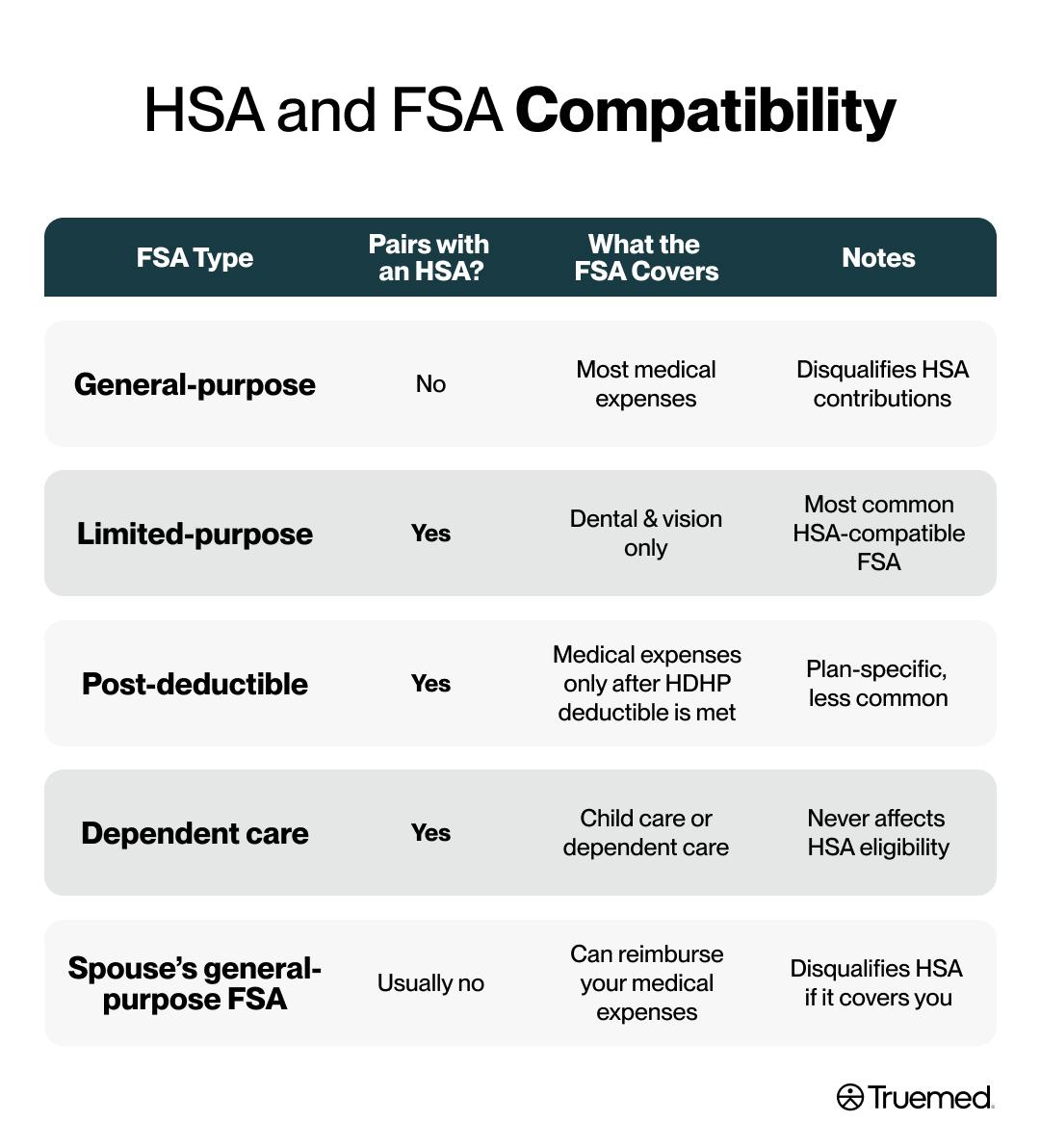
HSA and FSA compatibility:
| FSA type | Can you also contribute to an HSA? | What the FSA Covers | Common enrollment wording | Notes |
|---|---|---|---|---|
| General-purpose FSA | ❌ No | Most medical expenses | “Health FSA” | Disqualifies HSA contributions |
| Limited-purpose FSA (LPFSA) | ✅ Yes | Dental & vision only | “LPFSA,” “limited purpose FSA,” “dental/vision FSA” | Most common HSA-compatible FSA |
| Post-deductible FSA | ✅ Yes | Medical expenses only after HDHP deductible is met | “Post-deductible FSA,” “after-deductible FSA” | Plan-specific; less common |
| Dependent care FSA | ✅ Yes | Childcare or dependent care | “Dependent care FSA,” “DCFSA” | Never affects HSA eligibility |
| Spouse’s general-purpose FSA | ❌ Usually no | Can reimburse your medical expenses | Same as above | Disqualifies HSA if it covers you |
When You Generally Can’t
The table above shows two key points regarding when an FSA and HSA do not pair well together. So let’s explore those topics.
The first is if you have a general-purpose FSA. This type of FSA automatically disqualifies you from contributing to an HSA. “The reason is that a standard health FSA provides first-dollar coverage for medical expenses, which disqualifies you from contributing to an HSA,” Devine says. “Even if you personally do not use the FSA, simply being covered by it counts as disqualifying coverage under IRS rules.”
The second has to do with your spouse’s benefits. “If your spouse has a general-purpose health FSA that covers you,” Devine says, “that coverage can also disqualify you from contributing to an HSA, even if your own employer plan is HSA-eligible. This is a common blind spot for married couples coordinating benefits.”
Finally, you have one more consideration, and this has to do with when you’re electing your benefits during Open Enrollment periods or a job change. “An employee may enroll in an HSA-eligible health plan but forget that their employer automatically enrolls them in a general-purpose FSA, or they may carry over unused FSA funds from a prior year. Either scenario can unintentionally make their HSA contributions ineligible, which can lead to tax penalties if not corrected.”
How a Limited-Purpose FSA Works with an HSA
If you have a limited-purpose FSA, which typically can only be used for dental and vision, you can also have an HSA. The division works like this:
- You can use your HSA funds to pay for qualifying medical expenses, including deductibles but not for anything related to dental or vision healthcare.
- You can use your FSA funds to pay only for qualifying medical expenses related to dental and vision only.
How a Dependent Care FSA Works with an HSA
If you have a dependent care FSA, which can only be used to pay for childcare or adult daycare expenses, you can also have an HSA. The division works like this:
- You can use your HSA funds to pay for copays, deductibles, prescriptions, and other qualifying out-of-pocket expenses for medical, dental, and vision.
- You can use your FSA funds to pay for childcare or dependent care expenses so that you (and your spouse if you’re married) can work. This type of FSA generally covers daycare, preschool, before-and after-school care, and summer day camps (but not overnight) for children. It also covers adult daycare for dependent adults.
How a Post-Deductible FSA works with an HSA
If you have a post-deductible FSA, which only kicks in after your deductible is met, you can also have an HSA. The division works like this.
- Before you’ve met your deductible: You can use your HSA funds for copays, deductibles, prescriptions, and other qualifying out-of-pocket expenses for medical, dental, and vision before you’ve met your deductible.
- After you’ve met your deductible: You can only use your post-deductible FSA funds for qualifying medical expenses after you’ve met your deductible. But you can also use your HSA funds, as long as you are not double-dipping into both accounts for the same medical expenses. A good rule of thumb is to use up the funds in your FSA first, since those funds are use-it-or lose it within the year (unless you have a grace period or carryover).
How an HSA and FSA Work with Truemed*
You might be able to use dollars from your health savings account (HSA) or flexible spending account (FSA) for some products you might not have thought about, such as a piece of equipment for your home gym, an adjustable bed base, and more.
These might be eligible expenses if you’re using the product or service to address a specific medical condition. If approved by an independent licensed clinician, conditions that might qualify the purchase of an adjustable bed base, for example, include the following: chronic back or joint pain such as arthritis, sciatica, or herniated discs, or sleep disorders such as obstructive sleep apnea (OSA) or insomnia.
If you're looking to spend your HSA or FSA funds on such a product, you might need a letter of medical necessity (LMN). An LMN is a formal document from a licensed healthcare provider that explains why a certain product, treatment, or service is necessary to treat, mitigate, or prevent a medical condition.
Certain health products and services may be eligible for qualified customers with an LMN issued by an independent practitioner via Truemed’s clinical partner when the item is used to address a specific medical condition.
Note that in most cases, only part of the cost of a product is HSA/FSA-eligible (i.e., the incremental costs of the medically necessary features.) Truemed provides customers with a more detailed breakdown of partial eligibility; before entering your payment details, you'll complete a short survey to calculate the eligible amount for HSA/FSA reimbursement.
Truemed specializes in helping you maximize your FSA, HSA, and other health-related benefits:
- First, you can check whether a product or service is normally considered a qualifying medical expense or whether you might need an LMN.
- If an LMN is appropriate, an independent licensed practitioner (via Truemed’s clinical partner) will review your medical history, and if you qualify, they’ll issue the LMN. Truemed itself does not make eligibility determinations.
- You can then pay for qualifying products and services with your HSA’s or FSA’s debit card or get reimbursed for expenses after submitting your LMN and receipts.
- Truemed also offers support in the event you get a denial of reimbursement and need to provide substantiation documentation.
*Truemed is for qualified customers. HSA/FSA tax savings vary. Learn more at truemed.com/disclosures
FAQ
In some cases, you can contribute to an FSA and an HSA in the same year. This depends on the type of FSA. You can only have an HSA with a limited-purpose FSA, a dependent care FSA, or a post-deductible FSA. But you cannot have an HSA and contribute to a general-purpose FSA in the same year. This also applies if you are no longer enrolling in an FSA but you still have funds that have a carryover or grace period into the new year. In this case, you cannot enroll in an HSA.
If you have an FSA type that cannot legally be paired with an HSA, then the IRS will treat any contributions to your HSA as excess contributions. You will then need to pay a 6% excise tax on the excess amount for each year the funds remain in your HSA. To correct the issue, you must withdraw the excess contribution and any earnings on invested funds before the tax filing deadline of the next year (usually April 15.) If you have not contributed funds to your HSA, you will not incur a tax penalty.
If you have a general-purpose FSA that can be used to cover your spouse’s qualifying medical expenses, then your spouse cannot have an HSA—and vice versa. However, if your FSA is a limited-purpose, dependent-care, or post-deductible FSA, then your spouse can have an HSA.


Editorial Standards
At True Medicine, Inc., we believe better health starts with trusted information. Our mission is to empower readers with accurate and accessible content grounded in peer-reviewed research, expert insight, and clinical guidance to make smarter health decisions. Every article is written or reviewed by qualified professionals and updated regularly to reflect the latest evidence. For more details on our rigorous editorial process, see here.